
Published on June 26, 2026 — by Ellen Bennett, Women’s Health Researcher
Medical & Affiliate Disclosure: This article is for educational purposes only and is not medical advice. Always consult your doctor. Some links are affiliate links; if you buy through them we may earn a commission at no extra cost to you.
If you have stood in the supplement aisle (or scrolled a checkout page) wondering which of the best bladder control supplements actually do something and which are just expensive hope in a bottle, I have been exactly where you are: in my late forties, up twice a night and planning errands around restrooms. So I did what I do best and went through the research on every major option. One honest thing up front: no pill “cures” bladder leaks or infections, and any product that promises that is lying to you. What the best one on this list can do is support a healthy urinary tract, and for the women whose urgency, nighttime trips, or repeat UTIs are microbiome-driven, that is the part that matters.
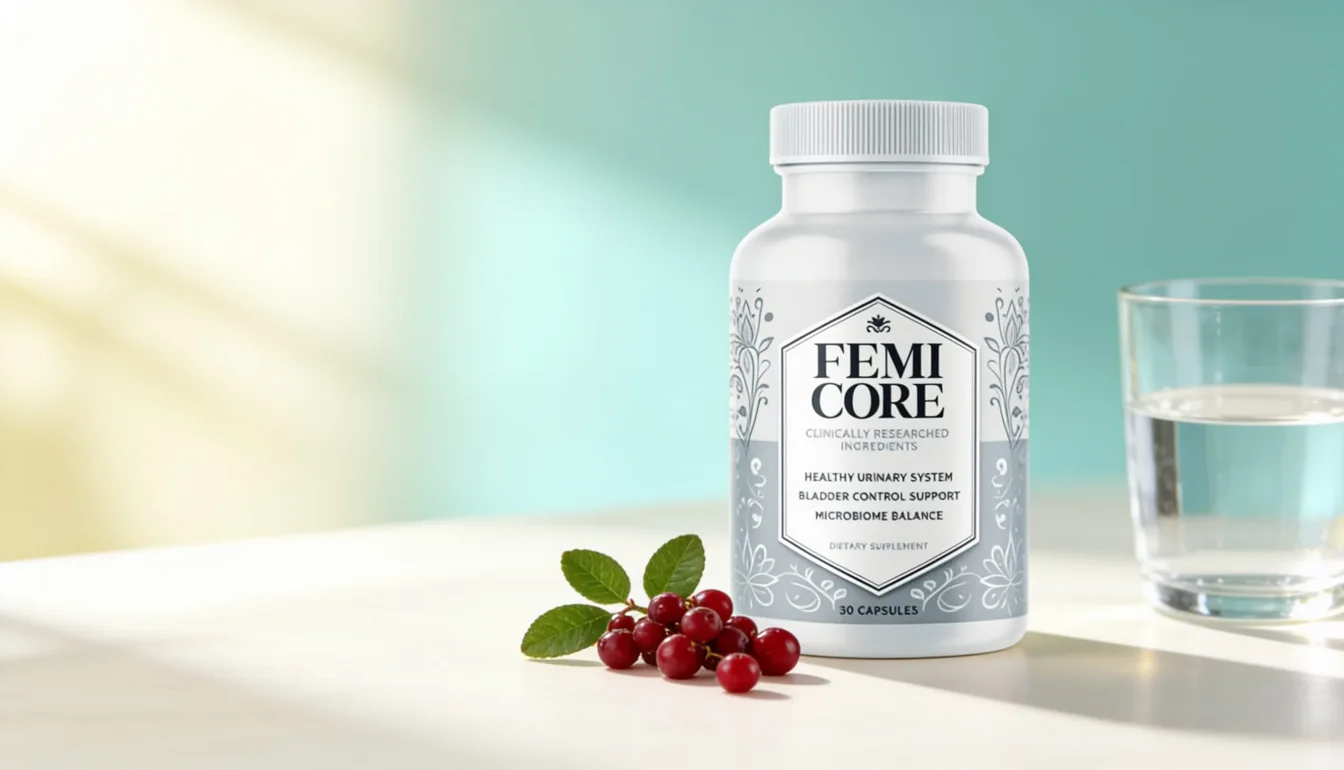
Our #1 Pick at a Glance: FemiCore (4.3/5)
- Why it wins: the only option here that combines cranberry standardized to 30% PACs with five named Lactobacillus strains, including L. crispatus, in one daily capsule.
- Best for: women 40+ with urgency, nighttime trips, or recurrent UTIs.
- Best first order: the 3-bottle package, about $2.30 a day, free shipping.
- Risk: 60-day money-back guarantee, official site only.
See why FemiCore is our #1 pick for 2026
Quick Answer: The best bladder control supplement overall in 2026 is FemiCore, a microbiome-targeted blend of cranberry, herbal extracts, and five Lactobacillus strains. Do bladder supplements actually work? The evidence is strongest for urinary tract health: a 2023 Cochrane review found cranberry reduced recurrent UTI risk by roughly 26% in prone women, which is why a formula built on standardized cranberry and the right probiotic strains tops this list. For leaks on a cough or sneeze alone, pair any supplement with pelvic floor training.
How we ranked these supplements
I did not rank these by which company pays the most or shouts the loudest. I weighed five things, in this order: the strength of the published evidence behind the key ingredients, how transparent the formula is (full doses listed, not hidden in a “proprietary blend”), sensible dosing, the refund guarantee, and overall value. A supplement can have a great story and still land low here if the research does not back it up. One newer entry I reviewed separately is NewEra Protect, which lists its ingredients but not their amounts, and I compare it directly in FemiCore vs NewEra Protect. For a cranberry-only alternative that does print its PAC dose, see FemiCore vs Ellura.
I also kept the honest distinction front and center throughout: the research is genuinely encouraging for preventing recurrent UTIs naturally, and much thinner for “leak” supplements. That shaped every rating below.
What to look for in a bladder supplement
Before you buy anything, run it through this short checklist. It will save you money and disappointment.
- Standardized active ingredients. For cranberry, look for a stated proanthocyanidin (PAC) content, not just “cranberry fruit.” PAC is the part with the research behind it.
- Named probiotic strains. “Lactobacillus blend” tells you nothing. Specific strains like L. crispatus have actual studies; generic ones may not.
- Transparent doses. If the label hides everything inside a proprietary blend, you cannot tell whether you are getting a research-backed amount or a sprinkle.
- A real money-back guarantee. Bladder support takes weeks to assess, so a 60-day or longer refund window matters.
- Made in a GMP-certified facility. Basic quality control for anything you take daily.
Scam red flags to avoid: claims to “cure” incontinence or UTIs, before-and-after photos, “doctors hate this,” fake countdown timers, no published ingredient research, and no refund policy. Honest products talk about support and may help, not miracles.
The best bladder control supplements of 2026 at a glance
| Supplement | Best for | Key ingredients | Guarantee | Rating |
|---|---|---|---|---|
| FemiCore | Best overall (microbiome) | Cranberry PAC, herbal blend, 5 Lactobacillus strains | 60 days | 4.3/5 |
| Standardized cranberry (PAC) | Budget UTI prevention | Cranberry extract, 36mg+ PAC | Varies by brand | 4.2/5 |
| Probiotic with L. crispatus | Microbiome support | L. crispatus and related strains | Varies by brand | 4.1/5 |
| D-Mannose | UTI-prone women | D-mannose powder/capsule | Varies by brand | 3.9/5 |
| Pumpkin seed + soy germ | Urgency / overactive bladder | Pumpkin seed extract, soy germ | Varies by brand | 3.8/5 |
| Vitamin D | Adjunct / deficiency | Vitamin D3 | Varies by brand | 3.7/5 |
1. FemiCore — Best Overall (4.3/5)
Where the 4.3 comes from: six scored categories, averaged with no weighting, with the arithmetic published. It loses most of its points on label transparency, because the per-ingredient doses inside the blend are not disclosed. See the full score breakdown.
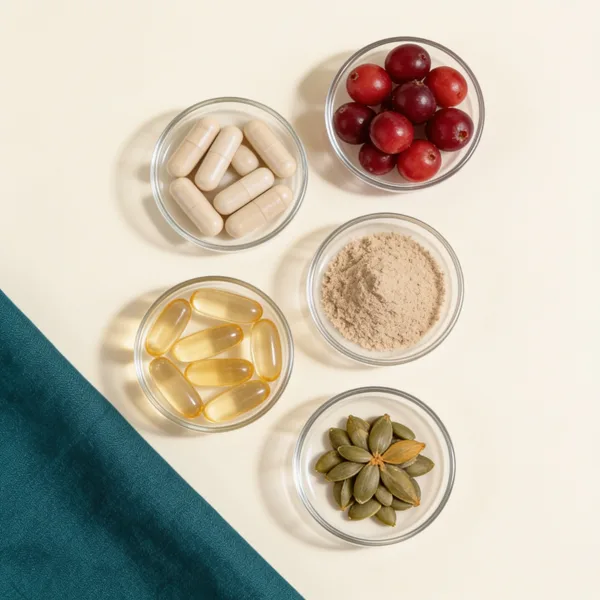
FemiCore earns the top spot because it is built around the one mechanism with the most promising recent research for women’s urinary health: the urinary microbiome. Instead of betting on a single ingredient, it pairs a roughly 350mg herbal blend (cranberry standardized to 30% proanthocyanidins, Mimosa pudica, bearberry/uva ursi, and berberine) with about 50mg of five Lactobacillus strains (crispatus, acidophilus, plantarum, gasseri, and casei) in one daily capsule. If you take a daily prescription, read FemiCore side effects and the uva ursi duration question before you start. If you take medication for blood sugar, read the caution on berberine and blood sugar medication first. Saw palmetto is the herb most often added to blends like this, and the evidence in women is thinner than the marketing suggests, as I show in my saw palmetto review.
What I like: the cranberry is standardized to a stated PAC level (the part that matters), the probiotic strains are named rather than hidden, it is made in a GMP-certified facility, and it carries a 60-day money-back guarantee, which gives you a fair window to judge it. What keeps me honest: this is structure-function support for a healthy urinary environment, not a treatment for infections, and it works gradually, so plan on the 3-bottle package and a few weeks before judging it. If you are worried a probiotic might send you to the bathroom more rather than less, I looked at that specific question in can probiotics make you pee more.
Pros: standardized cranberry PAC, five named probiotic strains, single daily capsule, 60-day guarantee, GMP-certified. Cons: only sold through the official site (worth confirming before you buy, since lookalike domains exist), not the cheapest option, and (like every supplement here) no effect on an active infection. The nearest competitor on this list gets the full treatment in FemiCore vs pHemmePure, where the guarantee and the label pull in opposite directions.
How we ranked these
Ellen Bennett weighs each product on published ingredient evidence, formula transparency, dosing, guarantee, and value — naming studies by date and source from Cochrane, the New England Journal of Medicine, and the Urology Care Foundation. We earn an affiliate commission if you buy through our links, but we flag weak or missing evidence regardless of who is paying. When the research does not support a marketing claim, we say so.
FemiCore — Our #1 Rated Bladder Health Supplement
Microbiome-targeted formula · 60-day money-back guarantee · GMP-certified facility
Want the full breakdown of what the research does and does not show? Read our honest FemiCore review, or see where to buy FemiCore safely to avoid counterfeits. For what real buyers gripe about, and which complaints are myths, see our FemiCore reviews and complaints investigation.
2. Standardized Cranberry (PAC) — Best Budget Pick (4.2/5)
Cranberry is the most-studied bladder supplement ingredient, and the evidence finally firmed up. A 2023 Cochrane review of 50 trials (8,857 participants) concluded that cranberry products reduced the risk of recurrent UTIs by roughly 26% in women prone to them. The catch is the form: standardized capsules with a stated PAC content are the reliable version, while sugary cranberry juice is not. We compare the two formats head to head in cranberry pills vs juice. If budget is your priority, a quality standardized cranberry extract is a sensible, evidence-backed buy. Our deep dive on whether cranberry works for UTIs covers the nuance.
Pros: strongest single-ingredient evidence (for UTI prevention), affordable, widely available. Cons: only helps prevention, quality varies wildly between brands, juice is largely useless.
3. Probiotic with L. crispatus — Best for Microbiome Support (4.1/5)
A healthy vaginal and urinary environment is dominated by protective Lactobacillus bacteria, and that protection erodes with age and after menopause. L. crispatus in particular has randomized-trial support for reducing recurrent UTIs in some women. A targeted probiotic can help support that protective environment, which is exactly why FemiCore folds five strains into its formula rather than asking you to buy them separately. If you go standalone, the strain has to be named on the label, or you are guessing. For a deeper dive into which strains have real evidence and which are marketing, see our guide to probiotics for bladder control.
Pros: addresses the root microbiome shift, good safety profile, synergy with cranberry. Cons: benefits are strain-specific, results are gradual, and generic “probiotic” products often skip the strains that matter.
4. D-Mannose — Best Single-Ingredient Alternative (3.9/5)
D-mannose is a simple sugar that appears to stop certain E. coli bacteria from sticking to the bladder wall, so they get flushed out instead of taking hold. For women who battle repeat UTIs, it is one of the more interesting single ingredients. A small 2014 trial suggested D-mannose may help reduce UTI recurrence, but the overall evidence base is still thin, and a 2024 trial in primary care found it did not clearly beat placebo for prevention. In other words: promising, not proven. And for leaks rather than UTIs, see why D-mannose is the wrong tool. Another single ingredient with a placebo-controlled trial behind it is pumpkin seed extract for bladder control. One popular women’s formula builds almost its entire pitch on this single ingredient, and I unpack how that holds up in my honest look at pHemmePure.
Pros: generally well tolerated, targeted mechanism, useful for the UTI-prone. Cons: mixed evidence, does nothing for incontinence, and never a substitute for antibiotics during an active infection.
5. Pumpkin Seed + Soy Germ — Best for Urgency (3.8/5)
This combination shows up in supplements aimed at overactive bladder and urgency. A handful of small studies have reported modest improvements in urinary frequency and urgency, but the trials are small and often industry-funded, so I rate the evidence as early rather than solid. If your main issue is the sudden “got-to-go” urge, it may be worth a cautious trial, ideally alongside bladder training. To understand whether your leaks are an urgency problem or a seal problem, see our breakdown of stress vs. urge incontinence. This is the Go-Less combination sold as AZO Bladder Control; my AZO Bladder Control review covers the trial and the dose, and FemiCore vs AZO explains which fits which problem.
Pros: targets urgency specifically, generally well tolerated. Cons: small, limited evidence base; soy may not suit everyone; effects are modest at best.
6. Vitamin D — Best Adjunct (3.7/5)
Vitamin D is not a “bladder supplement” in the marketing sense, but low vitamin D has been linked with pelvic floor weakness, and some research suggests correcting a deficiency may modestly help stress incontinence. It is cheap, it has wide health benefits, and it is worth checking your levels with your doctor. Think of it as a sensible adjunct, not a headline fix. It is not the only nutrient worth checking, either: see the vitamins linked to frequent urination and whether magnesium helps an overactive bladder. There is a catch at the high end, though, which I cover in does vitamin D make you pee more.
Pros: inexpensive, broad health value, may help if you are deficient. Cons: only relevant if your level is low, effect on incontinence is modest, not a targeted bladder solution.
Red flags that a bladder supplement is not worth your money
Most of what is sold in this category is not dangerous. It is just overpriced and vague. These are the signals I use to rule a product out before I even look at the price, and every one of them is something you can check on the label or the sales page in under a minute.
- A blend with nothing standardized and nothing named. Blends are the norm in this category, but a good one still tells you something checkable: a standardized PAC percentage for cranberry, named probiotic strains. A long list of herbs with no standardization and no strains gives you nothing to verify.
- A probiotic with a CFU count but no named strains. “10 billion CFU” tells you almost nothing. Benefit in the research is tied to specific strains, and L. crispatus is the one with the most credible urinary evidence. A big number without names is marketing.
- Cranberry with no PAC number. The active compound is proanthocyanidin. If the label does not state a standardized PAC content, the dose is unknowable, and with cranberry the dose is the whole ballgame.
- Any claim to treat, cure, prevent, or eliminate. Supplements are not permitted to make disease claims. A page promising to eliminate UTIs or cure incontinence is telling you it does not respect the rules, which says plenty about the rest of the operation.
- A perfect rating at implausible volume. A 4.98 out of 5 across 19,000 reviews is not a good sign, it is a statistical impossibility for a real product. The FTC finalized a rule against fake reviews in 2024, and this category is full of them.
- Auto-ship you did not ask for. Check whether the checkout enrolls you in a recurring order by default. A brand confident in its product does not need to make leaving difficult.
- “Doctor formulated,” with no doctor named. If nobody will attach a real name and credential to the formula, the phrase is decoration.
- Before and after photos. There is no honest before and after photograph of bladder control. Its presence means someone is willing to fabricate evidence.
One more, specific to this market: make sure you are looking at the official product and not a look-alike. Several brands here have near-identical names listed on Amazon by unrelated sellers, which is how women end up reviewing a supplement they never actually took. If the name is off by a word, it is a different product.
And a fair test, once you have chosen one. Give it eight weeks, not eight days, change one thing at a time, and keep a simple symptom diary. Choose a product with a real money-back guarantee so the test costs you nothing if it does not work for you; that is one of the main reasons FemiCore sits at the top of this list.
The Label Rules That Beat Any Ranking
Rankings age. The rules below do not, and they let you judge any bottle on any shelf, including the ones that did not make this list and the ones that will exist next year.
Rule 1: For cranberry, look for the PAC number, not the milligrams. This is the single most useful number in the category. A 2024 meta-analysis in Frontiers in Nutrition pooled 10 randomized controlled trials and found cranberry reduced UTI risk by 18% only when daily proanthocyanidin intake reached at least 36 mg (RR 0.82, 95% CI 0.69 to 0.98). Below that, no significant effect (PubMed 39668896). One popular formula fails this exact test, as I show in my Bladder Relief 911 reviews and complaints.
So “500 mg cranberry extract” on the front of a bottle tells you almost nothing. What you want is either a stated PAC amount of 36 mg or more, or a standardization percentage you can multiply. An extract standardized to 30% PACs needs about 120 mg to clear the threshold. If a label gives neither number, you are buying blind. Our top pick at least gives you the standardization percentage, which most blends in this category do not.
Rule 2: For probiotics, CFU is the unit. Milligrams are not. A blend listed only in milligrams tells you the weight of the powder, not how many live organisms arrive. Two bottles with identical milligram labels can differ enormously. Look for a CFU count and a strain name, since the research is strain specific. Urox is the clearest exception to that rule, since it is a blend with a named dose and a published trial, reviewed honestly in my Urox write-up. For a deeper look at choosing one after menopause, see the best probiotic for UTI prevention after menopause.
Rule 3: Convert everything to cost per day before comparing. Bottle price is a marketing number. Divide the bottle price by the number of days it lasts, and check capsules per bottle against capsules per dose. A product at the same price taken twice daily costs twice as much per day, which is where cheap-looking bottles stop being cheap. I run that arithmetic on two real products in FemiCore vs Bladder Relief 911.
Rule 4: A proprietary blend means answers come in ranges. Many products in this category, FemiCore among them, and you will also see it written femi core, publish only the blend total rather than each ingredient. That is standard industry practice rather than a scandal, but it does mean nobody outside the company can verify whether the cranberry clears 36 mg. Treat any reviewer who states an exact dose from a proprietary blend as someone repeating a guess. For a worked example of how far that ranging goes on one label, see the FemiCore ingredients breakdown.
Rule 5: Check the guarantee against the evidence window. That same meta-analysis found cranberry’s benefit emerged over 12 to 24 weeks of use. Most guarantees in this category run 30 to 60 days. The practical fix is to buy enough product for a fair run, such as a 3-bottle package covering 90 days, and to decide inside your refund window using a written symptom diary. One product in this category has an unusually tight window, which I worked through in my Confitrol24 reviews and complaints roundup.
Applied together, these five rules will disqualify most of what is sold in this category faster than any ranking can, and they will keep working long after this page is out of date.
Do bladder supplements actually work?
Here is the honest summary I wish more sites would give you. The strongest evidence is for preventing recurrent UTIs: cranberry PAC and certain probiotic strains both have real trial support there. For incontinence and leaks, supplement evidence is much weaker, and the things with the best track record are not pills at all: pelvic floor training, weight management, and (after menopause) local vaginal estrogen. A landmark randomized trial (Subak et al., New England Journal of Medicine, 2009) found that a modest weight loss of about 8% cut incontinence episodes by nearly half, which no capsule can match. The weight side is worth its own look: what the trials actually found.
So the smart way to use any supplement on this list is as one layer in a bigger plan. Our complete guide to bladder leaks lays out that plan, and our guide to pelvic floor exercises for women over 40 covers the single most effective DIY lever. If menopause is part of your picture, menopause and bladder health explains the hormone piece. For the menopause-specific version of this ranking, see best menopause bladder support options for 2026.

Key Takeaways
- FemiCore is our best overall pick, built around the urinary microbiome with standardized cranberry PAC and five named Lactobacillus strains.
- The evidence is strongest for UTI prevention, not for stopping leaks. Cranberry cut recurrent UTI risk about 26% in a 2023 Cochrane review.
- No supplement cures incontinence or UTIs. Treat any product that claims to with suspicion.
- Look for standardized actives, named strains, transparent doses, and a real guarantee. Avoid proprietary-blend mystery formulas.
- Pills are one layer. Pelvic floor training and weight management beat any supplement for leaks.
- An active infection needs a doctor, not a supplement.
Frequently Asked Questions
What is the best supplement for bladder control?
For overall women’s bladder and urinary health, we rate FemiCore highest because it targets the urinary microbiome with standardized cranberry and five named Lactobacillus strains, and backs it with a 60-day guarantee. That said, “best” depends on your goal: for UTI prevention specifically, standardized cranberry or D-mannose are evidence-based options. And if FemiPro is on your shortlist too, here is how the two formulas actually compare.
Do bladder control supplements really work?
For preventing recurrent UTIs, yes, there is real evidence: cranberry PAC and certain probiotic strains both have randomized-trial support. For stopping incontinence or leaks, supplement evidence is weak, and pelvic floor training, weight management, and (after menopause) vaginal estrogen work better. Supplements are best used as one supporting layer.
Can a supplement stop bladder leaks?
No supplement reliably stops leaks on its own, and any that promises to should be treated with caution. Leaks respond best to pelvic floor work, weight management, and addressing menopause-related estrogen loss. A supplement may support a healthy urinary environment, but it is not a standalone cure.
Is cranberry or D-mannose better for UTIs?
Cranberry has the larger evidence base, with a 2023 Cochrane review supporting standardized cranberry for reducing recurrent UTI risk. D-mannose is promising and well tolerated but has thinner, more mixed evidence. Some women use both. Neither treats an active infection, which needs medical care.
How long do bladder supplements take to work?
Most take several weeks of consistent daily use before you can fairly judge them, which is why a 60-day or longer money-back guarantee matters. Probiotic and microbiome effects in particular are gradual. If a product promises results in days, be skeptical.
Are bladder supplements safe?
The ingredients here are generally well tolerated in healthy adults, but supplements can interact with medications and are not right for everyone (for example, some are not advised in pregnancy). Choose products made in GMP-certified facilities and check with your doctor or pharmacist before starting, especially if you take other medications.
The Bottom Line
If you want one pick, FemiCore is the bladder support supplement I would reach for first in 2026, because it targets the right mechanism with honest, named, standardized ingredients and a fair guarantee. But the bigger truth is the one the marketing never tells you: the best results come from stacking a sensible supplement on top of pelvic floor training, smart lifestyle changes, and real medical care when you need it. If urgency, nighttime trips, or repeat UTIs are part of your picture, start with FemiCore: order the 3-bottle package, keep a symptom diary, and decide inside the 60-day guarantee. If your only complaint is daytime urgency with no infections, I compare the closest alternative in FemiCore vs Confitrol24.
Our #1 pick for 2026 · 60-day money-back guarantee
— Ellen Bennett

Ellen Bennett, Women’s Health Researcher. Ellen compiles peer-reviewed evidence on women’s bladder and pelvic health. About Ellen →
Last Reviewed: September 2026 by Ellen Bennett, Women’s Health Researcher. Sources: Cochrane (CD001321, 2023), New England Journal of Medicine (Subak et al., 2009), Urology Care Foundation, Mayo Clinic.