

Published on July 10, 2026 — by Ellen Bennett, Women’s Health Researcher
Medical & Affiliate Disclosure: This article is for educational purposes only and is not medical advice. Always consult your doctor or pharmacist, especially if you take medication or have kidney problems. Some links are affiliate links; if you buy through them we may earn a commission at no extra cost to you.
Your grandmother swore by a glass of cranberry juice. Your pharmacist points you toward the pills. And the internet, helpfully, tells you both — often on the same page. If you get recurrent UTIs and you are standing in the store trying to decide between a bottle of juice and a bottle of capsules, the mixed messages are enough to make you put both back on the shelf.
I have used both over the years, and I have read the studies that seem to contradict each other. The good news is that the confusion clears up fast once you understand the one thing that actually decides whether cranberry works: the dose of a compound called PACs. Let me reconcile the contradiction and give you a straight answer. For a branded capsule that states its PAC amount, see my Ellura review.
Quick Answer: Cranberry pills and cranberry juice work the same way — through proanthocyanidins (PACs) that help stop bacteria sticking to the urinary tract. So which is better? It comes down to PAC dose, sugar, and consistency. Standardized capsules deliver a reliable PAC dose without sugar, which makes them the practical daily choice for most women. Juice can work too, but you need real cranberry juice (not cocktail), and the sugar adds up. A 2023 Cochrane review found cranberry products cut recurrent UTIs by about 26%; neither form treats an active infection.
The capsule route, without the sugar
FemiCore pairs cranberry standardized to 30% PACs with five named Lactobacillus strains in one daily capsule, with a 60-day money-back guarantee.
What Are Cranberry Pills and Juice Both Trying to Do?
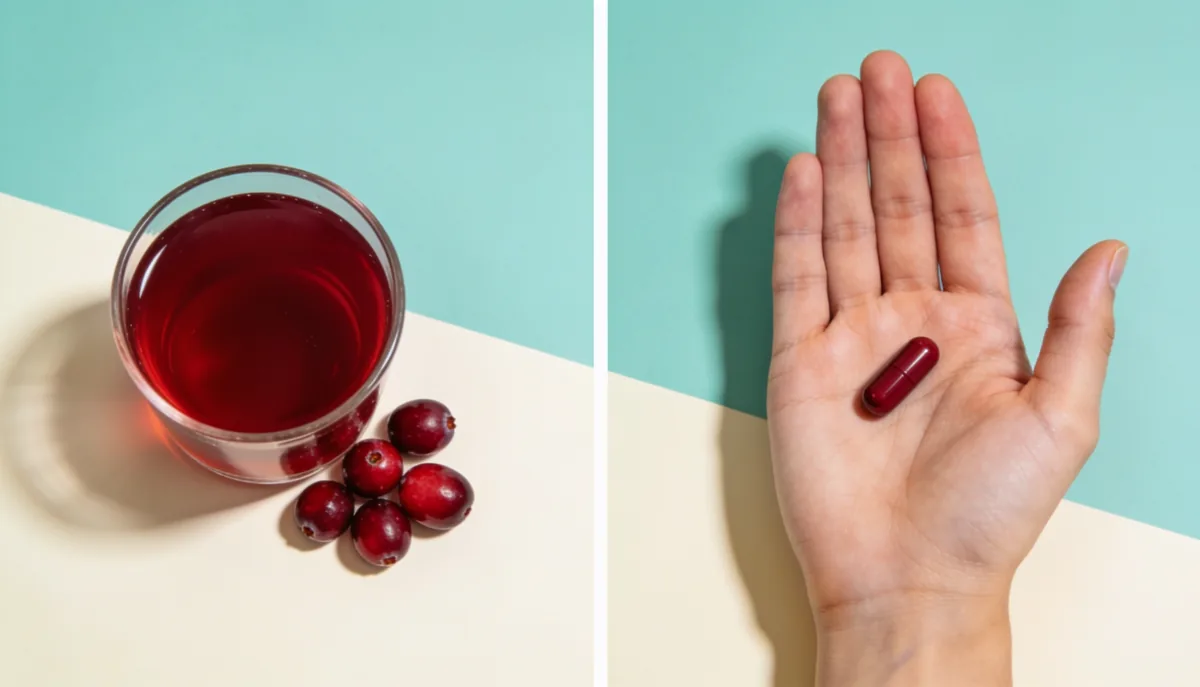
Whether you sip it or swallow it, the active players are the same: proanthocyanidins, or PACs. These compounds appear to make it harder for E. coli — the bacteria behind most urinary tract infections — to grip the wall of your urinary tract. If bacteria cannot hold on, they are more likely to be flushed out before they cause an infection. That is the whole mechanism, and it is why cranberry is about prevention, not treatment. I explain that distinction in does cranberry actually work for UTIs.
Because the mechanism is identical, the “pills vs. juice” question is really a delivery question: which form gets you a reliable PAC dose, in a way you will actually stick with, without unwanted extras like sugar?
The Research Contradiction, Reconciled Honestly
Here is why the internet seems to argue with itself. Some studies — including a 2024 network meta-analysis of 20 studies in European Urology Focus (Moro et al.) — found benefit specifically from cranberry juice. Other research and older reviews leaned toward capsules or tablets. A few sites then oversimplify into “juice is useless” or “pills don’t work,” and none of it matches up.
The honest reconciliation is this: the studies were not really testing juice against pills — they were testing different PAC doses in different forms, in different groups of people. When a form delivered enough PACs consistently, it tended to help. When it did not, it did not. The 2023 Cochrane review, which pooled many studies, landed on roughly a 26% reduction in recurrent UTIs from cranberry products overall. So the format is not the deciding factor. The PAC dose and consistency are. Anyone telling you one form is magic and the other is worthless is skipping that nuance. One claim repeated on supplement sites deserves a flat correction: that juice contains no PACs at all. It does. Whole cranberry juice is where PACs were first studied, and in that 2024 network meta-analysis the juice arm was associated with 59% lower antibiotic use compared with no treatment. The real trouble with juice is dose consistency and sugar, not an absence of the active compound.
PAC Content by Format
Research on prevention has centered on roughly 36 mg of PACs per day. The problem is that PAC content varies wildly by product and is often not printed on the label — especially for juice. Here is how the common formats generally compare.
| Format | PAC consistency | Notes |
|---|---|---|
| Standardized capsules/tablets | High — often states PAC mg | Best for a reliable daily dose; no sugar |
| Pure/unsweetened cranberry juice | Moderate — varies by brand | Can work, but PACs rarely labeled; tart |
| Cranberry juice “cocktail” | Low — heavily diluted | Mostly sugar and water; little PAC value |
| Cranberry gummies | Often low | Frequently underdosed and sugary |
The takeaway: a standardized capsule that states its PAC content takes the guesswork out. With juice, you are often trusting that a given brand delivers enough PACs — which it may or may not do.
Sugar and Calories: The Hidden Cost of Juice
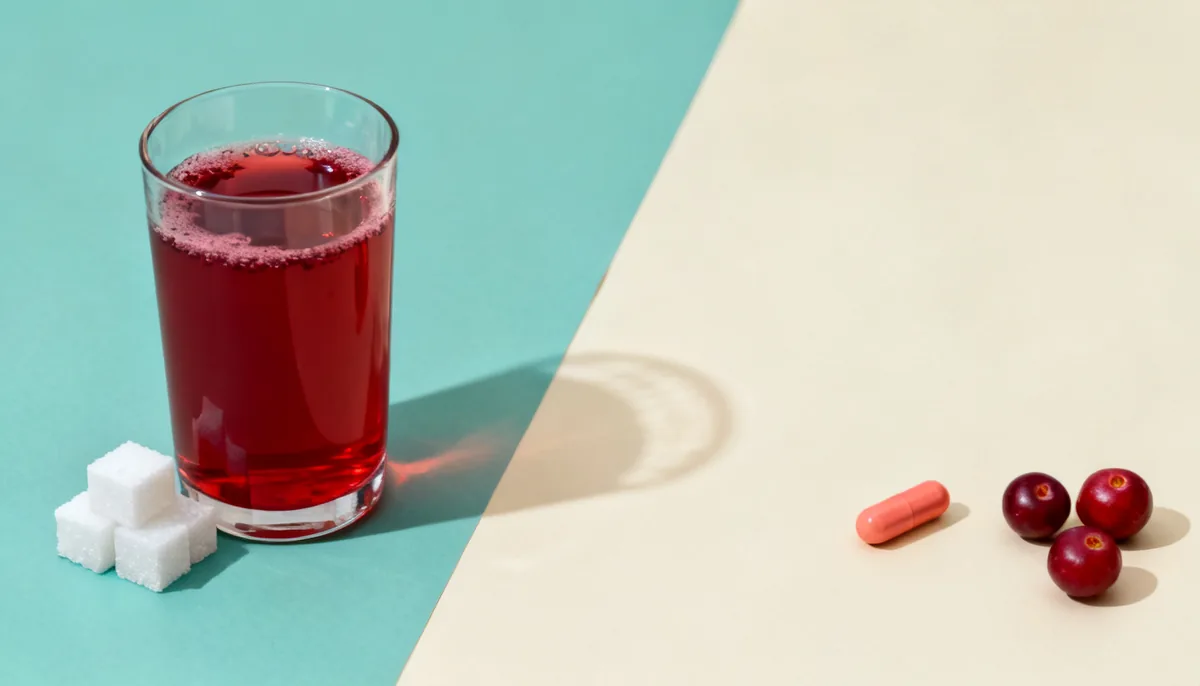
This is where juice quietly loses points for daily use. Pure cranberry juice is intensely tart, so most cranberry drinks on the shelf are “cocktails” sweetened with a lot of added sugar to be palatable. Drinking a sugary cranberry beverage every day for UTI prevention means a real daily dose of sugar and calories — not ideal for anyone watching blood sugar or weight, both of which matter for bladder health after 40.
Capsules sidestep this entirely: PACs without the sugar. If you love the ritual of a tart glass of pure, unsweetened cranberry juice and it agrees with you, that is fine — just know that “cranberry juice cocktail” is mostly sugar water with little preventive value.
Cost Over Time
For daily, ongoing prevention, capsules usually win on cost and convenience. A bottle of standardized cranberry capsules covers weeks at a fixed daily dose you can toss in your bag. Drinking enough pure cranberry juice every single day — the unsweetened kind, in a large enough amount to matter — adds up in both dollars and fridge space, and it is harder to keep up on a busy or traveling week. Consistency is the whole point with cranberry, and the easier habit tends to be the one you actually maintain.
So Which Is Better for Preventing UTIs?
For most women aiming at recurrent-UTI prevention, standardized cranberry capsules are the more practical choice: a reliable PAC dose, no sugar, portable, and easy to take consistently. Pure unsweetened juice is a reasonable alternative if you genuinely enjoy it and tolerate the tartness and cost. Juice “cocktail” and most gummies are the weakest options for prevention. And a reminder that applies to both: cranberry is preventive only — an active infection with burning, urgency, or fever needs a doctor, not more cranberry. My full prevention routine is in how to prevent recurrent UTIs naturally, and I cover daily-use questions in can you take cranberry pills every day.
Who Each Form Is Best For
- Choose capsules if: you want a consistent PAC dose, you are avoiding sugar, you travel or have a busy routine, or you struggle to drink enough juice daily.
- Choose pure juice if: you genuinely enjoy tart unsweetened cranberry juice, tolerate it well, and will keep it up — and you have no blood-sugar reason to avoid the extra sugar.
- Skip: cranberry “cocktail” and most gummies for prevention purposes — they are underdosed and sugary.
One caution for both forms: if you have a history of kidney stones or take warfarin, talk to your doctor before daily cranberry, since it contains oxalates and may interact with blood thinners.
Where a Combined Supplement Fits
If your goal is broader urinary and microbiome support rather than cranberry alone, a formula that pairs standardized cranberry with targeted probiotic strains in one daily capsule, like FemiCore, covers both — cranberry for the anti-adhesion effect, Lactobacillus for the microbiome side. It is one way to get a reliable PAC dose without a separate juice habit, especially useful for women over 40 dealing with recurrent infections.
Editor’s Recommendation
FemiCore combines cranberry standardized to 30% PACs with five named Lactobacillus strains in a single daily capsule — a no-sugar way to get a consistent PAC dose plus microbiome support. Backed by a 60-day money-back guarantee.
See how it ranks against other options →
Key Takeaways
- Same mechanism. Pills and juice both work through PACs that block bacterial adhesion — the format is just delivery.
- PAC dose decides it, not form. The studies really tested different PAC doses; consistency of ~36 mg PACs is what matters.
- Capsules are the practical daily pick. Reliable dose, no sugar, portable, easy to maintain.
- Juice can work — if it is pure. Unsweetened juice may help; “cocktail” is mostly sugar with little value.
- Prevention only. Neither treats an active infection; see a doctor for burning, urgency, or fever.
Frequently Asked Questions
Are cranberry pills as effective as cranberry juice?
They can be more practical. Both work through PACs, and standardized capsules deliver a consistent PAC dose without sugar, while juice PAC content varies and is rarely labeled. What matters most is getting enough PACs consistently, which capsules make easier for most people.
How much cranberry juice equals a cranberry pill?
There is no clean conversion because PAC content varies so much between juices and capsules. Research centers on about 36 mg of PACs daily. A standardized capsule states this; with juice you often cannot tell, which is part of why capsules are more reliable.
Is cranberry juice cocktail good for UTIs?
Not really. “Cocktail” is heavily diluted and sweetened, so it delivers little PAC value and a lot of added sugar. For prevention, pure unsweetened juice or standardized capsules are far better choices.
Can cranberry juice or pills cure a UTI?
No. Cranberry in any form is preventive, not a treatment. An active UTI with burning, urgency, cloudy urine, or fever needs medical care, usually antibiotics. Relying on cranberry to clear an infection can delay the treatment you need.
Does cranberry juice have too much sugar for daily use?
Most cranberry drinks are cocktails with significant added sugar, which adds up with daily use and is a concern if you watch blood sugar or weight. Pure unsweetened juice avoids added sugar but is very tart; capsules avoid sugar entirely.
Which is cheaper, cranberry pills or juice?
For consistent daily prevention, capsules are usually cheaper and more convenient than drinking enough pure cranberry juice every day. Since consistency is what makes cranberry work, the easier, more affordable habit is often the more effective one.
The Bottom Line
The pills-versus-juice debate is mostly a misunderstanding. Both work through the same PACs, and the research only looks contradictory because different studies delivered different doses in different forms. For a reliable, sugar-free, easy-to-keep daily habit, standardized capsules are the practical winner for most women. Pure unsweetened juice is a fine alternative if you love it and will stick with it. Just remember cranberry prevents, it does not cure — and if infections keep coming back, there is a bigger prevention plan worth building.
If you are going the capsule route, FemiCore is the one I would start with: standardized cranberry plus five named Lactobacillus strains, no sugar, one capsule a day, and a 60-day guarantee. My full FemiCore review covers the formula in detail.
— Ellen Bennett

Last Reviewed: July 2026 by Ellen Bennett, Women’s Health Researcher. Sources: Cochrane Database of Systematic Reviews (2023), FDA Qualified Health Claim on cranberry (2020), NIH/NIDDK, Urology Care Foundation.