

Published on June 25, 2026 — by Ellen Bennett, Women’s Health Researcher
Medical & Affiliate Disclosure: This article is for educational purposes only and is not medical advice. Always consult your doctor. Some links are affiliate links; if you buy through them we may earn a commission at no extra cost to you.
If you are reading this between rounds of antibiotics, I want you to know I have been there. For two years I treated a UTI roughly every other month, and the worst part was the dread — that first faint sting telling me another week of my life was about to disappear. I am not a doctor; I am a women’s health researcher who got tired of vague advice. So I went digging into what the actual trials say about how to prevent recurrent UTI naturally, and I want to walk you through it honestly, including the parts that did not work for me.
One thing first, because it matters more than anything else in this article: an active UTI is a real bacterial infection. If you have burning when you pee, fever, back pain, cloudy or bloody urine, or you simply feel unwell, that is a job for your doctor and usually an antibiotic. No supplement, herb, or juice “treats” or “cures” a UTI. Everything below is about prevention. It is about lowering how often these come back over time. And if the urgency keeps returning while your cultures come back clean, there are four causes of urgency with almost nothing coming out worth ruling out.
Quick Answer: Can you really prevent recurrent UTIs without antibiotics? Often you can reduce how often they come back. The two strategies with the strongest evidence are simply drinking more water and, for many women, standardized cranberry proanthocyanidins — a 2023 Cochrane review of 50 trials and 8,857 participants found cranberry products cut the risk of recurrent UTI by about 26% in women prone to them. For postmenopausal women, vaginal estrogen is the most effective option of all, but that is a decision to make with your doctor.
What counts as a “recurrent” UTI?
Doctors generally define recurrent UTIs as two or more infections in six months, or three or more in a year. If that is you, you are not doing anything wrong. Some women are simply more prone, often because of anatomy, hormones, or the makeup of their vaginal and urinary microbiome. Recurrence is common and well documented; the Urology Care Foundation notes that a large share of women who get one UTI will get another.
That is the frustrating bit and also the hopeful bit. Because recurrence is partly about patterns and environment, prevention is one of the few areas in this whole topic where lifestyle and structure-function support genuinely have a role, alongside, never instead of, medical care.
Does drinking more water actually prevent UTIs?
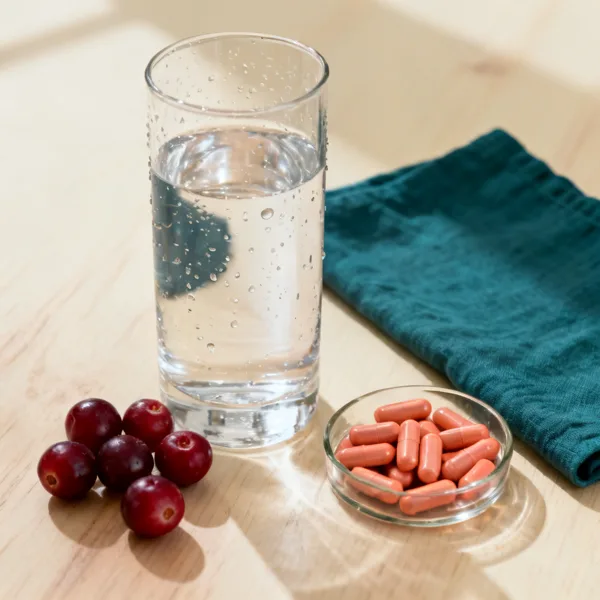
Yes, and this is the one I underrated for years. For a long time “drink more water” sounded like the thing you say when you have nothing useful to say. Then I read the randomized trial. In a 2018 randomized trial published in JAMA Internal Medicine (Hooton et al.), premenopausal women with recurrent UTIs who added about 1.5 liters of water a day cut their average number of infections roughly in half over a year (from 3.2 to 1.7) compared with women who did not increase intake.
The logic is mechanical and boring in the best way: more fluid means you flush your bladder more often, giving bacteria less time to climb and settle. It costs nothing, has no real downside for most healthy women, and it is the first thing I would change. If you take one action from this page, make it this one.
Which everyday habits help — and which are overrated?
This is where I have to be careful, because a lot of “UTI hygiene” advice is repeated confidently with thin evidence behind it. Here is my honest read.
Urinating after sex
The evidence that peeing after sex prevents UTIs is weaker than you would expect from how often it is recommended. But the risk is essentially zero and it takes ten seconds, so I still do it. File this under “low cost, possible benefit.”
Wiping front to back
Reasonable, plausible, and harmless. Again, the direct trial evidence is modest, but the mechanism makes sense and there is no downside.
Avoiding harsh soaps, douches, and tight synthetic underwear
Skip douches entirely. They disrupt the protective vaginal microbiome. Breathable cotton underwear and gentle, fragrance-free washing are sensible. None of these are silver bullets, but they remove things that may tip the balance the wrong way. For more on how hormones shift this balance, see my guide on menopause and bladder health.
Does cranberry really work for recurrent UTIs?
This is the one everyone asks about, and the answer has finally gotten clearer. The active compounds in cranberry are proanthocyanidins (PACs), which appear to make it harder for E. coli to stick to the bladder wall. The headline evidence comes from a 2023 Cochrane review of 50 trials covering 8,857 participants, which concluded that cranberry products reduced the risk of recurrent UTI by roughly 26% in women prone to them.
Two big caveats, because they are where most people go wrong. First, cranberry is for prevention, not treatment — it does nothing for an infection you already have. Second, form matters enormously. Sugary cranberry juice is the least reliable way to get a meaningful, consistent PAC dose, and the sugar load is a downside of its own. Standardized PAC supplements are far more predictable. I dig into the dosing and the noise in my full breakdown of whether cranberry works for UTIs.
The cranberry number that decides whether it works
Most pages tell you cranberry “may help” and stop there. There is a specific number, and without it the advice is close to useless, because a bottle that misses the threshold is not a weaker version of the treatment. It is nothing.
A 2024 meta-analysis in Frontiers in Nutrition pooled 10 randomized controlled trials and found cranberry reduced UTI risk by 18%, but only when daily proanthocyanidin intake reached at least 36 mg (RR 0.82, 95% CI 0.69 to 0.98). Below 36 mg the effect was not statistically significant. The benefit showed up when products were taken for 12 to 24 weeks, and in the analysis it appeared in women specifically (PubMed 39668896).
So when you pick a product, ignore the big milligram number on the front. Look for one of two things on the label:
- A stated PAC content of 36 mg or more per day. The clearest labels give it directly.
- A standardization percentage you can multiply. An extract standardized to 30% PACs needs roughly 120 mg to clear the bar.
If a label gives neither, you cannot know what you are taking, and that includes products inside proprietary blends where only the blend total is published. This is also the most likely explanation for the woman who says “I tried cranberry and it did nothing.” She may well have tried an underdosed one, for three weeks, which is not the intervention the trials tested.
What about D-mannose and probiotics?
D-mannose
D-mannose is a simple sugar that, like cranberry PACs, seems to interfere with E. coli sticking to the bladder lining. Early results are promising and it is generally well tolerated, but the high-quality trial evidence is still thinner than for cranberry or hydration. I would call it reasonable to consider, with the honest label “promising, needs more research.” For leakage rather than infection, the answer is clearer: D-mannose and bladder leaks.
Probiotics and Lactobacillus
A healthy vagina is dominated by Lactobacillus species, which keep the environment acidic and crowd out the bacteria that cause UTIs. Some randomized trials of Lactobacillus strains, including Lactobacillus crispatus, have shown a reduction in recurrence. The evidence is encouraging rather than definitive, but the rationale — supporting a healthy urinary and vaginal microbiome rather than killing anything — is exactly the structure-function angle that makes biological sense for prevention. We take a closer look at the strains and what the trials actually show in our guide to probiotics for bladder control.
What is the single most effective option after menopause?
If you are postmenopausal and getting recurrent UTIs, the most effective intervention is not on any supplement shelf: it is vaginal estrogen, prescribed by your doctor. After menopause, falling estrogen thins the vaginal tissue and shifts the microbiome away from protective Lactobacillus, which is a major driver of recurrence. Low-dose vaginal estrogen restores that environment, and the 2025 AUA/CUA/SUFU guideline on recurrent UTIs recommends it for preventing recurrent UTIs in peri- and postmenopausal women without contraindications.
This is a medical decision, full stop. But I include it because too many women suffer through years of recurrence without anyone mentioning the option that works best for their situation. If menopause is part of your picture, raise it at your next appointment.

The prescription option most women have never heard of
If you have reached the point of discussing daily preventive antibiotics with your doctor, there is another option worth having on the table, and it is not a supplement.
Methenamine hippurate is a urinary antiseptic rather than an antibiotic. It works by making urine inhospitable to bacteria instead of killing them, which means it does not drive antibiotic resistance the way daily prophylaxis does. It has been around for decades and was largely forgotten until a trial put it back in the conversation.
The ALTAR trial, published in the BMJ in 2022, randomized 240 women with recurrent UTIs to either daily preventive antibiotics or methenamine hippurate for 12 months. The antibiotic group averaged 0.89 UTI episodes per person-year and the methenamine group 1.38, an absolute difference of 0.49. Because the pre-set non-inferiority margin was one episode per person-year, methenamine met the bar for non-inferiority (PubMed 35264408).
Read that honestly, because the honest version is more useful than the headline. Methenamine was not better than antibiotics. Women on it averaged about half an extra infection a year. What the trial showed is that the gap is small enough that it becomes a genuine choice rather than a compromise, and the authors framed it exactly that way, as appropriate for some women “informed by patient preferences and antibiotic stewardship initiatives.”
Why it belongs on this page: everything else here is behavior and supplements, and for some women that is not going to be enough. Knowing this option exists changes the conversation you can have with your doctor, especially if the alternative on offer is a year of daily antibiotics you would rather avoid. It is prescription-only, it is not appropriate for everyone, and it is not something to source on your own. It is something to ask about by name.
UTI prevention strategies ranked by evidence
| Strategy | What the evidence shows | Strength of evidence |
|---|---|---|
| Increase water intake (~1.5 L/day extra) | RCT showed roughly half as many UTIs over a year | Strong |
| Vaginal estrogen (postmenopausal) | Markedly reduces recurrence; guideline-recommended | Strong (medical) |
| Standardized cranberry PACs | ~26% risk reduction in prone women (Cochrane 2023) | Moderate |
| Probiotics (Lactobacillus) | Some RCTs show reduced recurrence | Emerging |
| D-mannose | Promising for prevention; trials still limited | Emerging |
| Peeing after sex / wiping front-to-back | Weak direct evidence, but low risk | Weak (low cost) |
| Cranberry juice specifically | Inconsistent; sugar load is a downside | Weak |
| Avoiding “acidic foods,” etc. | No good evidence | Myth |
What does NOT work (the myths)
A few popular ideas deserve a gentle retirement. Cutting out “acidic” foods does not have evidence behind it. Megadosing vitamin C to “acidify” urine is not reliably effective and can irritate. And no, you cannot drink enough cranberry juice to clear an infection that is already underway — if it is active, you need a clinician. Chasing myths wastes the energy you could spend on the few things that actually move the needle. If juice versus capsules is your real question, I compared them in cranberry pills versus juice.
When should you see a doctor?
Please do not white-knuckle these symptoms. See a doctor promptly if you have burning or pain when you urinate, a fever or chills, pain in your back or side, blood in your urine, nausea or vomiting, or symptoms that are not gone within a couple of days. Those can signal a kidney infection, which is serious. Recurrent UTIs are also worth a dedicated conversation with your doctor about a prevention plan — sometimes that includes a low-dose preventive prescription. Prevention strategies are for the calm stretches between infections, not a substitute for treating one. If you are also dealing with leaks, my guide on stress vs urge incontinence may help you sort out what is going on.
Key Takeaways
- An active UTI needs a doctor. Nothing here treats or cures an infection — this is about lowering how often they return.
- Drink more water first. A randomized trial showed extra daily water roughly halved recurrences; it is the highest-value, lowest-cost step.
- Standardized cranberry PACs may help. Cochrane 2023 found about a 26% risk reduction in prone women — standardized PAC beats sugary juice.
- D-mannose and Lactobacillus probiotics are promising. They support a healthy urinary microbiome, though trial evidence is still building.
- After menopause, ask about vaginal estrogen. It is the most effective prevention option for many postmenopausal women — a medical decision.
- Skip the myths. Acidic-food avoidance and vitamin-C megadosing do not have the evidence to justify them.
How we research this
Ellen Bennett compiles peer-reviewed evidence — naming each study by date and source — from Cochrane, JAMA Internal Medicine, the AUA/CUA/SUFU recurrent-UTI guideline, and the Urology Care Foundation. We earn an affiliate commission if you buy through our links, but we flag weak or missing evidence regardless of who is paying. When the research does not support a marketing claim, we say so.
Editor’s Recommendation
If you would rather not juggle separate cranberry and probiotic supplements, FemiCore combines standardized cranberry proanthocyanidins with five Lactobacillus strains to support a healthy urinary microbiome — a structure-function blend for prevention, not a cure for any infection.
Want the unfiltered version before you decide? Read my honest FemiCore review, where I cover what it does, what it does not do, and the 60-day guarantee.
Frequently Asked Questions
Can I cure a UTI naturally at home?
No. An active UTI is a bacterial infection and usually needs an antibiotic from your doctor. Natural strategies are for preventing future infections, not curing a current one. Leaving a UTI untreated can let it spread to the kidneys.
How much water should I drink to prevent UTIs?
The randomized trial that showed benefit had women add about 1.5 liters per day on top of their usual intake. A practical goal is pale-yellow urine and regular bathroom trips. Check with your doctor if you have a heart or kidney condition that limits fluids.
Is cranberry juice or a cranberry supplement better?
For prevention, a standardized proanthocyanidin (PAC) supplement is more reliable than juice, which varies widely in active content and carries a lot of sugar. Neither treats an active infection. For the daily-use question, see whether cranberry pills are safe to take every day.
Does D-mannose really prevent recurrent UTIs?
Early evidence is promising and it is generally well tolerated, but high-quality trials are still limited. It is reasonable to discuss with your doctor as part of a prevention plan.
Can probiotics help with recurrent UTIs?
Some Lactobacillus strains have shown reduced recurrence in randomized trials by supporting a healthy vaginal and urinary microbiome. The evidence is encouraging but not yet definitive.
Why do I keep getting UTIs after menopause?
Lower estrogen after menopause thins vaginal tissue and shifts the microbiome, which raises UTI risk. Low-dose vaginal estrogen is the most effective prevention for many postmenopausal women — ask your doctor whether it is right for you.
Is FemiCore a treatment for UTIs?
No. FemiCore is a structure-function supplement that combines cranberry PACs and Lactobacillus strains to support a healthy urinary microbiome. It is not a drug and does not treat, cure, or prevent any disease. For an active infection, see your doctor.
The Bottom Line
Here is what I wish someone had told me two years ago: you probably cannot make recurrent UTIs vanish, but you can absolutely stack the odds in your favor. Drink more water — really do it. Consider standardized cranberry PACs and, if you are postmenopausal, ask about vaginal estrogen. Treat any active infection with a clinician, every time. Prevention is the quiet, unglamorous work between flare-ups, and it is where the real wins are. If you want the bigger map of bladder health, start with my complete guide to bladder leaks.
— Ellen Bennett

Ellen Bennett, Women’s Health Researcher. Ellen compiles peer-reviewed evidence on women’s bladder and pelvic health. About Ellen →
Last Reviewed: June 2026 by Ellen Bennett, Women’s Health Researcher. Sources: Cochrane (CD001321, 2023), JAMA Internal Medicine (Hooton et al., 2018), AUA/CUA/SUFU Recurrent UTI Guideline (2025), Urology Care Foundation.