
Published on September 4, 2026 — by Ellen Bennett, Women’s Health Researcher
Medical & Affiliate Disclosure: This article is for educational purposes only and is not medical advice. Always consult your doctor. Some links are affiliate links; if you buy through them we may earn a commission at no extra cost to you.
If you are looking up FemiCore ingredients before you buy, you are doing the right thing in the right order. Most people read the sales page, then the reviews, then the label, which is exactly backwards. The label is the only part of a supplement that cannot be rewritten by a marketing team.
This page is the dossier: every ingredient, what the research actually says about it, what dose the research used, and whether this formula plausibly delivers it. I am Ellen Bennett, and I research women’s bladder health for a living. Some of what follows is favorable and some of it is not.
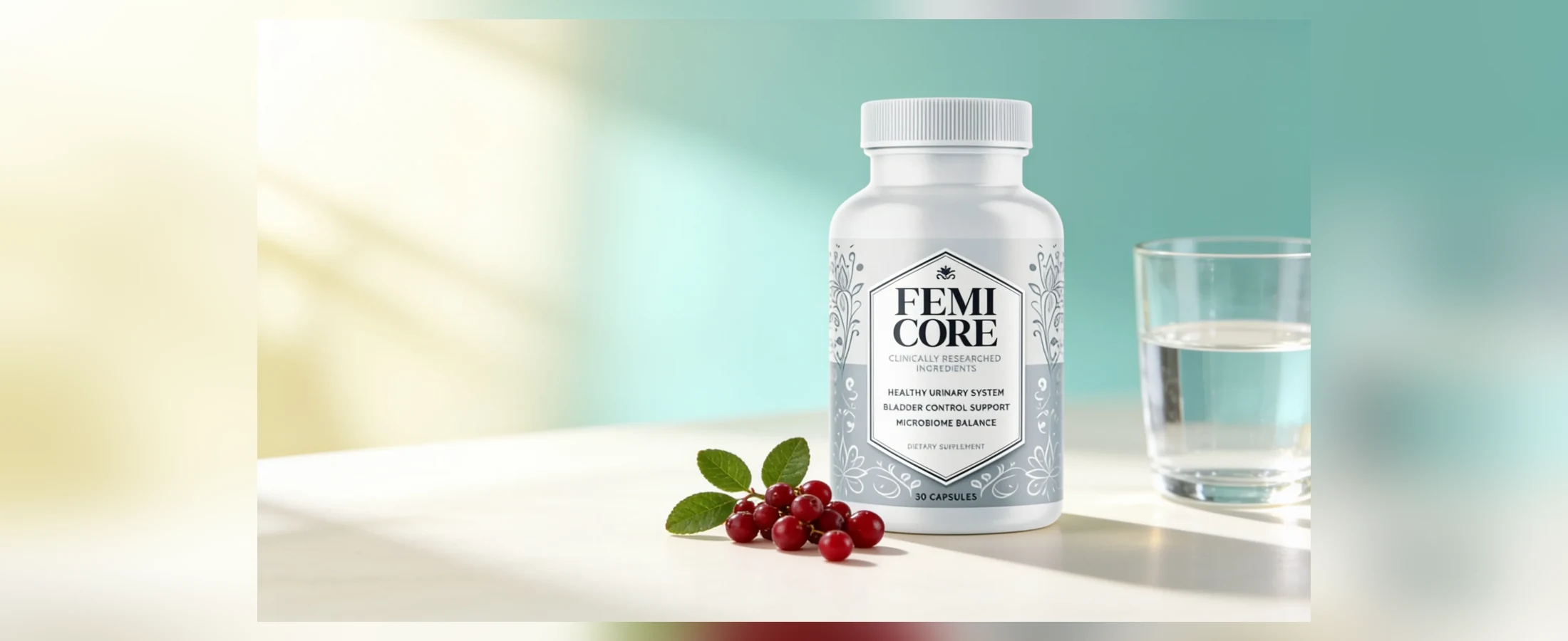
Quick Answer: FemiCore contains a 350 mg herbal blend (cranberry standardized to 30% proanthocyanidins, Mimosa pudica, berberine and bearberry) plus a 50 mg probiotic blend naming five Lactobacillus strains including L. crispatus. Are the ingredients good? The selections are well reasoned and the standardization is better than most competitors. The gap is dosing: individual amounts inside each blend are not disclosed, so you cannot verify whether the cranberry reaches the 36 mg of PACs a day that a 2024 meta-analysis identified as the threshold where benefit appears.
The Full FemiCore Ingredient List
| Ingredient | What it is for | Evidence strength |
|---|---|---|
| Cranberry extract (30% PACs) | Stops bacteria adhering to the bladder wall | Strong, dose-dependent |
| L. crispatus and 4 other Lactobacillus strains | Restores protective urinary and vaginal flora | Moderate, delivery route unresolved |
| Bearberry (uva ursi) | Traditional urinary antiseptic | Weak in humans, duration limits apply |
| Berberine | Broad antimicrobial and metabolic effects | Weak for urinary specifically |
| Mimosa pudica | Marketed for “detoxification” and binding | Very weak for bladder health |
Other ingredients on the label cover the capsule and manufacturing: gelatin, brown rice flour, magnesium stearate, olive oil and silicon dioxide. None of those do anything for your bladder and none of them are a red flag. They are ordinary capsule construction.
Cranberry Extract, Standardized to 30% PACs
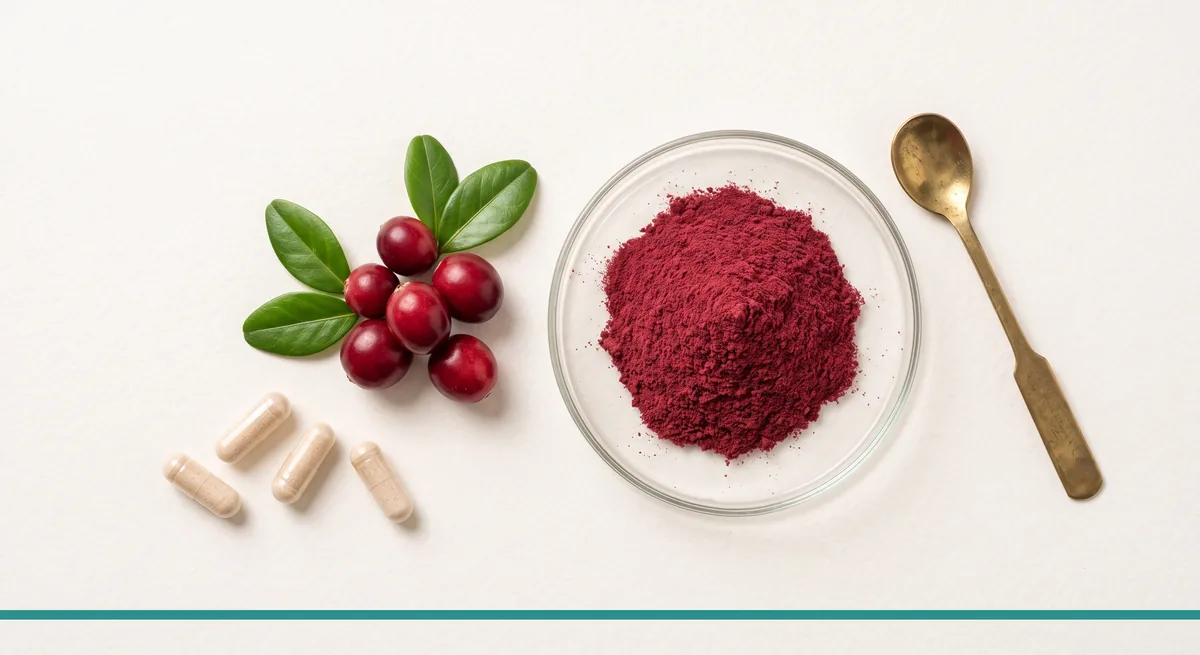
This is the ingredient with the best evidence in the bottle, and the standardization detail is the single most important number on the label.
Cranberry works by preventing bacteria from sticking, not by killing them. Its active compounds are proanthocyanidins, or PACs, which coat the lining of the urinary tract so E. coli cannot get a grip. This is also why cranberry can help prevent an infection but does nothing for one already underway.
The 2023 Cochrane review is the gold-standard source here. It pooled 50 randomized controlled trials with 8,857 participants and found cranberry products reduced recurrent UTI risk by roughly 26% in women prone to them.
A 2024 meta-analysis in Frontiers in Nutrition then answered the question Cochrane left open: how much? Pooling 10 randomized trials, it found UTI risk dropped 18% specifically when daily PAC intake reached at least 36 mg. Below that threshold, the benefit largely disappears. That single number is how you evaluate any cranberry product, including this one.
The arithmetic you can actually run
Here is where the standardization earns its keep. If the cranberry extract is standardized to 30% PACs, then delivering 36 mg of PACs requires roughly 120 mg of that extract. The herbal blend totals 350 mg across four ingredients.
So: is 120 mg of the 350 mg blend cranberry? It is entirely possible. It is also not disclosed. If cranberry is the largest component by a good margin, this formula clears the threshold. If the 350 mg is split evenly four ways, it does not.
I want to be precise about what that means. This is not proof of underdosing. It is a gap in what you can verify. And it is a gap that FemiCore made narrower than most competitors by publishing the standardization percentage at all, since a product that simply says “cranberry extract” gives you no arithmetic to run whatsoever. My full treatment of the dose question is in does cranberry actually work for UTIs, and the standardized-versus-juice question in cranberry pills vs juice.
The Five Lactobacillus Strains
FemiCore names its probiotic strains rather than hiding them behind “proprietary probiotic blend,” and that matters more than it sounds. In probiotic research, benefits attach to specific strains at specific doses. A label that says only “probiotic blend” is asking you to trust that the right ones are in there.
The headliner is Lactobacillus crispatus, and the choice is well made. A 2011 placebo-controlled trial published in Clinical Infectious Diseases found an L. crispatus probiotic roughly halved the rate of recurrent UTIs in UTI-prone women, a result that compared favorably with some conventional approaches.
The catch, and it is a real one
That study delivered the probiotic as an intravaginal suppository, placed directly where the bacteria needed to colonize. FemiCore is an oral capsule. Those are different delivery routes, and nobody has run the trial demonstrating that an oral version reproduces the suppository result.
There is a reasonable case that oral delivery does something, since the gut is a reservoir that reseeds the vaginal and urinary environment, and some oral probiotic studies in this area are encouraging. But “reasonable case” is not “demonstrated,” and any page telling you the 2011 halving applies to a capsule is quietly swapping one thing for another. I went through this properly in probiotics for bladder control.
The unit problem
There is a second issue specific to probiotics, and it is arguably worse than the cranberry one. Probiotics are measured in colony forming units, not milligrams. A 50 mg probiotic blend tells you the weight of the powder, not how many live organisms you are getting. Fifty milligrams could carry a serious CFU count or a token one, and the label does not say. Milligrams are simply the wrong unit for judging a probiotic, and when a label uses them it is not telling you the thing you need to know.
Bearberry (Uva Ursi)
Uva ursi has a long traditional use for urinary complaints, and laboratory work suggests its compound arbutin has antibacterial activity in the urinary tract. That is a real mechanism, not folklore alone.
Human evidence is thin, though, and there is a duration issue worth knowing about. Uva ursi is generally recommended for short-term rather than continuous long-term use, which sits awkwardly inside a daily supplement designed to be taken for months. If you are planning a six-month run, this is the ingredient to raise with your doctor or pharmacist. It is also covered in more detail in FemiCore side effects.
Berberine
Berberine has genuinely interesting human data, and almost none of it is urological. The research base is largely about blood sugar control and gut health, where it performs well enough to be taken seriously.
Its presence in a bladder formula is an extrapolation from broad antimicrobial activity rather than a direct urinary finding. That is not unreasonable, but it is a weaker justification than the cranberry has, and it should be described that way.
Berberine is also the ingredient here that most deserves a pharmacist conversation. It can lower blood sugar, which matters if you take diabetes medication, and it shares a liver enzyme pathway with a number of common drugs. If you take anything regularly, ask before you start.
Mimosa Pudica
I will be direct: this is the weakest ingredient in the formula. Mimosa pudica is marketed around “binding and removing toxins,” which is wellness language rather than a mechanism with urinary evidence behind it. There is no meaningful human research supporting it for bladder health, urgency, leakage or infection prevention.
It is not dangerous, and it appears in several products in this category, so FemiCore did not invent the practice. But if you are trying to work out what is doing the work in this bottle, it is not this.
What the Blend Totals Do and Do Not Tell You
FemiCore discloses two totals: a 350 mg herbal blend and a 50 mg probiotic blend. What it does not disclose is the split inside each.
Two things keep this fair. First, proprietary blends are the norm across this entire category, not a FemiCore invention, and companies use them partly to stop competitors copying a formula. Second, undisclosed does not mean underdosed. This is a gap in what you can verify, not proof that the product is weak.
But it does change how you should judge it. You cannot confirm the cranberry hits 36 mg of PACs, you cannot see the CFU count, and you therefore cannot predict from the label alone whether this bottle will do anything for you. That uncertainty is the honest reason the guarantee matters as much as it does: it is the mechanism by which you find out, rather than a bonus.
How These Ingredients Compare to the Alternatives
| Approach | Typical ingredients | Best-matched symptom | Evidence quality |
|---|---|---|---|
| Microbiome (FemiCore) | Standardized cranberry + named Lactobacillus | Recurrent UTIs | Good at ingredient level, none on the finished formula |
| Botanical tone (Urox) | Crateva, horsetail, Lindera | Urgency, frequency, nocturia | One phase 2 randomized placebo-controlled trial |
| D-mannose-forward | D-mannose, cranberry, dandelion, hibiscus | Marketed for UTIs | Lead ingredient failed MERIT 2024 |
| Single nutrient | Magnesium, vitamin D, pumpkin seed extract | Varies by nutrient | Modest, mostly for correcting a deficiency |
The useful takeaway from that table is that ingredient quality is only half the question. The other half is whether the ingredients are aimed at your symptom. FemiCore’s are aimed at infection. If your problem is urgency and frequency, a formula built on Urox has a better-matched trial, which I worked through in FemiCore vs Confitrol24.
FemiCore — Our #1 Rated Bladder Health Supplement
Microbiome-targeted formula · 60-day money-back guarantee · GMP-certified facility
What the Ingredients Cannot Do
This section exists because the ingredient list is the clearest possible evidence of what a product is not for.
Nothing in this formula acts on pelvic floor muscle, bladder muscle tone, or nerve signaling. Read the list again with that in mind: cranberry and bearberry are anti-adhesion and antimicrobial, berberine is antimicrobial and metabolic, the Lactobacillus strains are about flora. Every single one is aimed at bacteria.
Stress incontinence, leaking when you cough, sneeze, laugh, lift or run, is a muscular support problem. No ingredient on this label reaches it, and any review implying otherwise is not reading the label. Pelvic floor training has the strongest evidence for that, it costs nothing, and it is covered in pelvic floor exercises for women over 40. If you are unsure which type you have, start with the difference between stress and urge incontinence.
Key Takeaways
- Cranberry standardized to 30% PACs is the best ingredient here, and 36 mg of PACs a day is the threshold where benefit appears in the research.
- The arithmetic is possible but not confirmable. Reaching 36 mg needs roughly 120 mg of the extract out of a 350 mg blend, and the split is not disclosed.
- Naming five Lactobacillus strains is a genuine strength, but a 50 mg weight is the wrong unit for a probiotic; CFU is.
- The 2011 L. crispatus result used a suppository, not a capsule. The strain choice is right; the delivery question is open.
- Mimosa pudica is the weakest inclusion, with no meaningful human evidence for bladder health.
- Every active ingredient targets bacteria. Nothing here touches the pelvic floor, so nothing here addresses stress leaks.
Frequently Asked Questions
What are the main ingredients in FemiCore?
A 350 mg herbal blend of cranberry extract standardized to 30% proanthocyanidins, Mimosa pudica, berberine and bearberry, plus a 50 mg probiotic blend naming five Lactobacillus strains including L. crispatus. The remaining label items are capsule and manufacturing components.
Does FemiCore disclose its doses?
Partially. It publishes the two blend totals and the cranberry standardization percentage, which is more than most competitors do, but not the individual amount of each ingredient inside those blends.
How much cranberry is in FemiCore?
The exact amount is not disclosed. What is disclosed is that the extract is standardized to 30% PACs, which means delivering the researched 36 mg daily PAC dose would require roughly 120 mg of extract from within the 350 mg herbal blend.
Are FemiCore’s probiotics strong enough?
There is no way to tell from the label. Probiotic potency is measured in colony forming units, and the label gives a 50 mg weight instead, which describes the powder rather than the number of live organisms.
Are there any ingredients to be careful with?
Two. Berberine can lower blood sugar and shares a liver enzyme pathway with several medications, so check with your pharmacist if you take anything regularly. Bearberry is generally suggested for short-term rather than indefinite daily use, which is worth raising if you plan a long run.
Do the ingredients help with bladder leaks?
Not the stress-incontinence kind. Every active ingredient in the formula targets bacteria and urinary flora, and none of them acts on the pelvic floor muscles that control leaking when you cough, laugh or lift.
The Bottom Line
FemiCore’s ingredient list is better reasoned than most of this category, and the honest reasons are specific: the cranberry is standardized to a stated percentage, the probiotic strains are named rather than hidden, and the blend totals are published. Those three things let you do arithmetic that most competitors make impossible.
The limits are equally specific. You cannot confirm the cranberry reaches the dose the research supports, the probiotic is measured in the wrong unit to judge, Mimosa pudica is along for the ride, and the whole formula is pointed at bacteria rather than at muscle. Which means that if your bladder story is really a recurrent-infection story, this is a sensibly built bottle worth a guarded trial. If it is a leaking story, the label itself tells you to spend your money elsewhere.
— Ellen Bennett
 Ellen Bennett, Women’s Health Researcher. More about Ellen →
Further reading: the full FemiCore review and FemiCore side effects.
Last Reviewed: August 2026 by Ellen Bennett, Women’s Health Researcher. Sources: Cochrane (2023), Frontiers in Nutrition (2024), Clinical Infectious Diseases (2011), NIH, NIDDK, PubMed, Urology Care Foundation.