

Published on August 10, 2026 — by Ellen Bennett, Women’s Health Researcher
Medical & Affiliate Disclosure: This article is for educational purposes only and is not medical advice. Always consult your doctor. Some links are affiliate links; if you buy through them we may earn a commission at no extra cost to you.
The first time I searched for FemiCore side effects, in my late forties and five days into a bottle, I got scared for the wrong reason. Every article warned me about ashwagandha making me drowsy, DIM changing my hormones, iron constipating me, chasteberry and my cycle. I read four before I noticed that not one of those ingredients is in the product. An hour spent worrying about a formula that does not exist, and not one page touched the question I had actually typed: if I take this every day for a year, am I quietly doing something to my kidneys or my liver?
What I needed was boring and specific: was mild gas normal adjustment or a reason to stop, and did daily use for months carry anything worse than gas. Nobody writing about it had read the label, so nobody answered. Several readers have written to me describing the same loop: a vague fear of organ damage with no specific answer anywhere, so they either quit something that seemed to be helping or keep swallowing it while braced for harm. Nobody says out loud that “natural” and “studied for years of daily use” are not the same thing. So this is the article I wanted.
Quick Answer: Reported FemiCore side effects are mostly mild and digestive: gas, loose stools, or an unsettled stomach in the first one to two weeks, which is what you would expect from cranberry extract, berberine, and five Lactobacillus strains taken together. Who should be careful? Anyone on warfarin, metformin or insulin, anyone with a history of calcium-oxalate stones, anyone immunocompromised or catheterised, and anyone pregnant or breastfeeding. The bigger issue nobody raises: the formula contains bearberry (uva ursi), and the NIH LiverTox database states that because hydroquinone is potentially carcinogenic, uva ursi “is recommended in short courses only and not to be taken chronically.” Ask your doctor or pharmacist first.

What Is Actually in FemiCore?
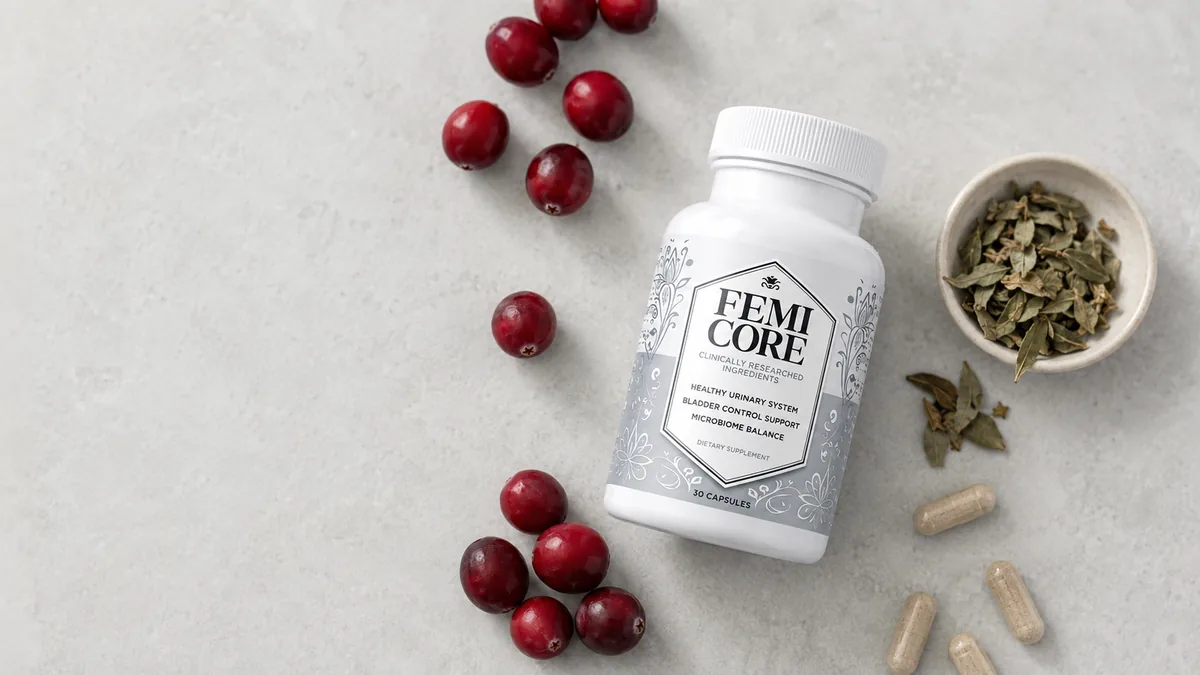
You cannot discuss FemiCore side effects without the label, so here it is. FemiCore is a once-daily capsule with two parts: a 350 mg herbal blend of Mimosa pudica, cranberry extract standardized to 30% proanthocyanidins, bearberry (also sold as uva ursi), and berberine; plus 50 mg of five Lactobacillus strains, namely crispatus, acidophilus, plantarum, gasseri, and casei. That is the whole list, and it is the same formula whether you search FemiCore or femi core as two words.
Two details shape everything below. The herbal load is 350 mg split four ways, a small amount of each herb by supplement standards. And it is a proprietary blend, so you cannot calculate how much berberine or arbutin you are taking. That is standard practice, not a scandal, but it means honest answers come in ranges rather than certainties. My full label walkthrough is in the FemiCore review. What each of those four herbs is actually doing, and how much of it there plausibly is, I cover in the FemiCore ingredients dossier.
Why Most “FemiCore Side Effects” Articles Describe the Wrong Product
If you have read three or four pages about FemiCore side effects and come away confused, that is not your fault. A cluster of review sites describes FemiCore as a hormone-and-energy formula built on ashwagandha, DIM, chasteberry, and iron, then lists the side effects of those four: drowsiness, hormonal shifts, cycle changes, constipation. None of them is on the FemiCore label.
It looks like one template copied sideways, and once a few sites carry it the error reads like consensus. The cost to you is real: you end up braced for the wrong problems and unprepared for the plausible ones. Nobody mentions cranberry and warfarin, or berberine if you take metformin, and nobody raises the bearberry duration issue. So, a quick test for any supplement page: does it name the ingredients on the bottle in your hand? If not, close the tab. I hold my own pages to it, including FemiCore reviews and complaints.
FemiCore — Our #1 Rated Bladder Health Supplement
Microbiome-targeted formula, 60-day money-back guarantee, made in a GMP-certified facility in the USA. Daily support for urinary microbiome balance rather than a fix for leakage, and worth clearing with your doctor if you take prescription medication.
My honest read on whether the evidence supports the price: does FemiCore really work.
What Side Effects Are Plausible From the Real Formula?
Based on what is documented for each ingredient, the plausible FemiCore side effects are overwhelmingly mild and digestive: gas, bloating, looser stools, mild nausea, sometimes an unsettled stomach if you take the capsule without food. Reviewers commonly mention that cluster in the first week or two, usually settling afterward.
That is unsurprising given the parts. NIH’s LiverTox monograph on cranberry notes that “with high doses, minor side effects may include diarrhea, abdominal discomfort and nausea.” NCCIH reports berberine’s side effects in research studies were “primarily gastrointestinal symptoms such as nausea, abdominal pain, bloating, constipation, or diarrhea.” Probiotics are the class most associated with a few days of gas. Stack three gut-active ingredients in one capsule and a quiet digestive adjustment is the expected outcome, not a warning sign.
Dose deserves a word. Berberine studies reporting those symptoms generally used 500 mg to well over 1,000 mg daily, and whatever berberine sits inside a 350 mg four-herb blend is a fraction of that, which makes strong berberine effects less likely. The catch: lower doses also make strong benefits less likely. One thing that is not a side effect: cranberry can tint urine and change its smell, so a color shift after starting is usually just the supplement. Blood in your urine, pain, fever, or burning is not.
Ingredient-by-Ingredient Interactions to Know
Interactions matter more than FemiCore side effects for most women here, because a mild stomach is annoying while a clash with a prescription drug is not. Below: each ingredient, the interaction with documentation behind it, and who should raise it with a doctor or pharmacist first.
| Ingredient | Plausible interaction or caution | Who should be careful | Source |
|---|---|---|---|
| Berberine | Lowers blood glucose via the AMPK pathway, so effects can add to glucose-lowering medication. Also documented to interact with cyclosporine. | Anyone on metformin, a sulfonylurea, insulin, or other diabetes medication; transplant recipients on cyclosporine | NCCIH; 2022 meta-analysis |
| Cranberry (30% PAC) | Conflicting evidence on warfarin. A 2021 USP safety review found reported cases mostly involved very large intakes, roughly 1–2 litres of juice daily or about 3,000 mg of extract. | Anyone on warfarin or another anticoagulant; ask first, never change a dose yourself | NCCIH; USP review, 2021 |
| Cranberry (oxalates) | Contains oxalates, and published data on calcium-oxalate stone risk are contradictory rather than settled. | Anyone with a history of calcium-oxalate kidney stones | USP review, 2021 |
| Cranberry (acid reducers) | LiverTox notes reduced plasma levels and effects of proton pump inhibitors and H2 blockers. | Anyone taking omeprazole, pantoprazole, famotidine, or similar | NIH LiverTox |
| Bearberry / uva ursi | Arbutin converts to hydroquinone. Because hydroquinone is potentially carcinogenic, LiverTox says short courses only, not chronic use. Rare severe reactions at high doses, plus a maculopathy case after three years of daily tea. | Everyone taking it daily and continuously; a duration question, not a dose question | NIH LiverTox |
| Lactobacillus blend | NCCIH states probiotic risk “is greater in people with severe illnesses or compromised immune systems,” including reported infections. | Anyone immunocompromised, on immunosuppressants, seriously ill, or with an indwelling catheter or central line | NCCIH |
| Mimosa pudica | Human safety data are thin; available work is largely laboratory and animal research. Traditionally avoided in pregnancy. | Anyone pregnant, trying to conceive, or breastfeeding | Evidence gap |
The berberine and blood sugar point, said clearly
Berberine and metformin lower glucose through overlapping mechanisms, and a 2022 systematic review and meta-analysis of berberine trials in type 2 diabetes found consistent reductions in fasting glucose. That pooled analysis found no significant increase in hypoglycemia overall, which is reassuring at group level and is not the same as clearance for your regimen. Additive glucose lowering in someone already dosed to a target is how a low happens, so if you take metformin, a sulfonylurea, or insulin, talk to your prescriber before you start and monitor afterwards. Never adjust a diabetes dose yourself.
The bearberry point nobody else covers
This is the section I would keep if I had to delete every other one. Uva ursi works through arbutin converting to hydroquinone in urine. Because of that, the convention is short courses only, commonly one to two weeks at a time, and LiverTox is explicit that it should not be taken chronically.
FemiCore is designed as a daily, ongoing supplement. Those two facts sit awkwardly together, and I have not seen another article notice it. The mitigating detail is dose: bearberry is one of four herbs inside 350 mg, so arbutin exposure is likely far below the levels those cautions were written for. A proprietary blend means nobody outside the company can verify how far below, and continuous daily use of an arbutin-containing herb over many months is not a well-studied scenario.
What I do instead of panicking: use it in defined stretches, and say “uva ursi” out loud to a pharmacist. The pattern I want to avoid is years of daily use of something never meant to be a forever product. If you would rather avoid an arbutin-containing herb altogether, compare formulas in the best bladder control supplements for 2026.
Who Should Skip FemiCore Entirely?
Six groups should not be weighing pros and cons at all: they should not start FemiCore without a doctor’s sign-off. That list covers pregnancy and breastfeeding, immune suppression, anticoagulant therapy, a history of oxalate stones, significant kidney or liver disease, and an active UTI. A 60-day guarantee is no help if the product was wrong for you on day one.
- If you are pregnant, trying to conceive, or breastfeeding. NCCIH states berberine “is likely to be unsafe for infants and may also be unsafe for use during pregnancy or while breastfeeding.” Mimosa pudica has almost no human pregnancy data.
- If you are immunocompromised, on immunosuppressants, or have an indwelling catheter. Live probiotic strains carry a different risk profile here, per NCCIH.
- If you take warfarin or another anticoagulant. Not automatically off limits, but the clinician managing your INR goes first.
- If you have had calcium-oxalate kidney stones. The evidence is contradictory, which is why this is a doctor’s call.
- If you have significant kidney or liver disease, or you are under 18. Both organs handle these compounds, and none of this was studied in children.
- If you currently have UTI symptoms. A UTI is a bacterial infection needing assessment, a supplement is not a treatment for one, and delay can let it reach the kidneys. See how to prevent recurrent UTIs naturally.
The First Two Weeks: Normal Adjustment vs. a Real Problem
On day five my question was not “what are the side effects,” it was “is this normal or should I stop.” That distinction is missing from almost everything written on the subject. Mild, digestive, and improving means adjustment. Sudden, severe, febrile, or worsening means stop and get assessed.
| What you notice | Usually a normal adjustment | Stop and contact a doctor |
|---|---|---|
| Digestion | Gas, mild bloating, slightly looser stools in week one or two, easing over time | Severe or persistent diarrhea, vomiting, or abdominal pain that stops you functioning |
| Urine | Slightly different color or smell after starting a cranberry supplement | Visible blood, burning, fever, chills, or flank and lower-back pain |
| Skin | Nothing. This formula should not do anything to your skin | Rash, hives, itching, facial or throat swelling, trouble breathing: emergency care |
| Blood sugar, if you take diabetes medication | Readings within your usual range | Shakiness, sweating, confusion, or readings lower than normal; call your prescriber |
| Timeline | Symptoms peak early and fade by roughly week two to three | Anything that starts later and worsens rather than improves |
Here is my mistake, and it is a common one. With my stomach already unsettled, I kept taking the capsule first thing on an empty stomach so I would not forget it. That made it worse for four more days; moving it to the middle of a meal fixed it in two. I had assumed the problem was the ingredient when it was the timing. And the first two weeks tell you almost nothing about whether a product works: digestive noise is fast, microbiome change is slow.
Editor’s Recommendation
If your doctor has cleared it and you want to trial FemiCore properly, buy direct and keep the 60-day guarantee intact, so a two-week digestive adjustment never becomes a financial decision. Support for microbiome balance, not a replacement for pelvic floor work.
Counterfeit bottles turn a safety question into a lottery. My guide to where to buy FemiCore covers how to avoid them.
How to Lower Your Chance of Side Effects
Most mild reactions to FemiCore are preventable with sequencing rather than willpower: clear the label with a pharmacist, take the capsule mid-meal instead of on an empty stomach, start one new supplement at a time, keep fluids steady, and set a defined trial window. None of this is clever, and none of it costs anything.
- Show the label to a pharmacist first. Bring the bottle and your medication list, and say berberine, cranberry, and uva ursi out loud.
- Take it mid-meal, not on an empty stomach. This one change resolves most early stomach complaints, including mine.
- Start one thing at a time. Begin a supplement, a magnesium capsule, and a fiber routine in the same week and you will never know what caused what.
- Keep fluids steady. Cutting water to reduce trips backfires, since concentrated urine irritates the bladder lining.
- Give it a defined window. Pick eight to twelve weeks, track leaks and night-time trips, and decide with data instead of drifting into open-ended daily use.
- Do not double up to catch up. One capsule a day is the design, and no capsule strengthens muscle: that part is pelvic floor exercises for women over 40.
When to Stop and Call Your Doctor
Stop the capsule and seek care the same day for any sign of an allergic reaction: rash, hives, swelling of the face, lips, or throat, or difficulty breathing. Call your doctor promptly for fever or chills, pain in your side or lower back, blood in your urine, severe vomiting or diarrhea, yellowing of the eyes or skin, or an inability to pass urine. The NIDDK notes that fever, chills, nausea, vomiting, and back or side pain can signal an infection that has reached the kidneys, which is not something to manage at home.
Also worth a call without alarm symptoms: glucose readings outside your normal range, any change in bruising or bleeding on an anticoagulant, and digestive symptoms still strong past three weeks. Worsening leakage deserves assessment rather than a longer trial, and working out whether yours is stress or urge incontinence changes what actually helps.
FemiCore — 60-Day Money-Back Guarantee
One capsule daily, made in the USA in a GMP-certified facility, non-GMO. Daily support for a healthy urinary microbiome alongside pelvic floor training, not a replacement for medical care. Check the label against your medication list with your doctor or pharmacist first.
If the ingredient list is what worries you, comparing formulas side by side helps: FemiCore vs. FemiPro sets out where the two differ on herbs and probiotic strains.
Key Takeaways
- Most articles about FemiCore side effects describe a formula that does not exist. There is no ashwagandha, DIM, chasteberry, or iron in it.
- The plausible effects are mild and digestive: gas, bloating, looser stools, or mild nausea in the first one to two weeks, matching what NIH sources document for cranberry, berberine, and probiotics.
- Four interactions deserve a real conversation: berberine with diabetes medication and cyclosporine, cranberry with warfarin, cranberry with acid reducers, and probiotics if you are immunocompromised or catheterised.
- The bearberry duration question is the one nobody else raises. LiverTox says uva ursi is for short courses, not chronic use, while FemiCore is designed for daily use.
- A proprietary blend means individual doses cannot be verified, so risks and benefits both belong in ranges.
- Skip it, or get explicit clearance, if you are pregnant, breastfeeding, immunocompromised, on an anticoagulant, prone to oxalate stones, or have UTI symptoms. Allergic reaction, fever with flank pain, blood in urine, or inability to urinate means care now.
Frequently Asked Questions
What are the most common FemiCore side effects?
Mild digestive ones: gas, bloating, slightly looser stools, or an unsettled stomach, most often in the first one to two weeks and easing after that. This matches what NIH sources report for cranberry extract, berberine, and probiotic strains individually. Taking the capsule mid-meal resolves it for many women.
Can I take FemiCore with metformin?
Ask your prescriber first. FemiCore contains berberine, which lowers glucose through a pathway overlapping with metformin, so effects can add up. A 2022 meta-analysis of berberine trials found no significant overall increase in hypoglycemia, but that is population data, not a green light for your regimen. Never adjust a diabetes dose yourself.
Is it safe to take FemiCore every day, long term?
This is the honest weak point. The formula contains bearberry (uva ursi), and NIH LiverTox states it is recommended in short courses only and not chronically, because arbutin converts to hydroquinone. The amount inside a four-herb 350 mg blend is likely small, but a proprietary blend makes it unverifiable. Use defined windows and discuss ongoing use with your doctor or pharmacist.
Does FemiCore interact with blood thinners?
Possibly. NCCIH describes conflicting evidence on whether cranberry interacts with warfarin, and a 2021 USP safety review found reported cases mostly involved very large intakes. Because getting anticoagulation wrong is serious, this belongs with whoever manages your INR before you start.
Can FemiCore cause a UTI or make one worse?
There is no evidence that it causes urinary tract infections. The real risk is treating a supplement as a substitute for care while an infection progresses. A UTI is a bacterial infection needing assessment, and untreated infections can reach the kidneys. If you have burning, fever, or blood in your urine, see a doctor. My read on the prevention evidence: cranberry for UTI, does it work.
Should I stop FemiCore if I feel bloated in the first week?
Not necessarily. Mild bloating that is improving is the expected adjustment when you add probiotic strains and gut-active herbs at once. Try taking it mid-meal and give it another week. Stop and call a doctor if symptoms are severe, still strong past three weeks, or come with fever, vomiting, or pain. Same logic for taking cranberry pills every day.
The Bottom Line
The plausible FemiCore side effects are mild, digestive, and mostly front-loaded into the first two weeks. Reassuring, and not the whole story. The interactions are where the real caution sits: berberine if you manage blood sugar with medication, cranberry if you take warfarin or acid reducers or have made oxalate stones, live probiotics if your immune system is compromised. And the bearberry duration question stays open, unnoticed by an internet still describing a formula with ashwagandha in it. None of this makes FemiCore dangerous. It makes it a real herbal product with a real label, deserving five minutes with a pharmacist rather than an hour with a search engine. For my broader assessment, start with the full FemiCore review.
— Ellen Bennett
Last Reviewed: July 2026 by Ellen Bennett, Women’s Health Researcher. Sources: NIH/PMC, NIDDK, NCCIH, Urology Care Foundation, Mayo Clinic, ACOG.

Ellen compiles evidence from NIH, NIDDK, ACOG, Cochrane, and the Urology Care Foundation to help women make calm, informed bladder-health decisions. More about Ellen →