
Published on August 19, 2026 — by Ellen Bennett, Women’s Health Researcher
Medical & Affiliate Disclosure: This article is for educational purposes only and is not medical advice. Always consult your doctor before starting a supplement, especially if you take prescription medication. Some links are affiliate links; if you buy through them we may earn a commission at no extra cost to you.
Turn over a bottle of almost any women’s bladder supplement and there is a decent chance saw palmetto is on the label. It has been there for years, it sounds herbal and harmless, and hardly anyone asks the obvious question.
The obvious question is who it was studied in. Because saw palmetto built its entire reputation on the prostate, and you do not have one.
Quick Answer: Saw palmetto (Serenoa repens) is a palm berry extract that became popular for prostate symptoms in men, and it is now included in many women’s bladder formulas. Does saw palmetto work for bladder control in women? The evidence is thin. A Cochrane review of 27 placebo-controlled studies in 4,656 participants found no improvement in urinary symptoms in men. In women there is one small trial: 72 Japanese women over 50 took 320 mg daily for 12 weeks, and daytime frequency scores improved by 0.8 points versus 0.4 on placebo (p = 0.04). That is a real result, but a very small one in a very specific group.
What is saw palmetto, and why is it in a women’s product?
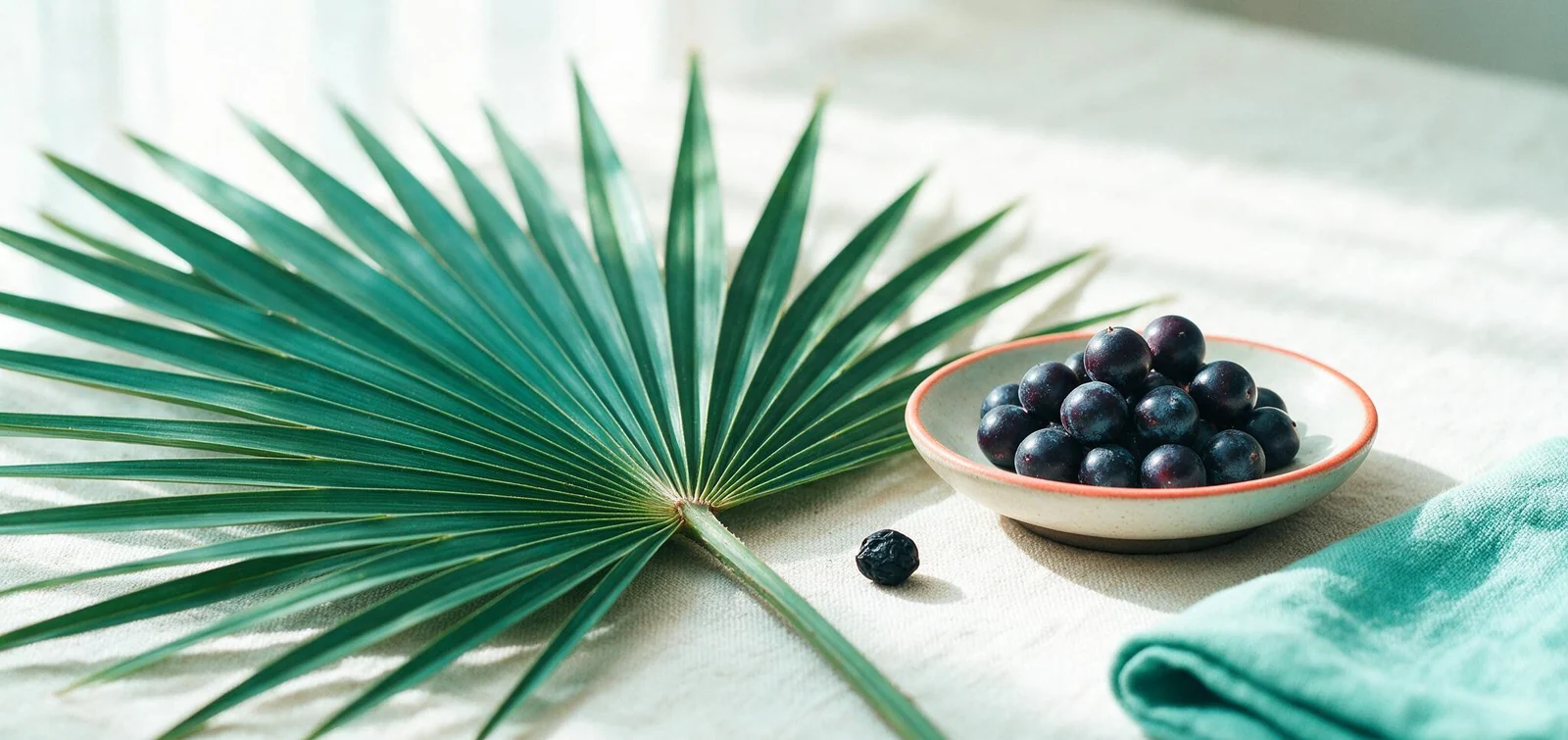
Saw palmetto is an extract of the dark berries of Serenoa repens, a low-growing fan palm native to the south-eastern United States. Native American communities used the berries traditionally, and in the twentieth century the extract became one of the best-selling herbal products in the world, almost entirely as a remedy for the urinary symptoms of an enlarged prostate.
Which is where the awkwardness starts. Benign prostatic hyperplasia produces a very recognisable set of complaints: needing to go often, getting up at night, a weak stream, not feeling empty. Those overlap heavily with what many women describe. Somebody noticed the overlap, reasoned that if the symptoms look alike the remedy might transfer, and saw palmetto migrated into women’s formulas on the strength of that reasoning rather than on the strength of research in women.
To be fair, there is a biological argument for the transfer. The proposed mechanisms are not purely prostate-specific: researchers have pointed to binding at muscarinic receptors in the bladder and inhibition of vanilloid receptors on the sensory nerves, both of which exist in women. Animal work in female rats reported increased bladder capacity. That is a hypothesis worth testing, not a finding you can apply to yourself. Rats are not women, and receptor binding in a dish is not fewer trips to the bathroom.
What the research actually shows in men
Start here, because this is where nearly all the data lives, and because it is not encouraging.
The Cochrane Collaboration pooled 27 placebo-controlled studies covering 4,656 participants, following them for periods up to 17 months. The conclusion was that saw palmetto produced no improvement in urinary symptoms and no improvement in quality of life compared with placebo.
I want to be clear about how much weight that carries. Twenty-seven randomised trials and nearly five thousand people is not a preliminary signal, it is a settled answer for the population studied. Harvard Health reached the same summary. When an ingredient has been tested that thoroughly and comes back flat, the reasonable prior for a new population is scepticism, not hope.

What the research shows in women
There is exactly one trial worth discussing, and it deserves credit for existing at all.
It was published in Nutrients in March 2022 and you can read it in full at PubMed Central. The design is sound: multicentre, randomised, double-blind and placebo-controlled. Seventy-two women completed it, 38 on saw palmetto and 34 on placebo, all over 50, with a mean age around 69. They took 320 mg of saw palmetto fruit extract once daily for 12 weeks.
The primary outcome was the daytime frequency question of the Core Lower Urinary Tract Symptom Score. The treatment group improved by 0.8 ± 0.9 points; the placebo group improved by 0.4 ± 0.8. The difference reached statistical significance at p = 0.04. The authors also reported improvement in daytime frequency and nocturia in a subset of women whose symptoms were worse at the start.
Reading that honestly
A result can be statistically significant and still be small enough that you would struggle to feel it. This is one of those.
The difference between the groups was four tenths of a point on a questionnaire item. Not four tenths of a bathroom trip, four tenths of a score. The p value of 0.04 sits just inside the conventional threshold, which means a result like this is exactly the kind that sometimes fails to reproduce. And the average participant was 69 years old, in a study restricted to women with everyday urinary symptoms rather than diagnosed overactive bladder. The authors flag that limitation themselves, and note it may have excluded the women most likely to benefit.
On funding: the study was partly funded by Yawata Corporation, which also supplied the extract that was tested. The authors declare no conflict of interest. I mention it not as an accusation but because you deserve the full picture, and because this pattern is near-universal in supplement research. It is the same pattern behind the trials for the Urox blend and pumpkin seed extract.
So my read is this. One small positive trial in women in their late sixties, with a modest effect, sitting next to twenty-seven trials in men showing nothing. That is enough to say “possibly, a little, in some women.” It is nowhere near enough to justify the confident language on the bottles.
Does it apply to you?
Probably less than you would like, and this is worth being specific about.
If you are in your forties or fifties and your leaks began around perimenopause, you are two decades younger than the women in that trial and your symptoms most likely have a different driver: falling oestrogen and pelvic floor changes rather than the general age-related bladder changes of a woman approaching seventy. Nothing in this research speaks to your situation directly.
And there is a bigger issue that no ingredient can solve. If you leak when you cough, sneeze, laugh or lift, that is a pelvic floor problem, and no berry extract addresses a pelvic floor. Saw palmetto’s proposed mechanisms are all about frequency and urgency, which is a completely different pathway. Sorting out which type of incontinence you actually have tells you more than any label will.
How saw palmetto compares to other bladder ingredients
| Ingredient | Mainly for | Evidence in women | Honest verdict |
|---|---|---|---|
| Saw palmetto | Frequency, urgency | One trial, 72 women, mean age 69, small effect (p = 0.04) | Weak. Reputation built in men, where Cochrane found nothing |
| Urox blend | Frequency, urgency, nocturia | One phase 2 RCT, 150 adults, larger effect | Better numbers, but manufacturer-funded and no phase 3 |
| Pumpkin seed extract | Control | Small placebo-controlled trials, industry-linked | Similar tier to Urox |
| Magnesium | Urgency, if depleted | One small 1998 trial, subjective only | Worth correcting a deficiency, not more |
| Cranberry (PACs) | UTI prevention | 2023 Cochrane, 50 trials, about 26% reduction | Strongest evidence here, but does nothing for leaks |
| Vitamin D | Pelvic floor muscle function | Trial evidence, strongest when correcting low levels | Test before supplementing |
The uncomfortable pattern, again: the ingredient with by far the best evidence in this table does nothing for leakage, and the ingredients aimed at leakage all rest on one small study each.
Dose and safety
The dose used in the women’s trial was 320 mg of saw palmetto fruit extract once daily, which happens to match the standard dose used in the male prostate research. Effects were measured at 12 weeks, so a fair trial of it is three months, not three weeks.
Saw palmetto is generally well tolerated. The most common complaints are mild digestive ones, and taking it with food usually helps. But “well tolerated” is not “irrelevant to your medication list”, and a few situations deserve a conversation with your doctor or pharmacist first:
- Hormone-sensitive conditions. Saw palmetto is thought to act on hormone pathways, so if you have a history of hormone-sensitive cancer or take hormone therapy, ask before starting.
- Blood thinners. There are case reports of bleeding associated with saw palmetto. If you take warfarin, a DOAC, or daily aspirin, check first.
- Upcoming surgery. For the same reason, mention it to your surgical team and expect to be told to stop beforehand.
- Pregnancy and breastfeeding. Not appropriate, and not studied. Avoid.
- Liver concerns. Rare liver-related reports exist. Stop and seek advice for unusual fatigue, dark urine or yellowing of the skin or eyes.
Separately, and more importantly than any of the above: blood in your urine, pain or burning when you urinate, fever, back or side pain, or suddenly being unable to empty your bladder are reasons to be seen promptly. Those are not supplement problems.
What I would do instead, and what I would do alongside
If you already own a bottle, I am not telling you to bin it. I am telling you where it belongs in the queue, and it is not at the front.
- Identify your type first. Pressure leaks and urgency leaks respond to nearly opposite strategies, and picking wrong wastes months. Start with stress versus urge incontinence.
- Do the work with the strongest evidence. Pelvic floor training done correctly for pressure leaks; a bladder training schedule for urgency. These have Cochrane behind them, which is more than anything in the supplement aisle can claim.
- Deal with the aggravators. Caffeine load, fluid timing, constipation, and any medication that started around the same time as your symptoms.
- Then trial one supplement at a time, for the full duration, with a three-day bladder diary before and after. One at a time is the part people skip, and it is the part that makes the answer readable.
FemiCore — Our #1 Rated Bladder Health Supplement
Microbiome-targeted formula · 60-day money-back guarantee · GMP-certified facility
For the record, FemiCore does not contain saw palmetto. It is built around the urinary microbiome, which puts it in the recurrent-UTI and comfort column rather than the muscle-control column, and I would rather say that plainly than imply it covers everything. Our comparison of bladder control supplements sets out which ingredient suits which problem, and the full FemiCore review includes what it does not do.
Key Takeaways
- Saw palmetto’s reputation was built in men, where a Cochrane review of 27 trials and 4,656 participants found no benefit for urinary symptoms or quality of life.
- There is one trial in women: 72 participants over 50, 320 mg daily for 12 weeks, published in Nutrients in 2022.
- The effect was small: a 0.8-point improvement in daytime frequency score versus 0.4 on placebo, p = 0.04.
- The average participant was about 69, so the findings may not describe a woman in her forties or fifties.
- It cannot help pressure leaks. Coughing, sneezing and lifting leaks are a pelvic floor issue and need pelvic floor work.
- Check with your doctor first if you take blood thinners or hormone therapy, or have surgery coming up.
- Give any trial 12 weeks and a bladder diary, and change only one thing at a time.
Frequently Asked Questions
Does saw palmetto work for bladder control in women?
Possibly a little, in some women. One randomised placebo-controlled trial of 72 women over 50 found a small but statistically significant improvement in daytime frequency after 12 weeks. Against that sits a Cochrane review of 27 trials in men finding no benefit. Treat it as weak evidence, not established.
Why is saw palmetto in women’s bladder supplements if it was studied in men?
Because the symptoms look similar and formulators assumed the effect would transfer. The proposed mechanisms, muscarinic and vanilloid receptor activity, are not prostate-specific, so the idea is reasonable. It just was not confirmed in women until one small trial in 2022.
What dose of saw palmetto was used in the women’s study?
320 mg of saw palmetto fruit extract, taken once daily for 12 weeks. That matches the standard dose in the male research. Judge any trial of it at three months rather than a few weeks.
Will saw palmetto stop me leaking when I cough or sneeze?
No. Leaks triggered by coughing, sneezing, laughing or lifting come from pelvic floor strength and timing, which no berry extract addresses. Pelvic floor training is the tool for that, and it has far better evidence than any supplement here.
Is saw palmetto safe for women?
It is generally well tolerated, with mild digestive complaints being most common. Speak to your doctor first if you take blood thinners, take hormone therapy or have a hormone-sensitive condition, or have surgery planned. Avoid it in pregnancy and breastfeeding.
Is saw palmetto better than pumpkin seed extract or Urox?
On current evidence it is the weakest of the three for women. Urox and pumpkin seed extract each have placebo-controlled trials with larger effects, though both are manufacturer-linked. See the Urox evidence for that comparison.
The Bottom Line
Saw palmetto is a good example of how an ingredient earns a place on a label without ever earning it in the research. It got famous in men, failed to beat placebo across 27 trials there, and arrived in women’s bottles on the strength of the resemblance between two sets of symptoms.
The one trial in women is real and I am glad someone ran it. It is also small, brief, in a group two decades older than most of my readers, and it moved a questionnaire score by four tenths of a point.
If it is already in a formula you take and you are doing well, there is no reason to panic. Just do not let it be the thing you are counting on, and do not let it stand in for the pelvic floor work that would actually change your week. The bottle is the easy part. It is rarely the part that works.
— Ellen Bennett
 Ellen Bennett, Women’s Health Researcher. More about Ellen →
Last Reviewed: August 2026 by Ellen Bennett, Women’s Health Researcher. Sources: Cochrane, Nutrients (PubMed Central), Harvard Health, NIDDK, Urology Care Foundation.