

Published on August 12, 2026 — by Ellen Bennett, Women’s Health Researcher
Medical & Affiliate Disclosure: This article is for educational purposes only and is not medical advice. Always consult your doctor. Some links are affiliate links; if you buy through them we may earn a commission at no extra cost to you.
In my early fifties I was getting up twice a night, every night, and I was tired enough to try almost anything. A pharmacist mentioned pumpkin seed, so I bought 1,000 mg pumpkin seed oil softgels and took them for ten weeks. My night trips went from two to roughly one on most nights, and my daytime urgency did not budge. Pleased and confused in equal measure. It took another month of reading to understand why, and the answer changed how I think about pumpkin seed extract for bladder control.
The mistake I made is the one almost every woman makes in that aisle. I assumed the bottle in my hand was the thing that had been studied. It was not.
Quick Answer: Pumpkin seed shows genuine early promise for overactive bladder symptoms, especially night-time urination, but the evidence is thinner than the marketing suggests. Does pumpkin seed extract help bladder control? The strongest study is a 2014 randomized, double-blind, placebo-controlled trial in 120 women aged 35 to 70, published in the Journal of Functional Foods, which tested a premixed pumpkin seed plus soy germ extract at 1 gram a day for 12 weeks and reported significant improvement from baseline in frequency, urgency and nocturia. The catch: the trial was funded by the ingredient supplier, and the placebo group improved significantly too.
Does Pumpkin Seed Extract Help Bladder Control?
There is real human evidence, which is more than most bladder supplements can claim. Two published 12-week studies in people with overactive bladder symptoms reported meaningful reductions in daytime frequency and night-time urination. Both are small, both have design limits, and neither justifies the “clinically proven” on the packaging. Promising is the accurate word.
The proposed mechanism is not mystical. Pumpkin seed contains lignans and phytosterols, and researchers have suggested a mild effect on the androgen pathway and on pelvic floor muscle tissue. That story holds together in animal and cell work. In women it has never been tested with anything like that rigor. Saw palmetto is proposed to work on that same androgen pathway, with equally limited testing in women, covered in saw palmetto for women.
So the honest answer sits in between: it may help support bladder comfort for some women, most reliably at night, over a couple of months, and it is unlikely to do anything for leaks that happen when you cough or sneeze. Worth working out whether your problem is stress or urge incontinence before you spend a cent.

What the 12-Week Trial Actually Tested
The study everyone cites came from a team including researchers at Ewha Womans University in Seoul, published in the Journal of Functional Foods in 2014. It enrolled 120 women aged 35 to 70 with overactive bladder-related voiding dysfunction, randomized double-blind against placebo, over 12 weeks. That design is a real strength: most supplement “evidence” here is an open-label pilot with no placebo arm.
The intervention was a premixed pumpkin seed and soy germ extract, 1 gram a day split between morning and evening, against a matching placebo. After 12 weeks the treatment group showed significant reductions from baseline in urination frequency, urgency, incontinence episodes, maximum urgency score, night-time urination and total symptom score, with no adverse events or abnormal safety findings reported. You can read the trial abstract at ScienceDirect. A similar herbal blend, Urox, has its own eight-week trial with the same funding caveat, which I go through in Urox for bladder control.
Now the two details the supplement blogs leave out, both from the published paper itself. First, the study was financially supported by Frutarom, the company supplying both extracts, a conflict of interest worth stating plainly. Second, and more important: the placebo group also reached statistical significance on three of the six outcomes, including urination frequency and total symptom score. Bladder symptoms respond strongly to attention and expectation, which is why placebo arms exist. One 120-woman study is a starting point, not a conclusion.
The Detail the Supplement Aisle Leaves Out
Here is the point of the whole article. The trial did not test pumpkin seed on its own. It tested a fixed blend of water-soluble pumpkin seed extract with soy germ extract standardized for isoflavones. Soy isoflavones have their own research in menopausal symptoms, and nothing in this trial can tell you which of the two extracts did the work.
Walk into a pharmacy and what you will mostly find is pumpkin seed oil in softgels: no soy germ, no relationship to the tested product beyond the words on the front. That was my bottle. Borrowing a blend’s trial results to sell a single-ingredient softgel is the quiet sleight of hand here.
To be fair in both directions, pumpkin seed oil alone is not evidence-free. A 2014 study in the Journal of Traditional and Complementary Medicine, available in full through PubMed Central, gave 45 people 10 g per day of Cucurbita maxima seed oil and found significant reductions in overactive bladder symptom scores at 6 and 12 weeks, daytime frequency and nocturia both falling. Note the design: open-label, no placebo. And note the dose. Ten grams a day is roughly five 2,000 mg softgels.
A third strand comes from men’s prostate research: an oil-free hydroethanolic pumpkin seed extract taken daily for three months was associated with reduced night-time urination in a 2019 pilot study indexed at PMC. That studied men with an enlarged prostate, a different mechanism entirely. When a product page cites prostate data at you, that is the tell.
Pumpkin Seed Oil vs. Extract vs. Eating the Seeds
These three are sold as interchangeable and they are not. They are made differently, they carry different compounds, and only two have any human bladder data behind them. If you are going to try pumpkin seed extract for bladder control, choose the form deliberately.
| Form | What it is | Human bladder evidence | Honest take |
|---|---|---|---|
| Water-soluble seed extract + soy germ | Concentrated, standardized blend; the form used in the 2014 randomized trial | Strongest available: 120 women, 12 weeks, placebo-controlled | Only form with placebo-controlled data. Hardest to find on a shelf. |
| Oil-free hydroethanolic seed extract | Alcohol and water extraction, low fat, lignan-rich | Small pilot work, mainly in men with prostate symptoms | Reasonable pick, but the data was not generated in women. |
| Pumpkin seed oil softgels | Pressed oil, mostly fatty acids; typically 1,000 to 2,000 mg | One 12-week open-label study, no placebo, at 10 g per day | Most widely sold, least matched to the studied dose. |
| Whole or roasted pumpkin seeds | Food; magnesium, zinc, fiber | None for bladder symptoms | Good food. Do not expect a bladder effect from a handful. |
One footnote, because it comes up constantly: a quarter cup of seeds is a strong source of magnesium, which has its own small and mixed bladder literature. If that is the effect you are chasing, read what the research says about magnesium for overactive bladder.
Dosing, Safety, and Who Should Be Careful
General information only, and a conversation to have with your doctor or pharmacist first, particularly if you take prescription medication. The randomized trial used 1 gram a day of the blend for 12 weeks. The open-label oil study used 10 g of oil daily. Most retail softgels land far below either figure, which is one plausible reason people report nothing happening.
Both studies reported good tolerability with no significant adverse events. Reassuring, not a blank cheque. The practical issues worth knowing:
- Blood pressure. A 2019 study in postmenopausal women indexed on PubMed found that 3 g a day of pumpkin seed oil for six weeks lowered systolic blood pressure. If you already take blood pressure medication, that stacking is worth flagging to your prescriber.
- The soy germ component. If you choose the blend that was actually studied, you are also taking isoflavones. A 2013 systematic review at PMC found no clear evidence of harm from dietary-level soy, but concluded that better safety evidence is needed before recommending high-dose isoflavone supplements to women with a history of breast cancer. If that is you, or if you take tamoxifen or an aromatase inhibitor, do not start this without your oncologist.
- Digestive tolerance. Oil softgels can cause burping, reflux or loose stools at higher doses. Taking them with food helps.
- Allergy. Seed allergies exist, and soy allergy rules out the blend entirely.
- Pregnancy and breastfeeding. Not enough data. Skip it.
- Loose regulation. Look for third-party testing and treat the front of the label as marketing. I go through how to read one in our guide to bladder control supplements.
Red flags that mean this is not a supplement question at all: blood in your urine, burning or pain when you urinate, fever or flank pain, an inability to pass urine, or a sudden change over days rather than months. Those need a doctor, not a bottle. Infection needs treatment; bladder control is a different matter.
How It Compares to Other Bladder Supplements
Placed next to the other options women weigh, pumpkin seed sits in the upper half for evidence quality, which says as much about the competition as about pumpkin seed.
| Supplement | Best evidence for | Strength of evidence | Where it falls short |
|---|---|---|---|
| Pumpkin seed + soy germ extract | Overactive bladder symptoms, especially nocturia | One placebo-controlled trial in 120 women, industry funded | Blend was tested, not pumpkin seed alone; not replicated |
| Cranberry (proanthocyanidins) | Reducing recurrent urinary tract infections | Cochrane-level review support for recurrent UTI | No evidence it improves leakage or urgency |
| D-mannose | Reducing recurrent UTI risk | Small trials, mixed; a large 2024 trial was disappointing | Not a bladder control ingredient at all |
| Magnesium | Muscle relaxation, possible urgency benefit | Very limited and dated for bladder specifically | Most women are not deficient; effect likely small |
| Lactobacillus probiotics | Urinary and vaginal microbiome support | Best evidence is for recurrent UTI, strain dependent | Weak evidence for leakage itself |
| Pelvic floor training (not a supplement) | Stress and mixed incontinence | Strongest evidence in this entire field | Requires weeks of consistent practice |
Two things fall out of that table. Ingredients for infection prevention and ingredients for bladder control are different categories that packaging blends together, and the non-supplement row still has the best evidence on the list. For the fuller breakdown, see vitamins and supplements for frequent urination. That mismatch is the whole problem with one heavily marketed formula, which I take apart in my Bladder Relief 911 review.
Is Pumpkin Seed Extract in FemiCore?
No, it is not, and I would rather say so than talk around it. FemiCore is the bladder supplement we rate highest here, and its formula is built on a different idea: a herbal blend of mimosa pudica, cranberry standardized for proanthocyanidins, bearberry and berberine, plus five Lactobacillus strains. A urinary microbiome approach, and pumpkin seed extract is not in it. What is actually inside it, and what the label will not tell you, is in the FemiCore ingredients breakdown.
The two answer different questions. If your main complaint is night-time trips and urgency with no infection history, the pumpkin seed and soy germ blend is the more logical experiment, and it is not something I can sell you. If your pattern is recurrent infections and a sense that your urinary balance is off, the microbiome route fits better, and I laid that evidence out in probiotics for bladder control.
Editor’s Recommendation
Pumpkin seed is worth a trial if urgency and nocturia are your issue. If your pattern is recurrent infections instead, FemiCore is the microbiome-targeted formula we rate #1, and it is best understood as daily support rather than a fix for leakage.
Read my full assessment first, weak spots included, in the FemiCore review.
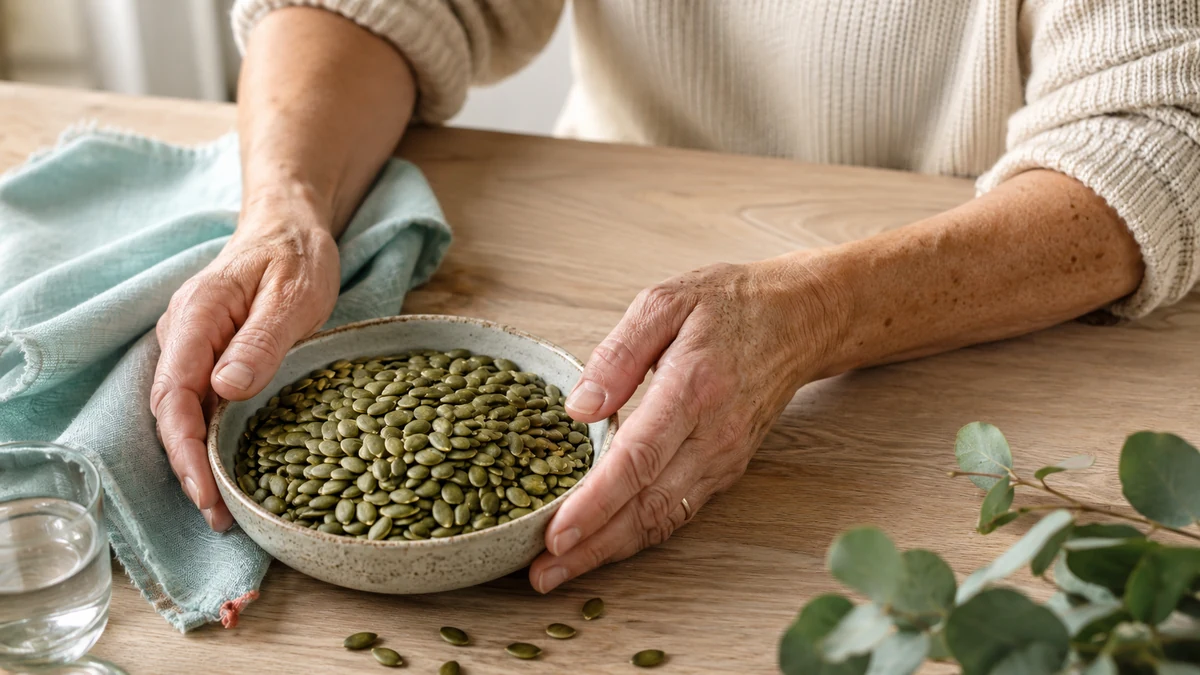
Where Pumpkin Seed Extract for Bladder Control Fits in a Real Plan
A woman wrote to me last spring describing almost exactly my own experience. Two months on pumpkin seed oil, three night wakings down to one, better rested, and frustrated that the daytime urgency she had actually bought it for was unchanged. She wanted to know whether to double the dose.
My answer was no. The gap was never the dose. She was asking one ingredient to solve two mechanisms, and she had skipped the boring intervention with the best evidence behind it. Nocturia responds to fluid timing, evening caffeine and alcohol, and sleep quality. Daytime urgency responds to bladder retraining and pelvic floor work. Neither arrives in a softgel.
The other question that keeps landing in my inbox is about loading doses. Women read that they should start high for two weeks and then taper, and when a hard week costs them two doses and the night waking comes back, they assume they have to begin the whole thing again. Neither study used a loading phase. And the cheaper bottle is rarely the problem: form and consistency matter far more than price.
There is a third pattern, and it shows up most in women living with more complicated bladder conditions, the painful ones that come with a longer treatment list than yours probably does. They start pumpkin seed oil on top of four or five other supplements and a prescription or two, all in the same month, and months later the honest verdict is that things help a little. Nobody can say which thing. Add one item, give it the full trial window, write down what changes.
The sequence I would use myself:
- Two weeks of tracking first. Times, volumes, leaks, what you drank and when. Without a baseline you cannot tell a real effect from a good week.
- The behavioral basics. Fluid spread across the day and tapered in the evening, caffeine and alcohol reviewed, and a proper bladder training schedule if urgency is your issue. The NIDDK puts these first for a reason.
- Pelvic floor work, done properly. Strongest evidence in the field, and free.
- Then, if you want to, one supplement at a time. Choose the form that matches the research, give it the full 12 weeks, keep tracking. One variable, or you learn nothing.
Better data is coming. Northwestern University is recruiting 40 women with overactive bladder symptoms for a 12-week pilot of 1,000 mg daily pumpkin seed oil extract, registered as NCT06944392 on ClinicalTrials.gov. Single-arm and open-label, so it will not settle the placebo question, but it is the first look at this ingredient in US women. For the wider context, start with my complete guide to bladder leaks.
Key Takeaways
- The best evidence is one 2014 randomized trial in 120 women aged 35 to 70, over 12 weeks, reporting significant improvement from baseline in frequency, urgency and nocturia.
- What was tested was a blend of pumpkin seed extract with soy germ extract, 1 gram a day. Not pumpkin seed alone, and oil, extract and seeds are not interchangeable: the softgels sold most widely are the form furthest from the studied dose.
- Two caveats the marketing omits: the trial was funded by the ingredient supplier, and the placebo group also improved significantly on three of six outcomes.
- Night-time urination is the symptom most likely to respond. Do not expect anything for leaks that happen when you cough or laugh.
- It is not in FemiCore. If your path is urinary microbiome support, that is a different product.
- Talk to your doctor or pharmacist first if you take blood pressure medication, or if you have a history of hormone-sensitive breast cancer and are considering the soy germ blend.
Frequently Asked Questions
How long does pumpkin seed extract take to work for bladder control?
Both published studies ran 12 weeks, and the open-label oil study measured improvement at 6 weeks too. Plan on eight to twelve weeks before you judge it, and track symptoms in writing rather than from memory. Nothing here works in days.
Is pumpkin seed oil the same as pumpkin seed extract?
No. Oil is pressed from the seed and is mostly fatty acids. A water-soluble or hydroethanolic extract concentrates different compounds, including lignans, and is what the placebo-controlled trial used alongside soy germ. Different products, and their studies used very different doses.
Can eating pumpkin seeds help bladder control?
No human trial has tested whole pumpkin seeds for bladder symptoms. The studied doses were concentrated extracts, and a handful of seeds is nowhere near equivalent. Worth eating for magnesium, zinc and fiber, just not as a bladder strategy on its own.
Does pumpkin seed extract help stress incontinence?
There is no good evidence for that. The research is in overactive bladder symptoms: urgency, frequency and night-time urination. Leaking when you cough, sneeze or lift is a muscular problem, and pelvic floor training is what has evidence there.
What is the right dose of pumpkin seed extract for bladder control?
As general information, the randomized trial used 1 gram a day of the pumpkin seed and soy germ blend, and the open-label oil study used 10 g of oil daily. Most retail products sit well below both. Talk to your doctor or pharmacist about what is appropriate for you, especially alongside prescription medication.
Are there side effects from pumpkin seed supplements?
Both trials reported good tolerability with no significant adverse events. In practice, oil softgels can cause burping, reflux or loose stools at higher doses. Pumpkin seed oil was also associated with lower systolic blood pressure in a small 2019 study of postmenopausal women, so mention it to your prescriber if you take blood pressure medication.
The Bottom Line
Pumpkin seed extract for bladder control is one of the more defensible options in a category full of indefensible ones, and it still rests on a single trial of 120 women, funded by the company that sells the ingredient, in which the placebo group also improved. If you want to try it, buy the form that matches the research rather than the form that dominates the shelf, give it 12 weeks, track it honestly, and do the pelvic floor work regardless. My night trips improved and my daytime urgency did not, and I no longer think that was bad luck. It was the ingredient doing roughly what the evidence says it does: modest, real, and nothing like the promise on the front of the box.
— Ellen Bennett
Last Reviewed: July 2026 by Ellen Bennett, Women’s Health Researcher. Sources: NIH/PMC, NIDDK, Urology Care Foundation, Mayo Clinic, ACOG.

Ellen compiles evidence from NIH, NIDDK, ACOG, Cochrane, and the Urology Care Foundation to help women make calm, informed bladder-health decisions. More about Ellen →