
Published on September 3, 2026 — by Ellen Bennett, Women’s Health Researcher
Medical & Affiliate Disclosure: This article is for educational purposes only and is not medical advice. Always consult your doctor. Some links are affiliate links; if you buy through them we may earn a commission at no extra cost to you.
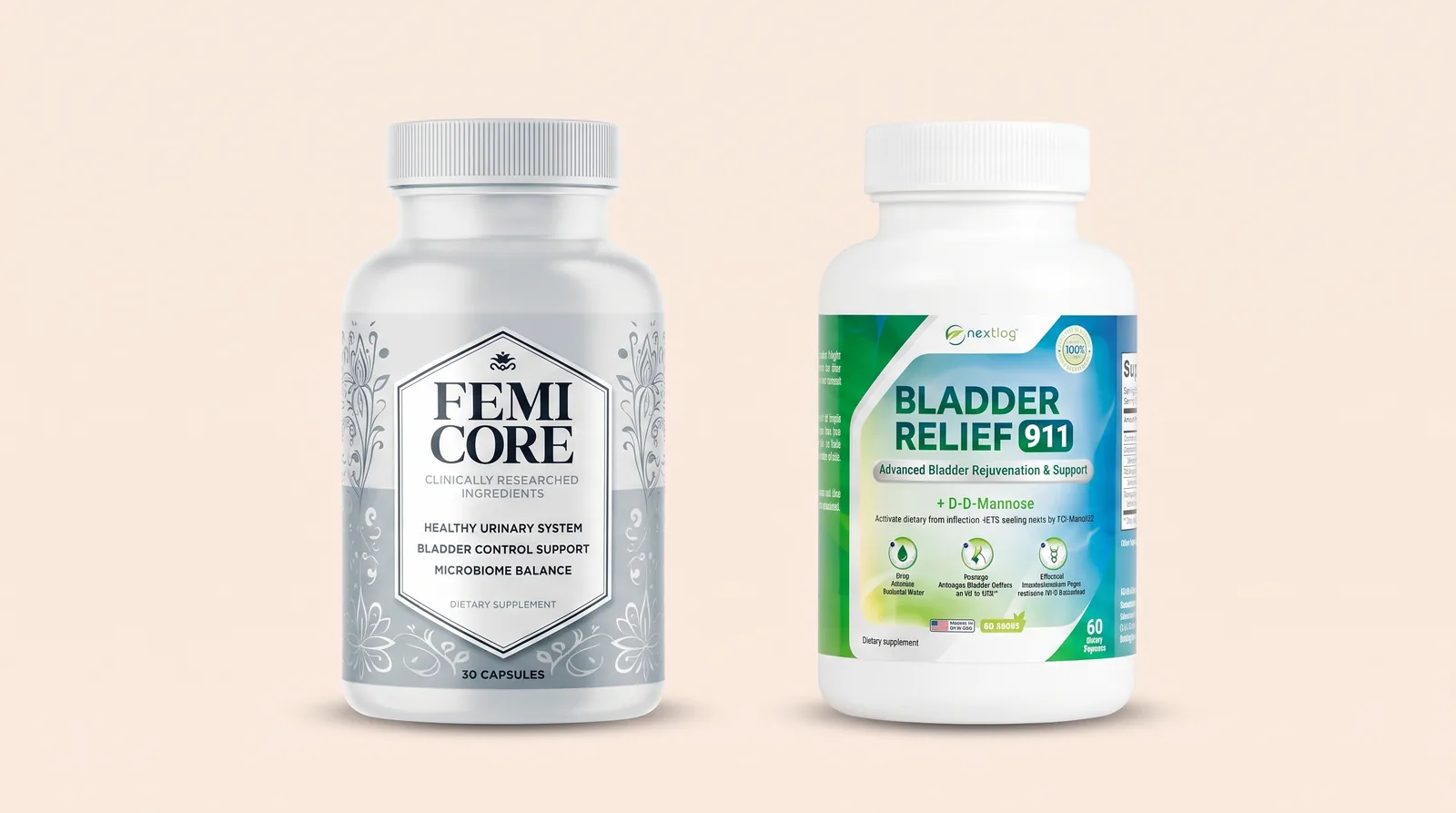
FemiCore vs Bladder Relief 911 comes up constantly, and for an understandable reason: both promise the same relief, both sell only through their own websites, and both sit in the same price band. On the surface they look interchangeable.
They are not. One of these formulas is built around an ingredient that failed a 598-woman trial in 2024, and includes two diuretics in a product sold to reduce bathroom trips. That is not a small distinction, and it is the one no comparison page seems willing to make. I am Ellen Bennett, and I research women’s bladder health for a living. Here is the head-to-head.
Quick Answer: FemiCore pairs standardized cranberry with five named Lactobacillus strains and a 60-day guarantee. Bladder Relief 911 pairs d-mannose with cranberry, hibiscus and dandelion, and offers 90 days. Which is better? FemiCore, on the evidence. Its cranberry is standardized to 30% proanthocyanidins and its probiotic strains are named, while Bladder Relief 911 leads with d-mannose, which the 2024 MERIT trial found no better than placebo across 598 women (51.0% vs 55.7%, p = 0.26). Bladder Relief 911 wins on the guarantee alone.
FemiCore vs Bladder Relief 911: The Verdict
- Winner: FemiCore. Its lead ingredient, cranberry standardized to 30% PACs, has Cochrane-level support; Bladder Relief 911 leads with d-mannose, which failed a 598-woman trial in 2024.
- Bladder Relief 911 contains dandelion, a diuretic, which works against the fewer-trips goal. FemiCore contains no dandelion.
- Only Bladder Relief 911’s guarantee is longer (90 vs 60 days).
- Best for: women 40+ with urgency, nighttime trips, or recurrent UTIs, especially since menopause.
- Safety net: 60-day money-back guarantee processed by ClickBank, official site only.
FemiCore — standardized cranberry, named strains, no dandelion
What Is FemiCore?
FemiCore is a once-daily women’s bladder support capsule built on the urinary microbiome idea. It combines a roughly 350 mg herbal blend, headlined by cranberry standardized to 30% proanthocyanidins alongside Mimosa pudica, berberine and bearberry, with a 50 mg probiotic blend that names five Lactobacillus strains including L. crispatus.
It sells only through its official site, carries a 60-day money-back guarantee, and is manufactured in a GMP-certified US facility. The full ingredient-by-ingredient walkthrough, including the dose arithmetic, is in the FemiCore ingredients breakdown, and my overall assessment is in the honest FemiCore review.
What Is Bladder Relief 911?
Bladder Relief 911 is a daily capsule from PhytAge Labs, marketed for frequent urination, nighttime urgency and mild leakage, and aimed at aging adults generally rather than women specifically. The formula is four ingredients: d-mannose, cranberry, hibiscus extract and dandelion root.
It sells direct, is made in FDA-registered GMP-certified facilities, and carries a 90-day money-back guarantee with free US shipping. I reviewed it on its own in Bladder Relief 911 reviews and complaints.
Key Differences at a Glance
| FemiCore | Bladder Relief 911 | |
|---|---|---|
| Lead ingredient | Cranberry standardized to 30% PACs | D-mannose |
| Probiotic strains | 5, named | None |
| Cranberry standardized? | Yes, to a stated PAC level | No stated PAC level |
| Diuretic ingredients | None | Two (dandelion, hibiscus) |
| Best evidence for lead ingredient | Cochrane 2023: ~26% fewer recurrent UTIs | MERIT 2024: no significant benefit |
| Blend totals disclosed | Yes (350 mg + 50 mg) | No |
| Dose | 1 capsule daily | Capsules daily, amount per ingredient unstated |
| Guarantee | 60 days | 90 days |
| Approx. best per-bottle price | ~$49 | ~$49.95 |
| Aimed at | Women | Adults generally |
Ingredient Comparison
What they share: cranberry
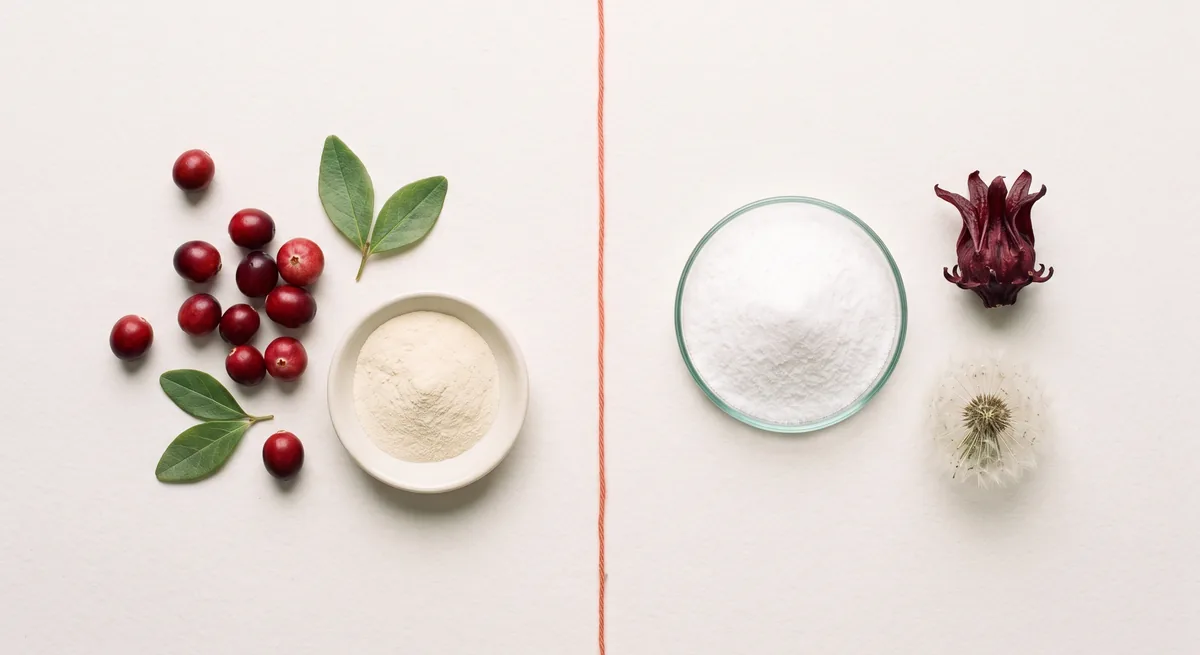
Both formulas contain cranberry, and it is the ingredient with the best evidence in either bottle. A 2023 Cochrane review of 50 randomized trials with 8,857 participants found cranberry products reduce recurrent UTI risk by roughly 26% in women prone to them. A 2024 meta-analysis in Frontiers in Nutrition narrowed the condition: the benefit appears once daily proanthocyanidin intake reaches at least 36 mg, cutting risk 18%.
That threshold is where the two products separate. FemiCore states that its cranberry is standardized to 30% PACs, which lets you do arithmetic: to deliver 36 mg of PACs you need roughly 120 mg of that extract, and the herbal blend totals 350 mg. Whether the cranberry portion reaches 120 mg is not disclosed, so this is a plausibility check rather than a confirmation, but at least the check is possible.
Bladder Relief 911 states no PAC level at all. There is no arithmetic to run. That is the difference between a product you can partly verify and one you cannot. My full treatment of the dose question is in does cranberry actually work for UTIs.
FemiCore’s distinctive ingredient: named probiotic strains
FemiCore names five Lactobacillus strains rather than hiding them behind “probiotic blend.” That matters because benefits in probiotic research are tied to specific strains, not to the word on the front of the bottle. A 2011 placebo-controlled trial in Clinical Infectious Diseases found that UTI-prone women given an L. crispatus probiotic had a UTI recurrence rate of about 15%, against 27% on placebo. It was a small trial and the overall difference did not reach statistical significance, but women who became well colonized with the strain had far fewer infections.
The honest caveat, which I have made before and will keep making: that trial delivered the probiotic as an intravaginal suppository, placed directly where it needed to colonize. An oral capsule is a different delivery route, and nobody has run the trial proving an oral version reproduces it. The strain choice is right; the delivery question is open. More on this in probiotics for bladder control.
Bladder Relief 911’s distinctive ingredient: d-mannose
D-mannose is the headline here, and it had its reckoning in 2024. The MERIT trial, published in JAMA Internal Medicine, was double-blind and placebo-controlled across 99 UK primary care centres. It enrolled 598 women with a mean age of 58 and a genuine history of recurrent UTIs, giving 303 of them 2 grams of d-mannose daily for six months and 295 placebo.
Outcome: 51.0% on d-mannose had a medically attended UTI versus 55.7% on placebo. Risk difference around 5 percentage points, confidence interval spanning from benefit to harm, p = 0.26. Not significant, in a trial large enough to have found a real effect.
There is a dosing problem on top of that. MERIT used 2 grams a day as a powder. Capsules typically hold 500 mg to 1 gram, and here they also have to carry cranberry, hibiscus and dandelion. So the studied dose is probably not being reached, in a study where the studied dose did not work. I went through this in does d-mannose help bladder leaks.
The ingredients pulling the wrong way
Dandelion root and hibiscus are both mild diuretics. Diuretics increase urine output. Bladder Relief 911 is marketed for frequent urination and nighttime urgency.
There is a charitable reading, that flushing the urinary tract fits a UTI-prevention rationale, and it holds if you are buying purely for infection prevention. It does not hold for the frequency claim on the label. If you take this product and go more rather than less, especially at night, that is the formula doing what its ingredients do. FemiCore contains no dandelion.

Price and Value Comparison
| FemiCore | Bladder Relief 911 | |
|---|---|---|
| Entry price | ~$79 (2-bottle starter) | ~$69.95 (1 bottle) |
| Mid tier | ~$69 per bottle (3 bottles) | ~$59.95 per bottle (2 bottles) |
| Best rate | ~$49 per bottle (6 bottles) | ~$49.95 per bottle (4 bottles) |
| Shipping | Free on larger bundles | Free on all US orders |
| Guarantee | 60 days | 90 days |
On price these land close enough that it should not decide anything. On the guarantee, Bladder Relief 911 wins outright and I will not pretend otherwise: 90 days versus 60 is a meaningful difference, and it is the strongest thing on its offer.
But notice the tension the guarantee creates. FemiCore’s 60-day window is shorter than the 12 to 24 weeks over which microbiome-targeted supplements are typically studied, which is a genuine criticism of FemiCore. Bladder Relief 911’s 90 days is more honest about the timeline, and it is attached to a formula whose lead ingredient was tested for six months and did not beat placebo. A longer window to test something that has already been tested is generous, not persuasive.
Side Effects
Neither product is dangerous for a healthy adult, and both have unremarkable safety profiles.
FemiCore’s realistic issues are digestive in the first week or two. Berberine deserves a pharmacist conversation because it can lower blood sugar and shares a liver enzyme pathway with several medications, and bearberry is not ideal for long-term continuous use. Details in FemiCore side effects.
Bladder Relief 911’s distinctive issue is the diuretic effect discussed above. D-mannose is a sugar, which is worth mentioning to your doctor if you are diabetic, though the amounts involved are small.
Who Should Choose FemiCore
Choose FemiCore if recurrent UTIs are your problem, if you want cranberry standardized to a stated PAC level rather than an unknown quantity, if named probiotic strains matter to you, if you want a formula without dandelion pulling against the goal, and if a once-daily capsule suits you.
FemiCore — Our #1 Rated Bladder Health Supplement
Microbiome-targeted formula · 60-day money-back guarantee · GMP-certified facility
Who Should Choose Bladder Relief 911
Choose Bladder Relief 911 if the 90-day refund window is genuinely the deciding factor for you, if you specifically want a d-mannose-forward formula despite the MERIT result, or if you have already tried a microbiome-style product without benefit and want to test a different approach before concluding that supplements are not your answer. Those are legitimate reasons, and I would rather name them than pretend there are none.
Who Should Choose Neither
If you leak when you cough, laugh, sneeze, lift or run, that is stress incontinence: a pelvic floor support problem, not a bacterial one. Neither of these bottles addresses it, and the intervention with the strongest evidence is free. Start with pelvic floor exercises for women over 40, and if you have tried without progress, why Kegels stop working for some women is the more useful read.
If your problem is urgency and frequency rather than infection, both of these are aimed at the wrong target, and a formula built on Urox has an actual placebo-controlled trial for that symptom. I covered that comparison in FemiCore vs Confitrol24.
Final Verdict
FemiCore — 4.3 / 5. Bladder Relief 911 — 3.2 / 5.
This is not a close call, and it comes down to one principle: when two products are sold on similar promises at similar prices, the tiebreaker is which one shows its work and which one bets on an ingredient that has already been tested and come up short.
FemiCore standardizes its cranberry, names its probiotic strains, discloses its blend totals, and contains no dandelion. Bladder Relief 911 leads with an ingredient that did not beat placebo across 598 women over six months, states no PAC level for the ingredient that does work, and includes two diuretics in a product sold to reduce bathroom trips.
Bladder Relief 911’s 90-day guarantee is the better offer, and it is the only category it wins. A better return policy on a weaker formula is still a weaker formula.
Key Takeaways
- The lead ingredients are not equally supported. Cranberry has Cochrane 2023 behind it at roughly 26%; d-mannose has MERIT 2024 against it at p = 0.26.
- Only one lets you check the dose. FemiCore states 30% PAC standardization; Bladder Relief 911 states no PAC level.
- Two diuretics vs none. Dandelion and hibiscus increase urine output, which contradicts the frequency claim.
- Bladder Relief 911 wins the guarantee, 90 days to 60. That is a real advantage and the only one.
- Neither helps stress incontinence. If you leak when you laugh, the pelvic floor is the answer and it is free.
Frequently Asked Questions
Is FemiCore better than Bladder Relief 911?
On the evidence, yes. FemiCore’s cranberry is standardized to a stated PAC level and its probiotic strains are named, while Bladder Relief 911 leads with d-mannose, which failed to beat placebo in a 598-woman trial published in 2024.
Which has the better guarantee?
Bladder Relief 911, clearly: 90 days against FemiCore’s 60. That is a genuine advantage, particularly since both types of supplement are typically studied over longer periods than 60 days.
Can you take FemiCore and Bladder Relief 911 together?
Ask your doctor or pharmacist first. There is no research on the combination, they overlap heavily in cranberry, and berberine in FemiCore warrants a medication check on its own.
Do either of them stop bladder leaks?
No, not the kind that happen when you cough, sneeze or lift. Those come from pelvic floor support, and neither formula contains anything that reaches it. Pelvic floor training is the intervention with real evidence there.
Is d-mannose useless then?
Not useless, but the best evidence does not support it for preventing recurrent UTIs. It is a safe, well-tolerated sugar that was never studied for leakage at all. The 2024 MERIT trial is the largest and best-designed study on it, and it did not find a significant benefit.
Are either sold on Amazon?
Neither brand sells officially through Amazon. Marketplace listings are unauthorized third parties, which means no guarantee coverage and no way to verify the contents.
The Bottom Line
These two products look like alternatives to each other, and in the way that matters they are not. FemiCore is a formula you can partially audit, aimed with reasonable precision at recurrent infection. Bladder Relief 911 is a formula built on an ingredient whose best trial came back negative, containing two diuretics in a product sold to reduce urination, wrapped in the most generous refund policy in the category.
If recurrent UTIs are the problem, FemiCore is the better-reasoned bet. If your bladder is simply going too often, neither is aimed at you. And if you leak when you laugh, please put the money toward pelvic floor work instead, because that is the intervention with the evidence and it does not need a refund window.
— Ellen Bennett
 Ellen Bennett, Women’s Health Researcher. More about Ellen →
FemiCore — Our #1 Rated Bladder Health Supplement
Microbiome-targeted formula · 60-day money-back guarantee · GMP-certified facility
Further reading: FemiCore vs pHemmePure and the best bladder control supplements.
Last Reviewed: September 2026 by Ellen Bennett, Women’s Health Researcher. Sources: JAMA Internal Medicine (MERIT, 2024), Cochrane (2023), Clinical Infectious Diseases (2011), Frontiers in Nutrition (2024), NIH, NIDDK, Urology Care Foundation.