
Published on September 30, 2026 — by Ellen Bennett, Women’s Health Researcher
Medical & Affiliate Disclosure: This article is for educational purposes only and is not medical advice. Always talk to your doctor about urinary symptoms and before starting or changing an exercise program, particularly if you have osteoporosis, a history of fracture, or a feeling of heaviness or bulging in the vagina. Some links below are affiliate links; if you buy through them we may earn a commission at no extra cost to you. That does not change what we write.
Independent women’s health research · Written and fact-checked by Ellen Bennett, Women’s Health Researcher · Last verified: September 2026
You did everything right. Your doctor said strength training would protect your bones through menopause, so you joined the gym, learned to squat, and started adding weight. Then one morning, halfway through a set of deadlifts, you felt it: a small, warm leak you did not decide to let go. You finished the set, walked carefully to the locker room, and started wondering whether lifting was a mistake.
It was not. Leaking when lifting weights is one of the most common experiences women in the weight room have, including very strong, very experienced lifters, and the research on it is more encouraging than you would guess. The first time it happened to me was in a fitness class in my late forties, and my instinct was to quit. This article is what I wish I had read instead: which lifts cause it, why it shows up after 40, the finding that should keep you lifting, and a practical plan for lifting dry.
Quick Answer: Leaking when lifting weights is stress incontinence: heavy lifts raise the pressure inside your abdomen faster than your pelvic floor can hold it back. It is common, with a 2025 systematic review finding it in 41% to 49% of women powerlifters, and the deadlift and squat are the lifts most often involved. The encouraging part is that in studies of competitive lifters, the number of years spent lifting was not linked to how bad the leaking was, while age and childbirth were. In a 2024 randomized trial, 64% of women who did 16 weeks of home pelvic floor training reported improvement, against 8% of those who did not. The answer is usually to train the pelvic floor and adjust how you lift, not to stop.
Why Lifting Makes You Leak
Think of your abdomen as a sealed canister. The diaphragm is the lid, the deep abdominal muscles are the walls, and the pelvic floor is the base. When you brace to pick up something heavy, every surface of that canister tightens and the pressure inside climbs. That pressure is what makes you strong under a bar. It also pushes down on the base.
If the pelvic floor contracts in time and holds against that downward push, nothing happens. If it is weak, slow to fire, or already tired from the previous sets, the pressure wins for a moment and the urethra opens slightly. That is stress urinary incontinence, the same mechanism behind leaks when you cough, sneeze or laugh, and our guide to stress vs urge incontinence explains how to confirm that is your type.
Heavy lifting adds a second factor: many lifters hold their breath and bear down at the hardest point of the rep. Breath-holding under load raises abdominal pressure further, which is why heavier sets, the last reps of a set, and competition-style maximal attempts are where leaks tend to happen.
How Common Is Leaking When Lifting Weights?
Very. Most of the research comes from competitive lifters, which is a limitation I will come back to, but the numbers are consistent across countries and study teams.
| Study | Who | What it found |
|---|---|---|
| Systematic review, Int Urogynecol J, 2025 | 5 studies, 1,809 women powerlifters and weightlifters | Leaking in 41.0% to 48.8% of powerlifters and 36.6% to 54.1% of weightlifters |
| Sports Medicine Open, 2021 | 480 competitive women powerlifters aged 20 to 71 | 43.9% had leaked in the previous three months |
| J Strength Cond Res, 2022 | 191 competitive women Olympic weightlifters | 31.9% had leaked in the previous three months |
| Norwegian national championships study, 2022 | 180 women powerlifters and weightlifters | 50% reported leaking, 41.7% the stress type; 87.8% of those said it hurt their performance |
| Meta-analysis, Int Urogynecol J, 2023 | 13 studies, 4,823 women doing CrossFit, aged 18 to 71 | Overall prevalence 44.5%; 81.2% of it the stress type |
So if you leak under a bar, you are in roughly the same company as four in ten women who lift seriously enough to compete. That does not make it something to ignore. It makes it something ordinary enough to be fixable, and well enough studied that we know what helps.
Which Lifts Cause the Most Leaks
Not all lifts are equal, and knowing which ones are the problem lets you adjust just those instead of abandoning your whole program.
| Movement | Leak risk in studies | Why |
|---|---|---|
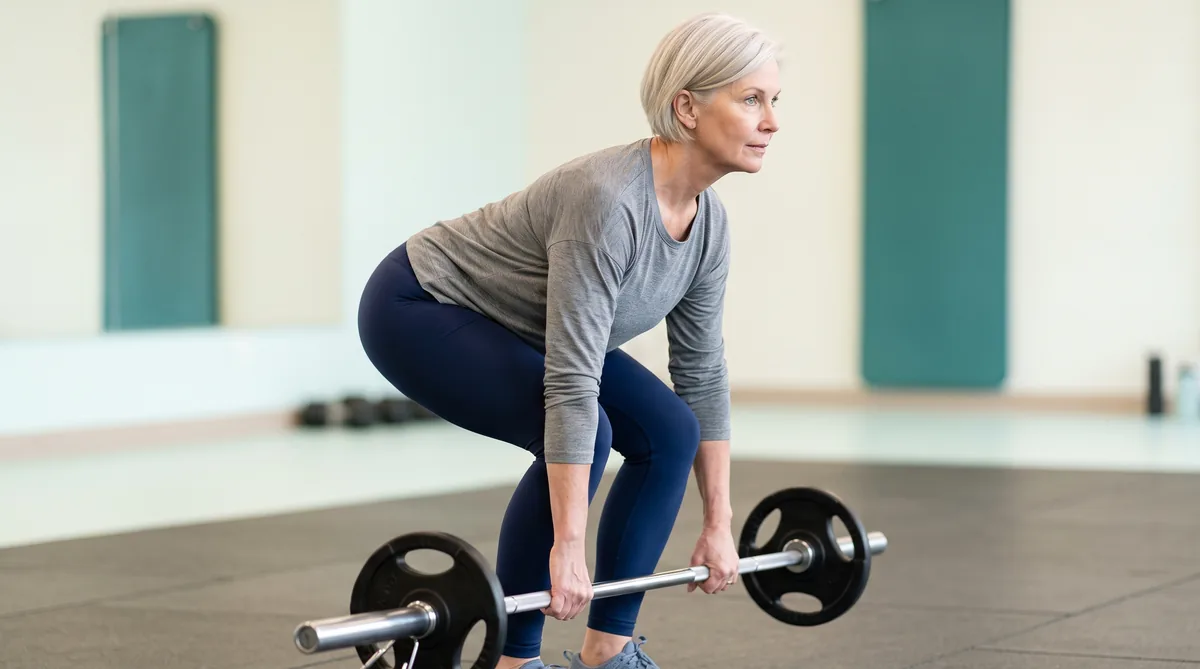
| Deadlift | Most likely lift to provoke leaks in powerlifters; the exercise most often associated with leaking in the 2025 review (42.5%) | Heaviest load most women lift, usually with a hard brace and breath-hold at the floor |
| Squat, especially heavy or deep | Most likely lift to provoke leaks in weightlifters; second in the 2025 review (36.3%) | High load plus the push out of the bottom position |
| Jumping moves (double-unders, rope, box jumps) | Top three leak triggers in a 2019 CrossFit study: 47.7%, 41.3% and 28.4% | Landing impact on top of pressure; covered in our guide to bladder leaks during exercise |
| Overhead press, thrusters | Moderate | Standing brace under load, often at the end of a tiring set |
| Bench press | Least likely lift to provoke leaks in powerlifters | Lying down, so less of the load bears down on the pelvic floor |
| Machines and seated or lying exercises | Lower | Supported positions reduce downward pressure |
The 2021 powerlifting study found the deadlift most likely and the bench press least likely to cause leaking, and the 2022 weightlifting study found the squat the most likely. The 2019 CrossFit study pointed at jumping. The 2025 review added that heavy loads, high repetitions and competition were all associated with leaking. In plain terms: heavy, standing, and tired is the risky combination.
The Finding That Should Keep You Lifting
This is the part of the research I most want you to hear, because it answers the fear directly: is lifting damaging my bladder?
In the 2021 study of 480 powerlifters, the severity of leaking rose with age, number of births, body mass index and how much weight a woman lifted in competition. It did not rise with the number of years she had been strength training or powerlifting. The 2022 study of 191 weightlifters found the same pattern even more plainly: severity tracked age and childbirth, and showed no correlation at all with years of resistance training or years of weightlifting, with a correlation coefficient of minus 0.01, essentially zero.
What that means for you: in these studies, the women who had lifted for ten years were not leaking worse than the women who had lifted for one. The leak reflected the body they brought to the gym, their age and their births, and the heaviness of the lift on the day, not an accumulating injury from the training itself.
One honest caveat. These are cross-sectional studies, meaning a single snapshot, and women who leaked badly may have quit lifting before anyone surveyed them. So they cannot prove lifting is harmless for every pelvic floor. What they do show is that there is no sign of a dose-response, where more years of lifting means more leaking, and that is what you would expect to see if lifting itself were the cause.
Now put that next to what lifting does for your skeleton. In the LIFTMOR randomized trial, published in 2018, 101 postmenopausal women with low bone mass, average age 65, were assigned either to supervised high-intensity resistance and impact training or to a gentle home program. The lifting group gained 2.9% in lumbar spine bone density while the home group lost 1.2%, improved on every measure of physical function, and had just one minor adverse event, a back spasm. The authors noted that this kind of training had traditionally been avoided in women with low bone mass out of fear of fracture, and found that fear unsupported under close supervision.
That is the trade you are actually making. Quitting the weights to avoid a leak gives up one of the few things proven to build bone after menopause, which we discuss in our guide to osteoporosis and bladder leaks. The leak is treatable. Bone loss is much harder to reverse.
Why It Shows Up After 40
If you lifted in your thirties without a problem and started leaking in your late forties or fifties, you are not imagining a change. Three things converge.
Age itself. Age was linked to leak severity in both the powerlifting and weightlifting studies, and to prevalence in the CrossFit meta-analysis. Muscle, including the pelvic floor, loses strength and speed with age unless it is specifically trained.
Estrogen. Falling estrogen through perimenopause and after menopause thins the tissue lining the urethra and reduces the cushioning that helps it seal, so the same pressure spike that you held back at 38 can get through at 52. Our guide to menopause and bladder health explains that shift, and it is worth asking your doctor whether vaginal estrogen is appropriate for you, because it acts on exactly that tissue.
Childbirth, delayed. Births were linked to severity in every lifting study here. Many women carry a pelvic floor that was stretched decades ago and compensated well until hormones and age removed the margin. If that sounds familiar, our guide to postpartum bladder leaks covers why effects can surface long after delivery.
What Actually Helps: The Evidence
The best-quality study here is a 2024 randomized controlled trial in the British Journal of Sports Medicine. Forty-seven women with stress leaks during functional fitness training, the CrossFit-style mix of lifting and jumping, were assigned either to 16 weeks of home pelvic floor training or to no training. The program was simple: three sets of 8 to 12 maximal pelvic floor contractions a day, with a weekly phone reminder. Women completed about 70% of the prescribed sessions, so not perfect adherence.
By 16 weeks, 64% of the training group reported their leaks had improved, against 8% of the control group, and the standard incontinence questionnaire score improved more in the training group. Interestingly, measured pelvic floor strength did not change significantly, which suggests the benefit came as much from timing and coordination, learning to contract at the right moment, as from raw strength.
Two other findings point the same way. In the 2021 powerlifting study, women who had had a pelvic floor examination, or who were confident they could do pelvic floor exercises correctly, had less severe leaking. And in the Norwegian championship study, 43% of the women did not know why to train the pelvic floor and 44% did not know how. The gap is knowledge, not willpower.
A caveat for our age group: the trial participants averaged 33 years old. There is no lifting-specific trial in women over 50. But pelvic floor muscle training is the first-line treatment for stress incontinence in women of every age, and nothing about the mechanism changes after menopause. Our pelvic floor exercise guide for women over 40 is the place to start.
A Leak-Free Lifting Plan
This is how I would approach it, in order. None of it requires you to stop training.
- Get your pelvic floor assessed. A pelvic floor physical therapist can tell in one visit whether your floor is weak, slow, or actually too tight. It matters, because a tight, guarding floor leaks too, and more squeezing makes it worse, which is the trap described in our guide to why Kegels are not working. Our guide to what to expect from pelvic floor therapy walks through the first appointment.
- Train the floor daily, off the bar. The trial program was three sets of 8 to 12 hard contractions a day. It takes a few minutes and can be done lying down.
- Use the Knack on every heavy rep. Tighten your pelvic floor a split second before the effort, the way you would brace before a sneeze, and hold it through the hardest part of the lift.
- Exhale through the effort on your working sets. Many pelvic floor therapists teach lifters to breathe out through the hardest part of the rep rather than holding the breath, to keep pressure from spiking. Very heavy maximal attempts may need a brief brace; work that out with a coach or therapist.
- Find your leak threshold. Note the heaviest weight you can lift dry for a given exercise. Train just under it, build reps and control there, and inch the weight up over weeks as the floor catches up.
- Adjust the risky lifts first. If deadlifts and heavy squats are the problem, reduce their load or volume temporarily and keep everything else. Supported and seated exercises let you keep training the same muscles with less downward pressure.
- Empty your bladder before you start, and do not dehydrate. Going to the bathroom right before training is sensible. Skipping water all morning is not: the 2022 weightlifting study specifically warned that training dehydrated, a common self-care strategy, can hurt performance, and concentrated urine irritates the bladder. Our guide to how much water to drink with an overactive bladder covers the balance.
- Deal with constipation. Straining on the toilet loads the same floor you are trying to protect, as our guide to constipation and bladder leaks explains.
- Use protection without shame. A liner or leak-proof underwear while you train is not giving up. It lets you keep lifting while the floor improves.
When to See a Doctor or Pelvic Floor Therapist
- A feeling of heaviness, dragging, or a bulge in the vagina, especially after lifting, which can signal pelvic organ prolapse and needs examination before you keep loading
- Leaking that is getting worse despite a few months of consistent pelvic floor training
- Leaking at rest, or leaking with urgency, not just with effort
- Pain with lifting, pain with urination, or visible blood in your urine
- A sudden change in bladder or bowel control together with new back pain, which needs prompt care
The NIDDK overview of bladder control problems is a good plain-language primer before an appointment, and our complete guide to bladder leaks lays out the full range of treatments, from pessaries to procedures, if training alone is not enough.
Editor’s Recommendation
A daily microbiome formula for women whose bladder trouble includes repeat infections, not just leaks under the bar.
A straight word on supplements. No capsule stops a leak that happens because abdominal pressure beats the pelvic floor during a deadlift. That is fixed by training the floor and adjusting the lift, full stop. Where supplements can fit is a separate pattern: if you also deal with urgency or recurrent urinary infections, which become more common after menopause, our honest ranking of bladder control supplements shows which products have evidence for which problem, and our FemiCore review explains the one we rate highest for the infection pattern.
Key Takeaways
- It is common. Leaking affects 41% to 49% of women powerlifters and 37% to 54% of weightlifters in a 2025 systematic review.
- Deadlifts and squats are the main triggers. The bench press is the least likely lift to cause leaks. Heavy, standing and tired is the risky combination.
- Years of lifting were not linked to worse leaking. Age and births were, and among powerlifters, the weight lifted in competition.
- Training the pelvic floor works. In a 2024 randomized trial, 64% of women improved with 16 weeks of home pelvic floor training versus 8% without it.
- Knowledge is the gap. Women who had a pelvic floor assessment or knew how to train it had less severe leaking.
- Do not quit. Supervised strength training raised spine bone density 2.9% in postmenopausal women with low bone mass in the LIFTMOR trial. Adjust the lift, treat the leak, keep the bone.
Frequently Asked Questions
Why do I pee a little when I lift heavy weights?
Heavy lifting raises the pressure inside your abdomen, especially if you hold your breath and brace, and that pressure pushes down on the bladder. If your pelvic floor does not contract fast or strongly enough to hold against it, a small amount of urine escapes. This is stress urinary incontinence. It is common in women who lift, affecting 41% to 49% of competitive powerlifters in a 2025 systematic review.
Is lifting weights bad for my pelvic floor?
The research does not show that. In studies of 480 competitive powerlifters and 191 weightlifters, the severity of leaking rose with age and childbirth, and among powerlifters with the weight lifted in competition, but not with the number of years a woman had been lifting. These were snapshot studies, so they cannot rule out harm for every woman, but they show no sign that more years of lifting means more leaking.
Which exercises cause the most bladder leaks in the gym?
The deadlift and the squat are the lifts most often linked to leaking, and jumping movements such as double-unders, jump rope and box jumps are the biggest triggers in CrossFit-style training. The bench press was the least likely lift to cause leaks in a study of 480 powerlifters, probably because lying down puts less downward pressure on the pelvic floor.
Should I stop lifting weights if I leak?
Usually not. Strength training is one of the best-proven ways to protect bone after menopause, and a randomized trial of postmenopausal women with low bone mass found supervised heavy training raised spine bone density by 2.9% while a gentle home program lost 1.2%. Train your pelvic floor, use the Knack, exhale through the effort and reduce the heaviest lifts temporarily. See a doctor first if you feel heaviness or a bulge in the vagina.
Do Kegels help with leaking during weightlifting?
Yes, for most women. In a 2024 randomized trial of women who leaked during functional fitness training, 64% of those who did 16 weeks of home pelvic floor training reported improvement, compared with 8% of women who did not. The program was three sets of 8 to 12 maximal contractions a day. If Kegels do not help after a few months, have your pelvic floor assessed, because some women leak from a floor that is too tight rather than too weak.
Why did I start leaking during workouts after 40?
Age, falling estrogen and earlier childbirth are the usual reasons. Age and number of births were both linked to leak severity in studies of women lifters. Lower estrogen around menopause thins the tissue that helps the urethra seal, so pressure spikes you once held back can get through. A pelvic floor that compensated for years after childbirth may lose that margin as hormones change.
The Bottom Line
Leaking when lifting weights feels like your body telling you to stop. The research says something different. It is common among women who lift at every level, it clusters in the heaviest standing lifts, and in the studies we have, it tracked age and childbirth rather than years under the bar. It also responds to a few minutes a day of pelvic floor training, to better timing and breathing, and to smarter loading of the two or three lifts that trigger it. Meanwhile, the weights are doing something for your bones that very little else can. Keep the bar. Fix the leak.
— Ellen Bennett

Ellen Bennett
Women’s Health Researcher. Compiles peer-reviewed evidence on bladder, urinary, and pelvic health, naming each study and source. About the author →
Research methodology. This article is a desk review of published research on urinary incontinence in women who lift weights, including a 2025 systematic review of 1,809 powerlifters and weightlifters, cross-sectional studies of 480 powerlifters, 191 weightlifters and 180 Norwegian national-level lifters, a 2023 meta-analysis of 4,823 CrossFit participants, a 2024 randomized controlled trial of pelvic floor training in 47 women, and the 2018 LIFTMOR randomized trial of strength training in 101 postmenopausal women. Every study named is linked and was checked against its abstract on the verification date below. Most lifting studies involve competitive athletes and younger women, and none tests pelvic floor training specifically in lifters over 50; those limits are stated in the text.
Medical disclaimer. This article is for information only and is not medical advice, diagnosis, or treatment. Talk to your doctor before starting heavy strength training if you have osteoporosis or a fracture history, and have any vaginal heaviness or bulge examined before continuing to lift. Dietary supplements are not intended to diagnose, treat, cure, or prevent any disease and do not strengthen the pelvic floor.
Last Reviewed: September 2026 — Last Updated: September 2026 — by Ellen Bennett, Women’s Health Researcher. Sources: International Urogynecology Journal, 2025 and 2023; Sports Medicine Open, 2021; Journal of Strength and Conditioning Research, 2022 (two studies); British Journal of Sports Medicine, 2024 (RCT); Neurourology and Urodynamics, 2019; Journal of Bone and Mineral Research, 2018 (LIFTMOR); NIDDK.