
Published on September 15, 2026 — by Ellen Bennett, Women’s Health Researcher
Medical & Affiliate Disclosure: This article is for educational purposes only and is not medical advice. Always talk to your doctor before starting a fasting protocol, and about any new or worsening urinary symptoms. Some links below are affiliate links; if you buy through them we may earn a commission at no extra cost to you. That does not change what we write.
Independent women’s health research · Written and fact-checked by Ellen Bennett, Women’s Health Researcher · Last verified: September 2026
You started fasting for the hot flashes, or the middle-age weight that stopped responding to everything else. Two weeks in, something else changed that nobody warned you about: you are in the bathroom constantly. Not a little more. Noticeably more, and often at four in the morning.
Search for it and you will find thousands of articles about intermittent fasting and bladder control that talk about hormones, autophagy and insulin sensitivity, and not one that mentions urine. That gap is strange, because the mechanism is well documented in kidney physiology and has been for fifty years. It just never made the leap into the language women actually read. So let me explain what is happening in your body, why the timing follows a predictable pattern, and what you can change without abandoning a protocol that may be working for you otherwise.
Quick Answer: Intermittent fasting and bladder control are connected through your kidneys, not your bladder. When you stop eating, insulin falls, and insulin is one of the hormones that tells the kidney to hold on to sodium. With insulin low, sodium leaves in your urine and water follows it. Physiologists have called this the natriuresis of fasting since the 1970s, and a 2020 review in Frontiers in Endocrinology re-examined the mechanism directly. Three things stack on top of it: black coffee in the fasting window, an eating window that compresses your fluid intake into eight hours, and the electrolytes you lose along the way. Most of it settles within two to four weeks.
Why Does Fasting Make You Pee More?
The definition worth knowing: natriuresis means sodium leaving the body in urine. Where sodium goes, water follows, because your kidneys move water by moving salt. Fasting reliably triggers it, which is why the effect has a name of its own.
Here is the chain, in order. You eat, your blood sugar rises, your pancreas releases insulin. Insulin does the famous job of moving glucose into cells, but it has a second, quieter job in the kidney: it signals the distal tubules to reabsorb sodium instead of letting it go. That is why a salty meal plus insulin equals fluid retention and the ring that suddenly feels tight.
Now run it backwards. You stop eating for sixteen hours. Insulin drops to baseline and stays there. The signal to hold sodium goes quiet, the kidney stops reabsorbing it, and sodium heads for the bladder with water attached. You are not drinking more. You are excreting more, and the volume shows up in your bladder on a schedule you did not choose.
The 2020 review in Frontiers in Endocrinology is worth naming because it treats this as the open question it actually is. The authors call fasting-induced natriuresis “an old enigma” and propose that sodium-glucose co-transport in the proximal tubule explains part of it: when less glucose is being filtered and reabsorbed, less sodium rides along with it. They also list what else is in play, including glucagon, ketone levels, atrial natriuretic peptide and the renin-angiotensin-aldosterone system. The honest summary is that the effect is not disputed and the exact split between mechanisms still is.
| What changes when you fast | Effect on urine | When you notice it |
|---|---|---|
| Insulin falls to baseline | Sodium and water excretion rise | Days 2 to 10, strongest early |
| Glycogen stores are used | Each gram of glycogen releases about 3g of stored water | First week |
| Black coffee in the fasting window | Caffeine on an empty stomach, mild diuretic plus bladder irritant | Every fasting morning |
| Fluid intake compressed into the eating window | Large volumes in a short period, then a long dry stretch | Ongoing until you fix the timing |
| Sodium, potassium and magnesium leave with the water | Fatigue, cramps, and a thirst that keeps returning | Week 2 onward if not replaced |
Why the First Two Weeks Are the Worst
There is a second source of water in the early days, separate from the sodium story, and it explains why the effect is front-loaded. Your body stores carbohydrate as glycogen, and glycogen is stored wet: roughly three grams of water bound to every gram of it. When you start fasting, you draw those stores down, and the water that was holding them together has to leave. That is most of the dramatic weight drop people report in week one, and it is also why the bathroom trips are worst at the start and then ease off.
This is the part I wish someone had put plainly to me. In my late forties I tried a 16:8 window for the same reasons everyone else does, and I stopped after eleven days because I assumed my bladder had taken a turn for the worse. It had not. I had confused a predictable fluid shift with a new symptom, and if I had understood the timeline I would have simply waited it out and fixed my electrolytes. Knowing the shape of the curve is most of the battle here: sharp at the start, flattening over two to four weeks, and then a new normal that for most women sits close to where they began.

Black Coffee Is Not a Neutral Choice Here
Almost every fasting protocol permits black coffee, and almost every woman who fasts takes that permission. It is worth understanding what you are agreeing to. Caffeine has a mild diuretic effect, but that is the smaller half of the problem. Caffeine is also a direct bladder irritant, meaning it increases the urgency signal at a given volume rather than simply increasing volume. You do not just have more urine. You feel a stronger need to deal with less of it.
Drinking it on an empty stomach concentrates that effect. There is no food slowing absorption, so the peak is faster and higher than the same cup with breakfast. Stack it on top of fasting natriuresis and you get the classic pattern: two cups of black coffee between 7am and 10am, then a morning spent noticing your bladder. Our detailed breakdown of how caffeine affects bladder leaks covers the dose thresholds, and the practical fix here is unglamorous. Halve the amount, move it later in the fasting window rather than first thing, or switch one of the cups to something without caffeine. Most women find one of those three enough.
Your Hydration Window Just Got Shorter Too
This one is structural and it catches people who are otherwise doing everything right. If you eat between noon and 8pm, you are not only compressing your food. Most people drink around meals, so you have quietly compressed your fluid intake into the same eight hours, and then you drink very little for the other sixteen.
That produces two problems at opposite ends of the day. In the evening you are taking in a large volume in a short period, which the kidneys process on their own schedule, often at two or three in the morning. In the fasting stretch you drift toward mild dehydration, and concentrated urine is more irritating to the bladder lining, so the urgency you feel is disproportionate to the volume you are holding. Drinking less does not help; it is the mistake we cover in how much water to drink with an overactive bladder, and it reliably backfires.
The fix is timing rather than quantity. Spread water evenly across the fasting hours, because plain water does not break a fast under any mainstream protocol. Then front-load the eating window instead of back-loading it, and taper fluids in the last two to three hours before bed. If night waking is your main complaint, that single change tends to do more than anything else, and our guide to why women wake at night to urinate goes through the rest of the evening routine.
What Changes If You Are Over 40
Everything above applies to any adult. Two things make it land harder for women in perimenopause and after, and they are worth separating so you can tell which one you are dealing with.
The first is tissue. Falling estrogen thins and dries the tissue of the urethra and bladder neck, which lowers the threshold at which a given volume registers as urgent. The extra fluid load from fasting is the same in a 35-year-old and a 55-year-old; the sensitivity it lands on is not. If you are already noticing urgency that arrived alongside other menopause symptoms, fasting will amplify what is there rather than create something new, and how menopause changes bladder health covers what else is moving at the same time.
The second is a benefit worth stating fairly, because it cuts the other way. Weight loss genuinely reduces stress incontinence, and the effect is well established rather than marginal. If fasting is working for you as a weight approach, it may improve your leaking over months even while it makes you urinate more frequently in the first weeks. Those two things are not contradictory, and we set out the evidence in whether losing weight helps bladder leaks. Judge the protocol at three months, not at day nine.
How to Keep Fasting Without the Bathroom Problem
In order of how much difference each one makes:
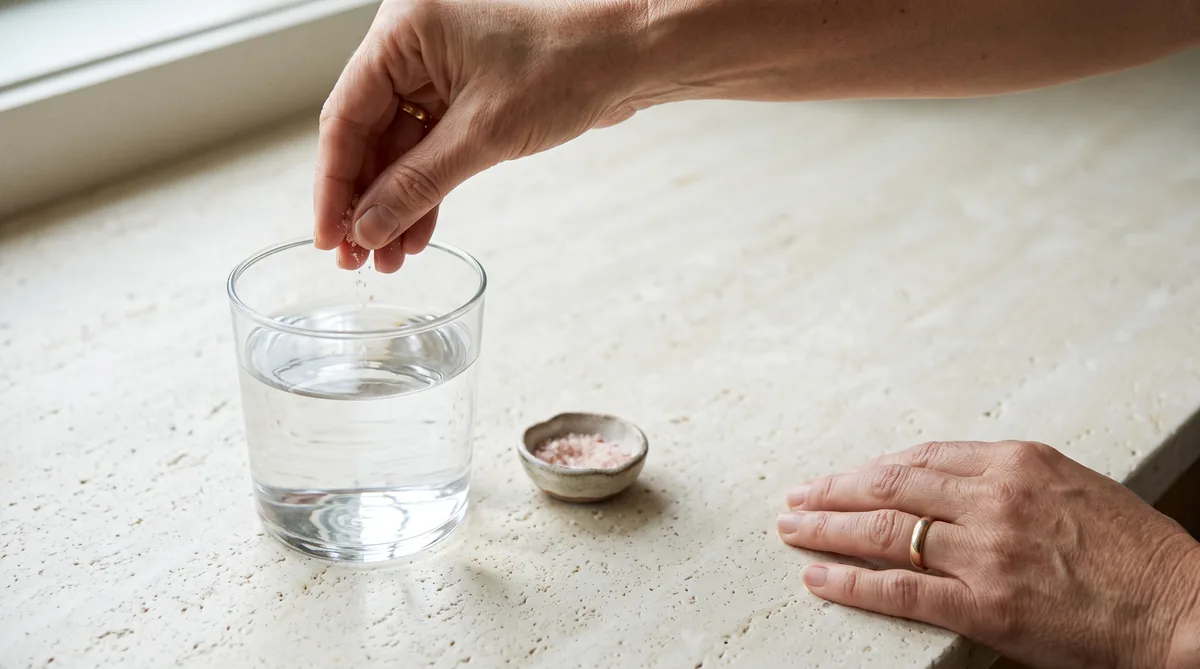
- Replace the electrolytes you are excreting. This is the step people skip and the one that changes the most. You are losing sodium by design, and potassium and magnesium with it. A pinch of good salt in your water during the fasting window is not cheating and does not raise insulin.
- Move your coffee, or halve it. Not first thing on an empty stomach. Later in the window, with less caffeine, or with one cup swapped out.
- Spread water across the fasting hours. Same total, different distribution. Plain water breaks nothing.
- Front-load the eating window. Eat and drink more of your intake earlier, taper in the last two to three hours before bed.
- Widen the window before you quit. If 16:8 is too sharp, 14:10 keeps most of the metabolic benefit with a gentler fluid shift.
- Give it four weeks before judging. The glycogen water is a one-time cost. The sodium effect softens as your body adjusts.
Editor’s Recommendation
A daily formula for women whose bladder issues go beyond a passing fluid shift.
A straight word on where supplements fit, because I would rather be useful than sell you something that does not apply. If your frequency arrived with your fasting protocol and follows the timeline above, this is a fluid and electrolyte problem and no capsule addresses it. Fix the salt and the timing. Supplements become relevant only if you also have the underlying urgency or recurrent infection picture that was there before you ever skipped breakfast, and our honest ranking of bladder control supplements is clear about which ingredients have evidence behind them and which are marketing. Sort the mechanism first.
When It Is Not the Fasting
The pattern described here has a shape: it begins within days of starting, it is worst early, and it eases. If what you are experiencing does not match that shape, do not file it under fasting. Talk to your doctor if you notice any of the following.
- Burning, cloudy or strong-smelling urine, or any visible blood
- Frequency with unusual thirst that water does not settle, which needs a blood sugar check rather than a diet tweak
- Symptoms that started weeks after your protocol did, not days
- Frequency that keeps getting worse past the four-week mark instead of easing
- Leaking rather than frequency, which is a different problem with different fixes
- Dizziness on standing, which can mean you have taken the fluid loss further than intended
The National Institute of Diabetes and Digestive and Kidney Diseases has a plain-language overview of bladder control problems that is a reasonable place to start if you are unsure which category you are in. And if the urgency was there before the fasting, the fasting is an amplifier, not the cause. That distinction changes what you should do about it.
Key Takeaways
- The mechanism is your kidney, not your bladder. Insulin falls, sodium stops being reabsorbed, water follows it out. Physiologists named it the natriuresis of fasting decades ago.
- Week one is not the baseline. Glycogen is stored with roughly three times its weight in water, and that water leaves once, at the start.
- Black coffee on an empty stomach is doing real work. Caffeine is a bladder irritant as well as a mild diuretic, and fasting removes the food that would have slowed it down.
- You compressed your fluids, not just your food. Evening loading causes night waking; the dry fasting stretch concentrates urine and raises urgency.
- Electrolytes are the highest-value fix. You are excreting sodium by design. Replacing it does not break a fast.
- Judge it at four weeks. And be fair to fasting: if it is helping you lose weight, that reduces stress incontinence over months, in the opposite direction.
Frequently Asked Questions
Does intermittent fasting make you pee more?
Yes, especially in the first two weeks, and the reason is hormonal rather than behavioral. When insulin falls during a fast, your kidneys stop reabsorbing sodium, and water leaves with it. This is a documented effect known as the natriuresis of fasting. Depleting glycogen stores releases additional stored water early on, and black coffee in the fasting window adds a mild diuretic effect on top.
Will the frequency go away if I keep fasting?
For most women it eases substantially within two to four weeks. The glycogen water is released once and does not come back. The sodium effect softens as your body adjusts to lower baseline insulin. What does not resolve on its own is the part caused by timing, meaning the compressed fluid window and the coffee, so those need changing rather than waiting out.
Can I drink water during my fasting window?
Yes. Plain water does not break a fast under any mainstream protocol and does not raise insulin. Drinking less to reduce bathroom trips is counterproductive, because concentrated urine irritates the bladder lining and increases urgency at lower volumes. Spread the same total intake more evenly instead of reducing it.
Should I add salt to my water while fasting?
A pinch of salt in water during the fasting window is a common approach because you are actively excreting sodium, and it does not raise insulin or break a fast. It is not right for everyone. If you have high blood pressure, kidney disease, heart failure, or take medication that affects sodium or potassium, ask your doctor or pharmacist first rather than treating it as a harmless habit.
Why am I waking up at night to urinate since I started fasting?
Usually because your eating window is back-loaded. If you eat and drink between 4pm and 8pm, you are taking in a large volume late and your kidneys process it while you sleep. Moving more of your intake earlier in the window and tapering fluids two to three hours before bed addresses this directly, and it is generally more effective than reducing your total intake.
Is intermittent fasting bad for your bladder?
There is no evidence that fasting harms the bladder itself. The frequency it causes reflects fluid handling by the kidneys, which is a normal physiological response rather than damage. Fasting can amplify existing urgency, particularly where menopause has already thinned urethral tissue. Weight loss, meanwhile, is one of the better-established ways to reduce stress incontinence, so the longer-term effect may run the other way.
The Bottom Line
If you started fasting and your bladder got loud, you are not imagining it and you have not broken something. You changed a hormone that controls how your kidneys handle salt, and salt is how your body moves water. The effect is real, it is documented, it is front-loaded, and it responds to three unremarkable adjustments: put the electrolytes back, move the coffee, and spread your fluids across the whole day instead of a third of it. Give it four weeks before you decide whether fasting suits you, and judge the leaking separately from the frequency. They are different problems, and only one of them is about your eating window.
— Ellen Bennett

Ellen Bennett
Women’s Health Researcher. Compiles peer-reviewed evidence on bladder, urinary, and pelvic health, naming each study and source. About the author →
Research methodology. This article is a desk review of published renal physiology on fasting-induced sodium and water excretion, alongside consumer guidance on bladder irritants and fluid timing. Every study named is linked and was opened and checked on the verification date below. The precise mechanism of fasting natriuresis remains an open question in the literature, with several pathways proposed rather than one settled answer, and that uncertainty is stated in the text rather than smoothed over.
Medical disclaimer. This article is for information only and is not medical advice, diagnosis, or treatment. Do not start a fasting protocol, change medication, or add sodium to your intake based on anything you read here, particularly if you have diabetes, high blood pressure, kidney disease, or a history of disordered eating. Dietary supplements are not intended to diagnose, treat, cure, or prevent any disease. Burning, fever, or visible blood in your urine needs prompt medical care.
Last Reviewed: September 2026 — Last Updated: September 2026 — by Ellen Bennett, Women’s Health Researcher. Sources: PMC, Fasting-Induced Natriuresis and SGLT: A New Hypothesis for an Old Enigma, Frontiers in Endocrinology 2020; NIH/NIDDK, Bladder Control Problems; Urology Care Foundation; Mayo Clinic.