
Published on November 11, 2026 — by Ellen Bennett, Women’s Health Researcher
Medical & Affiliate Disclosure: This article is for educational purposes only and is not medical advice. New urgency, blood in the urine, pain or fever need a medical evaluation before trying any complementary therapy. Some links are affiliate links; if you buy through them we may earn a commission at no extra cost to you.
Independent women’s health research · Written and fact-checked by Ellen Bennett, Women’s Health Researcher · Last verified: November 2026
You have cut the coffee, timed your bathroom trips, maybe tried a prescription that left your mouth dry as paper. The urgency is still there. So when a friend says acupuncture calmed her bladder down, it is tempting, but you also wonder whether it is real or just a relaxing hour on a table.
I looked at the trials on acupuncture for overactive bladder, including the ones with fake (sham) needles that tell you whether the effect is more than expectation. The answer is more interesting than yes or no, and it includes a needle-based treatment your urologist can offer that most people have never heard of.
Quick Answer: Acupuncture for overactive bladder shows real but modest benefits. In a 2005 trial of 85 women, four weekly sessions reduced urinary frequency by 14% and urgent trips by 30% compared with sham needles. Is there a stronger option? Yes: percutaneous tibial nerve stimulation, an acupuncture-like treatment at the ankle, helped 54.5% of patients vs 20.9% with sham in a 2010 trial of 220 adults, and it is part of the AUA guideline.
Editor’s Recommendation
Calming the bladder’s nerves is one side of urgency. If repeat UTIs or bladder irritation are part of your picture, support your urinary microbiome too: FemiCore pairs standardized cranberry with five named Lactobacillus strains in one daily capsule, with a 60-day money-back guarantee.
Does Acupuncture for Overactive Bladder Work?
Overactive bladder means a sudden, hard-to-delay urge to pee, often with frequent trips and sometimes leaks. It is a problem of signals: the bladder muscle and the nerves around it fire too early. That is why a nerve-focused treatment like acupuncture is at least plausible.
The most careful trial in women was published in Obstetrics & Gynecology in 2005. It randomized 85 women to four weekly sessions of bladder-specific acupuncture or to placebo acupuncture at points not linked to the bladder.
| Outcome after 4 weekly sessions | Real acupuncture | Placebo acupuncture |
|---|---|---|
| Leak episodes | Down 59% | Down 40% (difference not significant) |
| Urinary frequency | Down 14% | Significantly smaller improvement |
| Trips with urgency | Down 30% | Significantly smaller improvement |
| Bladder capacity | Up 13% | Significantly smaller improvement |
| Quality-of-life scores | Improved 54% | Improved 30% |
Two things stand out. First, both groups leaked less, which shows how strong the placebo effect is with bladder symptoms, and why trials without a sham group can mislead. Second, the real acupuncture group did better on the measures that define overactive bladder: frequency, urgency and how much the bladder could hold. That is a genuine, if modest, effect.
Electroacupuncture: The Newer Research
Most recent trials come from China and test electroacupuncture, where a mild current runs through needles placed near the sacrum and the inner ankle. A 2025 randomized trial in women with overactive bladder compared it with standard medication. The electroacupuncture group had a higher overall response rate (88.6% vs 48.5%), but the two groups did not differ significantly on the main symptom score. The authors call it promising and want larger studies, which is a fair summary of the whole field.
The Acupuncture-Like Treatment Your Urologist Offers
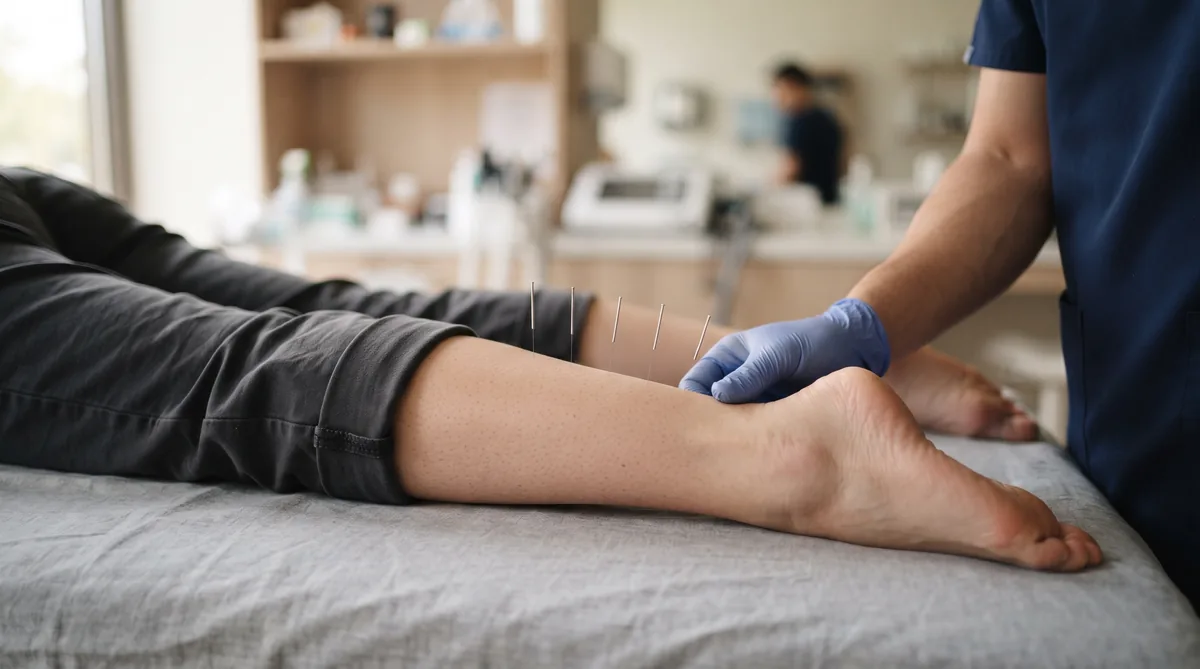
Here is the part most acupuncture articles miss. One of the points used in bladder acupuncture sits above the inner ankle, right over the tibial nerve, which shares nerve roots with the bladder. Urologists built a treatment on exactly that spot: percutaneous tibial nerve stimulation (PTNS).
A thin needle is placed near the ankle and connected to a small stimulator for 30 minutes, once a week for 12 weeks, then less often to maintain the result. In the SUmiT trial published in 2010, 220 adults with overactive bladder received PTNS or a sham. At 13 weeks, 54.5% of the PTNS group reported moderate or marked improvement vs 20.9% with sham.
The AUA overactive bladder guideline includes PTNS among its treatment options, so it is offered in urology offices and is often covered by insurance when other treatments have not worked.
Editor’s Recommendation
Many women add a daily urinary-microbiome formula alongside lifestyle changes. FemiCore pairs standardized cranberry with five Lactobacillus strains, and it comes with a 60-day money-back guarantee.
Acupuncture vs PTNS vs Medication
| Option | Best evidence | Typical schedule | Things to know |
|---|---|---|---|
| Traditional acupuncture | Sham-controlled trial in 85 women (2005): less frequency and urgency | Weekly for about 4 weeks, then as needed | Usually paid out of pocket; choose a licensed acupuncturist |
| Electroacupuncture | Small trials, mostly from China | Several sessions a week in trials | Promising, less available in the US |
| PTNS | Sham-controlled trial in 220 adults (2010): 54.5% vs 20.9% improved | Weekly for 12 weeks, then maintenance | Done in urology offices; often covered by insurance |
| Bladder medication | Many large trials | Daily pills | Side effects such as dry mouth; see mirabegron vs oxybutynin |
If you are concerned about older bladder drugs and memory, I cover that research in oxybutynin and dementia. Acupuncture and PTNS are attractive precisely because they avoid those systemic side effects.
How to Try Acupuncture for Overactive Bladder
- Rule out other causes first. A urine test checks for infection, and your doctor can check for things like incomplete emptying or diabetes.
- Find a licensed practitioner. Look for an L.Ac. credential or a physician trained in acupuncture. The NIH’s NCCIH notes that acupuncture is generally safe when done by a qualified practitioner using sterile needles.
- Ask for a bladder-focused plan similar to the trial: about four weekly sessions to start.
- Keep a three-day bladder diary before and after, counting trips, urgent trips and leaks.
- Keep the basics going. A bladder training schedule and cutting irritants like caffeine work alongside any needle therapy.
- No change after four to six sessions? Ask your urologist about PTNS.
Support the bladder from the inside, too
FemiCore combines cranberry standardized to 30% PACs with L. crispatus and four more Lactobacillus strains to support a healthy urinary microbiome while you work on the urgency. One-time purchase, no autoship.
Where Supplements Fit, Honestly
Acupuncture and PTNS work on nerve signaling. They do nothing about the other common driver of urgency in women over 50: an irritated bladder lining and a urinary microbiome that has shifted after menopause, antibiotics or repeat infections. Many women with “overactive bladder” also have a history of UTIs, and the urgency often started or worsened around them.
That is the gap a daily formula like FemiCore is designed to cover. It pairs cranberry standardized to 30% PACs, which helps keep E. coli from clinging to the bladder wall, with five named Lactobacillus strains, including L. crispatus, to support the protective bacteria that thin after menopause. I explain why that matters for bladder symptoms in probiotics for bladder control.
To be clear about roles: FemiCore is not a treatment for overactive bladder, and it does not replace acupuncture, PTNS or medication. It supports urinary comfort and the microbiome alongside them. Other supplements studied for urgency include pumpkin seed extract and magnesium. My full FemiCore review has the details on price and guarantee. Cranberry itself has been tested for urgency too, as I explain in cranberry for overactive bladder.
Who Should Be Careful
- Blood thinners or bleeding disorders: bruising is more likely; tell your practitioner.
- Pacemaker or implanted defibrillator: ask before electroacupuncture or PTNS, which use electrical current.
- Pregnancy: some points are avoided; tell your practitioner.
- Red flags: blood in the urine, pain, fever or sudden inability to pee need a doctor, not needles.
Key Takeaways
- Acupuncture for overactive bladder helps modestly: 14% less frequency and 30% fewer urgent trips vs sham in a 2005 trial of 85 women.
- Placebo effects are strong with bladder symptoms, so trust sham-controlled studies.
- PTNS is the evidence-backed cousin: 54.5% vs 20.9% improved in a 220-person trial, and it is in the AUA guideline.
- Give it four to six weekly sessions and track results in a bladder diary.
- Keep bladder training and irritant control going alongside any needle therapy.
- Urgency with repeat UTIs also calls for urinary microbiome support.
FemiCore: daily urinary microbiome support
Standardized cranberry + five Lactobacillus strains · 60-day money-back guarantee · one-time purchase, no autoship
Frequently Asked Questions
Does acupuncture help overactive bladder?
It appears to help modestly. In a 2005 sham-controlled trial of 85 women, four weekly sessions reduced urinary frequency by 14%, urgent trips by 30% and increased bladder capacity by 13% compared with placebo acupuncture. Leak episodes fell in both groups.
How many acupuncture sessions does it take for bladder symptoms?
The main US trial used four weekly sessions. Percutaneous tibial nerve stimulation, a related treatment, uses 12 weekly sessions followed by maintenance. Give acupuncture four to six sessions and track changes in a bladder diary.
What is percutaneous tibial nerve stimulation?
PTNS is a treatment for overactive bladder in which a thin needle near the inner ankle stimulates the tibial nerve, which shares nerve roots with the bladder. In a 2010 trial of 220 adults, 54.5% improved vs 20.9% with sham, and it is included in the AUA guideline.
Which acupuncture points are used for the bladder?
Trials have used points on the lower back near the sacrum and on the lower leg, including a point above the inner ankle over the tibial nerve. A licensed acupuncturist chooses points based on your symptoms.
Is acupuncture covered by insurance for bladder problems?
Coverage for acupuncture varies and is often limited. PTNS, done in urology offices, is more often covered when other treatments have not worked. Check with your plan before starting.
Is acupuncture safe for older women?
The NIH’s NCCIH says acupuncture is generally safe when performed by a qualified practitioner using sterile needles. Tell your practitioner if you take blood thinners or have a pacemaker, and see a doctor first for any new or severe urinary symptoms.
The Bottom Line
Acupuncture for overactive bladder is not a cure, but it is more than a placebo. The best US trial found real reductions in frequency and urgency after just four sessions, and its medical cousin, PTNS, has strong enough evidence to sit in the urology guidelines. If pills have not suited you, both are worth a conversation. Keep bladder training going, track your symptoms honestly, and if urgency travels with repeat UTIs, add daily support for your urinary microbiome so you are working on the bladder from both sides.
— Ellen Bennett

Ellen Bennett
Women’s Health Researcher. Compiles peer-reviewed evidence on bladder, urinary, and pelvic health, naming each study and source. About the author →
Further reading: the key-in-the-door urge to pee, yoga for bladder leaks over 50 and stress vs urge incontinence.
Research methodology. This article is based on a 2005 sham-controlled trial of acupuncture in women with overactive bladder (Obstetrics & Gynecology), the 2010 SUmiT trial of percutaneous tibial nerve stimulation (Journal of Urology), a 2025 randomized trial of electroacupuncture (Frontiers in Medicine), the AUA overactive bladder guideline, and NCCIH guidance on acupuncture. Each figure was checked against the original abstract. We did not purchase or test FemiCore.
Medical disclaimer. This article is for information only and is not medical advice, diagnosis, or treatment. Dietary supplements are not intended to diagnose, treat, cure, or prevent any disease. Blood in the urine, fever, pain or inability to urinate need prompt medical care.
Last Reviewed: November 2026 by Ellen Bennett, Women’s Health Researcher. Sources: Obstetrics & Gynecology (2005); Journal of Urology (2010); Frontiers in Medicine (2025); American Urological Association; NCCIH.