

Published on October 6, 2026 — by Ellen Bennett, Women’s Health Researcher
Medical & Affiliate Disclosure: This article is for educational purposes only and is not medical advice. Always talk to your doctor about new or worsening bladder symptoms. Some links are affiliate links; if you buy through them we may earn a commission at no extra cost to you.
Independent women’s health research · Written and fact-checked by Ellen Bennett, Women’s Health Researcher · Last verified: October 2026
You were fine in the car. You were fine walking up the driveway. Then the key goes into the lock and suddenly it is an emergency, the kind where you drop the grocery bags in the hallway and hope you make it. Sometimes you do not.
If that sounds familiar, you are not imagining the timing, and you are not alone. The key in the door urge to pee is common enough to have several names (latchkey incontinence, key-in-the-lock syndrome) and specific enough that researchers can now reproduce it in a lab with nothing more than a photograph of your front door. That last part is the good news, because it means the trigger is learned, and what is learned can be retrained.
Quick Answer: The key in the door urge to pee is a form of urge incontinence triggered by a learned cue rather than a full bladder. Why does it happen? Years of going to the bathroom right after arriving home teach your brain to link the door with emptying, and the signal fires early. Situational triggers like this account for up to half of urge leaks in women, according to a 2025 University of Pittsburgh study, and running water was the cue that most clearly separated women with bothersome urgency in a 2024 study. Behavioral retraining is the first-line fix.
Urgency that came with menopause or repeat UTIs?
FemiCore supports the urinary microbiome with standardized cranberry and five named Lactobacillus strains, one capsule a day. 60-day money-back guarantee.
What Is Latchkey Incontinence?
Latchkey incontinence is a sudden, hard-to-postpone urge to urinate, sometimes with leakage, set off by a specific situation rather than by how much is actually in your bladder. The front door is the classic trigger. Others are just as common:
- Hearing or touching running water: washing dishes, rinsing vegetables, the shower
- Pulling into the driveway or garage
- Seeing a bathroom door, or walking past one
- Getting out of the car after a drive
- Cold air or cold water on your hands
- Undressing for a shower
Doctors usually file it under urge incontinence, the type of leak that comes from a bladder muscle contracting before you are ready, as opposed to stress incontinence, where pressure from a cough, sneeze or lift pushes urine past a pelvic floor that is not holding. If you are not sure which you have, our guide to stress vs urge incontinence sorts it out in a few minutes. Plenty of women have both, which is called mixed incontinence.
Why the Front Door Sets Off Your Bladder
Your bladder does not empty on its own schedule. The brain decides when it is safe to let go, and part of that decision is based on habit. Think about the last few thousand times you came home: keys, door, bag down, bathroom. Over years, the brain learns that “front door” reliably predicts “toilet in about thirty seconds,” and it starts getting the bladder ready early.
Most of the time that is harmless. But if the bladder muscle is already a bit overactive, or the pelvic floor has weakened with age and menopause, that early “get ready” signal turns into an urgent, sometimes uncontrollable contraction. The cue has become stronger than your ability to hold.
That is not a theory pulled from thin air. Researchers have now watched it happen.
What the research has actually shown
The trigger can be reproduced in a lab. In a 2020 study in Neurourology and Urodynamics, researchers asked women with situational urge incontinence to photograph their own trigger situations, then showed them the pictures during bladder testing. Looking at the personal trigger photos changed bladder sensation in the lab, and even a standardized set of trigger images changed sensation in 7 of 12 participants.
The brain reacts differently to the trigger. A 2022 brain imaging study of 23 women put them in an MRI scanner and showed them their personal “urgency trigger” photos and their “safe” photos. Trigger images lit up the brain’s attention and decision-making areas, along with regions involved in bladder control. In plain terms: your brain pays sharp attention to that front door.
It may be its own type of overactive bladder. A 2024 study from Virginia Commonwealth University surveyed women with an average age of 60 about how strongly different situations triggered urgency. Women with highly bothersome urgency scored higher on 11 of 37 cues, including running water, cold weather, arriving home and worry. On the short-form survey, only one cue cleanly separated the groups: running water, reported by 33.3% of the high-bother women and none of the low-bother women. The authors suggested a “cue-responsive” overactive bladder phenotype. The study was small, 36 women, so treat it as a strong hint rather than a final answer.
It accounts for a lot of leaks. A 2025 University of Pittsburgh pilot study of 58 women aged 40 and over notes that situational triggers account for up to half of all urge leak episodes in women. That is a big share of the problem to hand to something as specific as a front door.
Why It Gets Worse After 40
Most women do not develop latchkey urgency in their twenties, even though they have been coming home and heading to the bathroom for decades. Several things change in the forties and fifties that turn a harmless habit into a problem:
- Falling estrogen. The bladder, urethra and vaginal tissue are estrogen-sensitive. Thinner, drier tissue after menopause can make the bladder more irritable and the urethra less able to seal. I go into this in menopause and bladder health.
- A weaker pelvic floor. The muscles that clamp the urethra shut lose strength with age, childbirth history and hormonal change, so there is less margin when the urge hits.
- More urgency overall. Overactive bladder becomes more common with age, and a bladder that is already twitchy reacts more to any cue.
- Longer habit. Simply put, the link between “home” and “bathroom” has had more years to strengthen.
For me it was the garage. In my late forties I noticed that the drive home was fine, but the sound of the garage door opening started the countdown. I could sit in a meeting for two hours without thinking about my bladder, then barely make it from the car to the hallway bathroom. It took me an embarrassingly long time to realize the garage door was doing more than my bladder volume was.

Is It Latchkey Urgency or Something Else?
A sudden urge at the door is usually a learned cue. But not always, and a few patterns mean you should see a doctor rather than retrain at home.
| What you notice | Most likely | What to do |
|---|---|---|
| Urgency only at predictable moments (door, water, car), fine the rest of the time | Situational urge (latchkey) | Behavioral retraining, below |
| Urgency all day, frequent small trips, waking at night | Overactive bladder | Retraining plus a doctor visit; see our nocturia guide |
| Burning, cloudy or smelly urine, or new urgency over a few days | Possible urinary tract infection | See a doctor for a urine test before anything else |
| Leaks when you cough, sneeze, laugh or lift | Stress incontinence (may be mixed) | Pelvic floor training |
| Strong urge but little comes out | Several possible causes | See urge to pee but nothing comes out |
| Urgency with new numbness, weakness, back pain, or blood in the urine | Needs medical assessment | See a doctor promptly |
The Doorstep Drill: How to Retrain the Trigger
The treatment with the best track record for urge leaks is not a pill. In a landmark 1998 randomized trial in JAMA, 197 women aged 55 to 92 with urge or urge-predominant incontinence received either behavioral training, the prescription drug oxybutynin, or a placebo for 8 weeks. Behavioral training cut leak episodes by 80.7% on average, compared with 68.5% for the drug and 39.4% for placebo. Only 14% of the behavioral group wanted to switch treatments, against 75.5% in the other groups.
A key part of that training is called urge suppression: instead of rushing to the toilet when the urge hits, you stop, calm the bladder down, and then walk. Here is how to apply it to the front door.
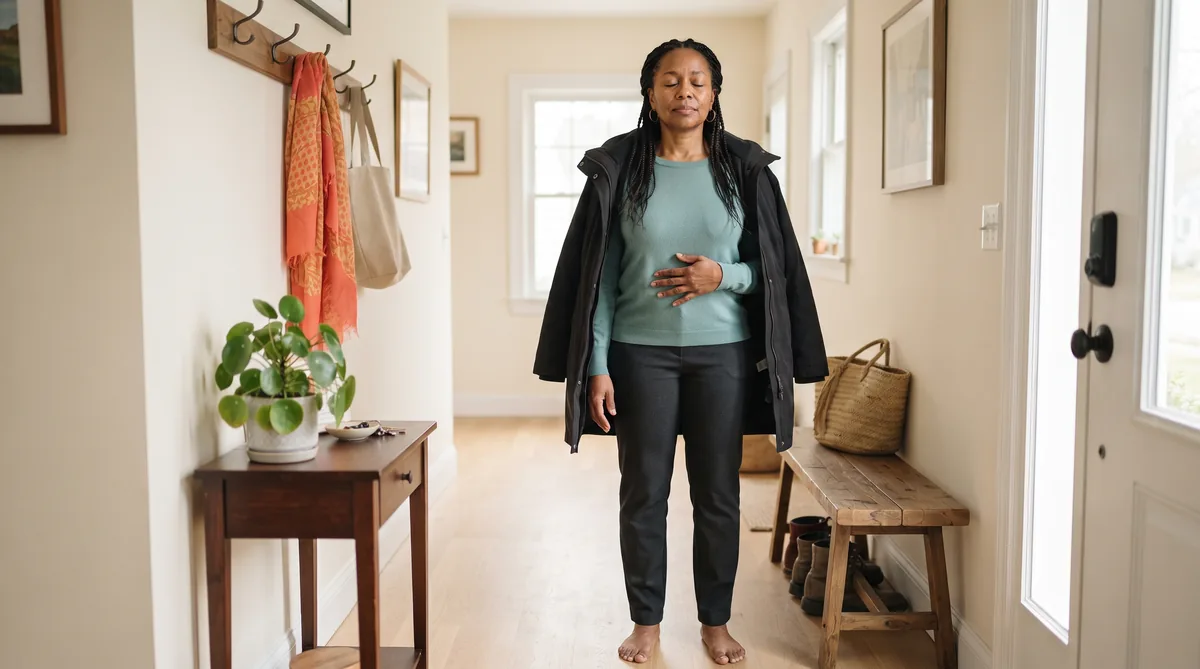
- Stop. Do not rush. When the urge hits at the door, stand still, or sit on the nearest chair or step. Rushing jostles the bladder and raises the panic that makes the urge stronger.
- Squeeze quickly, several times. Do five or six quick, firm pelvic floor contractions, the same muscles you use to stop the flow of urine. Quick squeezes can signal the bladder muscle to relax. If you are not sure you are using the right muscles, our guide to pelvic floor exercises for women over 40 walks you through it.
- Breathe and distract. Slow breaths, and give your brain something else to do: count backward from 100 by sevens, or list five things you can see.
- Wait for the wave to pass. Urges come in waves. Within a minute or so, the peak usually fades.
- Then walk calmly. Go to the bathroom at a normal pace once the urge has eased, not during its peak.
Break the routine on purpose
Urge suppression handles the moment. To weaken the cue itself, you have to stop reinforcing it. If every arrival home ends in the bathroom within seconds, the link keeps getting stronger.
- Change the order. When you come in, put the bags down, take your shoes off, hang up your coat, put the kettle on, and only then go to the bathroom. Start with a delay of a minute or two and build up.
- Use a different door. Some women find it easier to start with a side or garage door, which carries a weaker association.
- Do the same with water. If the kitchen tap is a trigger, run it while you practice the drill with an empty or nearly empty bladder, then turn it off and walk away.
- Do not make “just in case” trips a habit. Going every time you pass a bathroom trains the bladder to signal at smaller volumes. A bladder training schedule gradually stretches the gap between trips.
A short-term safety step is fine while you retrain. If you have a long drive home, emptying before you leave reduces the stakes at the door. The goal is to stop the door from being a guaranteed bathroom trip, not to suffer through a full bladder.
Keep a Trigger Diary for Two Weeks
Most women know their main trigger. Fewer know their second and third. A simple two-week diary shows you which cues to work on and whether the drill is helping.
| Date and time | Trigger | Urge strength (0 to 10) | Leak? (none, drops, more) | What you did |
|---|---|---|---|---|
| Mon 6:10 pm | Front door | 8 | Drops | Rushed in |
| Mon 7:30 pm | Washing dishes | 6 | None | Drill, waited 1 minute |
| Tue 6:05 pm | Front door | 7 | None | Drill, shoes off first |
Look for patterns at the end of each week. Are some triggers fading? Does caffeine late in the day make the evening cues stronger? Our guide to caffeine and bladder leaks explains why that is common. Bring the diary to your doctor if you do see one; it is far more useful than a description from memory.
What Researchers Are Testing Next
Because situational urgency is driven by the brain’s response to a cue, some researchers are testing treatments aimed at the brain rather than the bladder.
In the 2025 Pittsburgh pilot study, 58 women aged 40 and over practiced either mindfulness while viewing their own trigger and safe photos, a mild brain stimulation technique called transcranial direct current stimulation (tDCS), or both, over four sessions in about a week. All three groups cut leaks by roughly 0.8 to 0.95 episodes a day, and more than 60% of participants halved their leakage. That sounds impressive, but it was a small pilot with no placebo group and only a one-week follow-up, so it tells you the idea is worth testing properly, not that you should seek out brain stimulation.
The practical takeaway is simpler. Calm, deliberate attention at the moment of the trigger, rather than panic, appears to be part of what helps. That is exactly what the doorstep drill trains.
Where a Microbiome Formula Fits
The trigger itself is retrained with the drill above, and the 80.7% figure came from that training. A daily formula works on a different layer: the bladder environment underneath.
Where a supplement can play a supporting role is in the background conditions that make the bladder more reactive in the first place. If your urgency comes with repeat urinary tract infections or started around menopause, an irritated bladder lining and a thinner protective vaginal flora can keep the whole system on a hair trigger. That is the pattern FemiCore is designed around: cranberry standardized to 30% PACs and five named Lactobacillus strains, aimed at the urinary microbiome. Pair it with the drill: the training rewrites the cue, and the formula supports the environment that keeps the bladder on edge. I lay out the full case, including who it suits best, in my FemiCore review.
Editor’s Recommendation: FemiCore
For women 40+ whose urgency comes with repeat UTIs or menopause changes. One capsule a day, 60-day money-back guarantee.
When to See a Doctor
Retraining is safe to try on your own, but see a doctor if:
- The urgency started suddenly over days or weeks
- You have burning, fever, back pain, or blood in your urine
- You notice new numbness, tingling or weakness in your legs, or changes in bowel control
- Leaks are getting worse despite four to six weeks of consistent practice
- It is affecting your sleep, work or social life
A doctor can check for infection, review medications that make urgency worse, and refer you to a pelvic floor physical therapist, who can teach urge suppression hands-on. Prescription options exist too, as the Urology Care Foundation explains, but behavioral treatment is the recommended first step for a reason.
Key Takeaways
- It is a learned cue. The key in the door urge to pee is urge incontinence triggered by a situation your brain has linked with emptying.
- It is common and real. Situational triggers account for up to half of urge leaks in women, and brain imaging shows the response to personal trigger images.
- Running water is a standout trigger. It was the cue that best separated women with bothersome urgency in a 2024 study.
- Behavioral training works. In a 1998 JAMA trial, it reduced urge leaks by 80.7%, more than the drug tested.
- Stop, squeeze, breathe, walk. Then break the routine so the door stops predicting the bathroom.
- Rule out infection. New urgency with burning or blood needs a doctor first.
Frequently Asked Questions
Why do I have to pee as soon as I get home?
Usually because your brain has learned to link arriving home with going to the bathroom. After years of the same routine, the cue of the door, the driveway or the garage starts the bladder’s emptying signal early. If your bladder is already a little overactive or your pelvic floor is weaker after menopause, that early signal becomes an urgent need to go.
What is latchkey incontinence?
Latchkey incontinence is a sudden urge to urinate, sometimes with leakage, triggered by a specific situation such as unlocking the front door or hearing running water, rather than by a full bladder. It is a form of urge incontinence and is driven by a learned association between the cue and emptying.
Why does running water make me need to pee?
The sound and feel of running water are strongly associated with urinating, so for many people the cue alone starts the urge. In a 2024 study of women with an average age of 60, running water was the trigger that most clearly separated women with highly bothersome urgency from those with mild urgency.
How do I stop the key in the door urge?
When the urge hits, stop instead of rushing, do five or six quick pelvic floor squeezes, breathe slowly and distract yourself until the wave fades, then walk calmly to the bathroom. Over time, change your routine on arrival so the door no longer predicts an immediate bathroom trip.
How long does it take to retrain the trigger?
Many women notice the urge becoming more manageable within a few weeks of consistent practice. In the 1998 JAMA trial, behavioral training ran for 8 weeks and reduced urge leaks by 80.7% on average. Results vary, so track your progress with a diary.
Can a UTI cause sudden urgency at the door?
A urinary tract infection can cause urgency at any time, not only at the door, often with burning, cloudy or strong-smelling urine. If urgency is new, came on over a few days, or comes with burning, fever or blood, see a doctor for a urine test before trying to retrain it.
The Bottom Line
The urge that hits as your key turns in the lock is not a sign that your bladder is failing. It is your brain doing exactly what years of routine taught it to do, a little too early and a little too forcefully. That is frustrating, but it is also the most fixable kind of urgency there is. Stop at the door instead of rushing, squeeze, breathe, let the wave pass, and slowly rewrite the routine so that coming home means shoes off and kettle on, not a sprint down the hallway. Give it a few weeks and a written diary, and see a doctor if anything about it feels new, painful or worsening. If your urgency arrived with menopause or repeat UTIs, add daily microbiome support like FemiCore alongside the drill.
— Ellen Bennett

Ellen Bennett
Women’s Health Researcher. Compiles peer-reviewed evidence on bladder, urinary, and pelvic health, naming each study and source. About the author →
Further reading: cold weather bladder leaks, holding your pee at work and why Kegels are not working.
Research methodology. This article draws on the 1998 JAMA randomized trial of behavioral vs drug treatment for urge incontinence in older women; a 2020 Neurourology and Urodynamics study reproducing situational urgency with trigger images; a 2022 brain imaging study of situational urgency; a 2024 American Journal of Clinical and Experimental Urology study of situational cues in women with overactive bladder; a 2025 Continence pilot study of mindfulness and tDCS; and Urology Care Foundation guidance. Each figure was checked against the published abstract or full text.
Medical disclaimer. This article is for information only and is not medical advice, diagnosis, or treatment. Dietary supplements are not intended to diagnose, treat, cure, or prevent any disease. Sudden new urgency, burning, fever, blood in the urine, or new neurological symptoms need a doctor.
Last Reviewed: October 2026 by Ellen Bennett, Women’s Health Researcher. Sources: JAMA (1998); Neurourology and Urodynamics (2020, 2022); American Journal of Clinical and Experimental Urology (2024); Continence (2025); Urology Care Foundation.