

Published on June 23, 2026 — by Ellen Bennett, Women’s Health Researcher
Medical & Affiliate Disclosure: This article is for educational purposes only and is not medical advice. Always consult your doctor. Some links are affiliate links; if you buy through them we may earn a commission at no extra cost to you.
If you have ever stood in the pharmacy aisle holding a bottle of cranberry pills, wondering whether they actually do anything or just make your wallet lighter, you are asking the right question. Cranberry has been the folk remedy for urinary tract infections for generations, passed from mother to daughter like a recipe. But folk wisdom and real evidence do not always line up, and for years I drank sweetened cranberry juice every single day, convinced it was protecting me, when it was doing almost nothing.
So let’s separate the myth from the evidence and answer the real question: does cranberry for UTI prevention actually work in 2026? The honest answer is more nuanced than “yes” or “no,” and the form you choose matters far more than most people realize.
Quick Answer: Do cranberry pills work for UTIs, and are they better than juice? For preventing recurrent UTIs, a standardized capsule helps modestly; sugary juice usually does not. A 2023 Cochrane review (50 trials, 8,857 people) found cranberry reduced repeat UTIs in prone women by about 26% (RR 0.74) — but only at roughly 36 mg of proanthocyanidins (PACs) a day, a dose juice rarely delivers. And no form treats an active infection.
What Does Cranberry Actually Do in Your Urinary Tract?
Cranberry works by stopping bacteria from sticking, not by killing them. Its active compounds, called proanthocyanidins (PACs), coat the lining of your bladder so that E. coli, the bacteria behind most UTIs, cannot anchor itself to the wall. Bacteria that cannot grip get flushed out when you urinate, which lowers the chance an infection takes hold in the first place.
This anti-adhesion mechanism is the whole story, and it explains everything that follows. Because cranberry only prevents bacteria from latching on, it is a prevention tool, not a treatment. Once an infection is established and multiplying, anti-adhesion does nothing to clear it. That single fact clears up most of the confusion people have about cranberry, including the frustration of taking it during a flare-up and feeling no relief.
There is a catch, though, and it is a big one: the PAC content of cranberry products varies wildly. Whole cranberries, juice, cocktail, and concentrated capsules are not interchangeable. The dose of PACs is what makes or breaks the effect, and that is exactly where most people go wrong.
Does Cranberry Work for UTIs? What the 2026 Evidence Shows
The strongest evidence says cranberry modestly reduces recurrent UTIs in women, but only at the right dose and only for prevention. The landmark 2023 Cochrane review pooled 50 randomized trials and 8,857 participants and found that in women with recurrent UTIs, cranberry cut the risk of a new culture-confirmed infection by roughly a quarter (relative risk 0.74, across 8 studies and 1,555 women).
That is a real, measurable benefit — but notice how specific it is. The effect showed up in women who already get UTIs repeatedly (three or more a year). It did not show a clear benefit in elderly nursing-home residents, in people with neurological bladder conditions and incomplete emptying, or in pregnant women. Cranberry is not a universal shield; it helps a particular group.
Dose is the deciding factor. A 2024 meta-analysis in Frontiers in Nutrition found that when daily PAC intake reached at least 36 mg, UTI risk dropped meaningfully; below 36 mg, there was no statistically significant effect at all. The same research showed you need to take it consistently for 12 to 24 weeks. This is a slow, preventive habit, not a quick fix.
Major medical bodies have taken note. In its 2025 update, the American Urological Association (AUA/CUA/SUFU) guideline upgraded its language from clinicians “may” offer cranberry to clinicians “should” offer cranberry as a non-antibiotic prevention option for women with recurrent UTIs. When a urology guideline strengthens a recommendation, that is a signal worth respecting — within its limits.
Why Cranberry Juice Usually Isn’t the Answer
Cranberry juice is the least reliable way to get a useful PAC dose, and it often comes loaded with sugar. Most “cranberry juice cocktail” on the shelf is mostly water, sweetener, and apple or grape juice, with a token splash of actual cranberry. A 12-ounce serving can carry over 40 grams of sugar, and added sugar is not what an irritated bladder needs. I broke the trade-off down in cranberry pills versus juice.
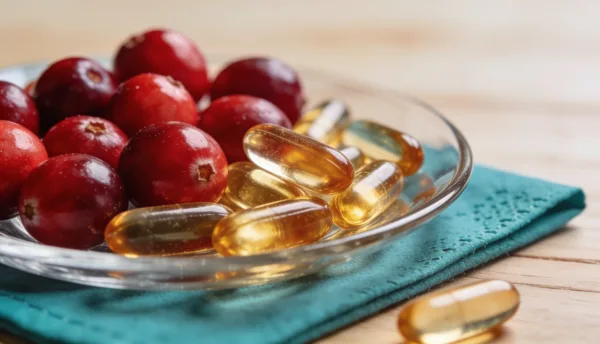
Here is the part almost no one is told: the PACs that do the work are concentrated in the fruit, and standardized capsules are formulated to deliver a measured amount of them, while juice content is inconsistent and frequently far below the 36 mg threshold. This is why I spent three years drinking a glass of sweetened cranberry cocktail with breakfast, religiously, and still averaged three or four UTIs a year. I was taking the placebo version of the remedy. The pattern only started to shift once I switched to a standardized PAC capsule as part of a fuller routine. Capsules also concentrate PACs far more reliably than juice does. Here is how the common forms stack up:
| Cranberry form | Reliable PAC dose? | Sugar load | Realistic take |
|---|---|---|---|
| Cranberry juice cocktail | No, usually well below 36 mg | High (often 40g+ per serving) | Tastes good, but the weakest option for prevention |
| Pure unsweetened cranberry juice | Inconsistent, hard to verify | Lower, but very tart | Better than cocktail, still unreliable dosing |
| Whole cranberries / dried | Variable | Dried versions are sugared | Fine as food, not a measured dose |
| Standardized PAC capsule | Yes, formulated to a set amount | None | The form the evidence actually supports |
The takeaway is simple. If you want the benefit the studies describe, you are looking for a product that states its PAC content (aim for around 36 mg per day), not a jug of sweet red juice. For a fuller look at choosing and buying these products, see our guide to where to buy a quality bladder supplement.
Cranberry vs. D-Mannose: Which One Should You Trust?
Between the two, the current evidence favors cranberry over D-mannose used on its own. D-mannose, a simple sugar that also interferes with bacterial adhesion, became hugely popular online, and on paper the mechanism sounds promising. But the 2025 AUA guideline concluded that D-mannose alone may not be effective for prevention, after newer trials failed to beat placebo. That was a genuine surprise to many of us who had recommended it. I dug into what that means for leaking specifically in whether D-mannose helps bladder leaks.
This is exactly the kind of honesty the supplement world usually skips. A remedy being natural, popular, and biologically plausible does not make it proven — D-mannose is a useful reminder of that. Cranberry has the deeper, more consistent body of evidence behind it, which is why guidelines now name it specifically. None of this means either one is a cure; both are modest prevention aids at best, and neither replaces medical care for an active infection.
Where Cranberry Fits in a Real Prevention Plan
Cranberry works best as one piece of a broader prevention routine, not as a stand-alone solution. On its own it trims risk by about a quarter for the right person — helpful, but not enough to lean on entirely. The women who see the best results tend to stack a few evidence-based habits together.
- Hydration. The AUA now advises increasing water intake for women drinking under about 50 ounces a day; more dilute urine and more frequent flushing genuinely lowers recurrence.
- Bathroom habits. Urinating after intercourse and not holding it for hours reduces the window bacteria have to settle in.
- The vaginal and urinary microbiome. A healthy population of protective Lactobacillus is associated with fewer recurrences, which is why probiotic strains are an area of growing research interest.
- Standardized cranberry PACs. Around 36 mg daily, taken consistently for several months.

This is where a thoughtfully combined supplement can be more practical than juggling separate pills. FemiCore, for example, pairs standardized cranberry with several Lactobacillus strains in a single daily capsule — an approach designed to support a healthy urinary microbiome rather than to treat any infection. It is not a cure, and no supplement is; but for a woman building a prevention routine, a combined formula is a reasonable, convenient way to cover cranberry and probiotics at once. Curious how the probiotic half of that equation holds up on its own? See our honest look at probiotics for bladder control.
How we research this
Ellen Bennett compiles peer-reviewed evidence — naming each study by date and source — from Cochrane, Frontiers in Nutrition, the AUA/CUA/SUFU recurrent-UTI guideline, and the Urology Care Foundation. We earn an affiliate commission if you buy through our links, but we flag weak or missing evidence regardless of who is paying. When the research does not support a marketing claim, we say so.
Editor’s Recommendation: FemiCore combines standardized cranberry with five Lactobacillus strains to support a healthy urinary microbiome. Made in the USA, GMP-certified, with a 60-day money-back guarantee.
Want the full breakdown of the formula, the evidence, and the honest pros and cons? Read our complete FemiCore review.
When Cranberry Won’t Help — and When to See a Doctor
Cranberry cannot treat an active UTI, and relying on it during a real infection can be dangerous. If you already have symptoms such as burning when you urinate, urgency, or cloudy, strong-smelling urine, that infection needs proper evaluation, not cranberry pills. Anti-adhesion does nothing once bacteria are multiplying, and a delayed UTI can climb to the kidneys.
Call your doctor promptly if you notice any of these red flags, which can signal a more serious infection:
- Blood in your urine
- Fever, chills, or back/flank pain (possible kidney involvement)
- Nausea or vomiting alongside urinary symptoms
- Symptoms that last more than a day or two, or keep coming back
- You are pregnant and have any urinary symptoms
It is also worth knowing that recurrent UTIs become more common after menopause, when shifting estrogen changes the vaginal and urinary environment. If that is your pattern, our article on menopause and bladder health covers options like vaginal estrogen that cranberry simply cannot address. And if you want a step-by-step prevention routine, see our guide on how to prevent recurrent UTIs naturally.
Who should be careful with cranberry, and what it interacts with
Cranberry is about as low-risk as supplements get, which is exactly why the cautions rarely make it into the articles selling it. There are four worth knowing, and none of them is a reason for most women to avoid it.
| If this applies to you | What is going on | What to do |
|---|---|---|
| You have had calcium oxalate kidney stones | Cranberry contains oxalate, and whether that raises stone risk is genuinely unresolved: the evidence points both ways | Do not decide this from a blog. Raise it with the doctor who managed your stones |
| You take warfarin | Case reports exist, but the safety review published in Planta Medica in 2021 found the cases involved very large intakes, around 1 to 2 litres of juice a day or roughly 3,000 mg of extract | A standard supplement dose is a conversation with your pharmacist, not an automatic no |
| You take a proton pump inhibitor or an H2 blocker for reflux | The NIH LiverTox monograph on cranberry notes cranberry can lower plasma levels of these drugs | Separate them by a couple of hours and mention it at your next review |
| You are watching blood sugar | Juice, not capsules, is the problem. A glass of cranberry juice cocktail is mostly sugar | Use a standardized capsule instead of juice |
The most common side effect in the research is unremarkable: stomach upset and loose stools at high doses. If that happens, the dose is too high for you before the product is wrong.
The four habits that beat any supplement for UTI prevention
This is the part I would want you to read even if you close the page and never buy a cranberry capsule. The behaviours below have better evidence behind them than any pill in this category, they are free, and they get skipped in almost every article on the subject because nobody makes money from them.
- Drink enough, steadily. Women drinking roughly 1.5 to 2 litres a day have been shown to have fewer UTI episodes than women drinking less. This is the single most evidence-backed habit here, and it costs nothing.
- Empty your bladder after sex. It flushes bacteria that were pushed toward the urethra before they have a chance to settle in.
- Wipe front to back. Unglamorous, and it genuinely reduces how much gut bacteria reaches the urethra.
- Do not let constipation run. A loaded bowel presses on the bladder and makes complete emptying harder, and urine that sits is urine that grows bacteria. More fibre and fluid, and see our piece on how constipation affects the bladder.
And after menopause there is a fifth that outperforms all of the above for many women: vaginal estrogen, which restores the tissue and the protective bacteria that falling hormones took away. It is prescribed, not bought off a shelf, and it is worth asking about. For the full prevention picture, including where each option really sits, see how to prevent recurrent UTIs naturally.
Key Takeaways
- Cranberry prevents, it does not treat. It blocks bacteria from sticking to the bladder wall, so it only helps before an infection takes hold.
- The benefit is modest but real. A 2023 Cochrane review found about a 26% reduction in recurrent UTIs in women prone to them.
- Dose decides everything. Aim for roughly 36 mg of PACs daily; below that, studies show no significant effect.
- Skip the sugary juice. Standardized capsules deliver reliable PACs without the sugar load; juice cocktail is the weakest option.
- D-mannose alone disappointed. The 2025 AUA guideline favors cranberry and notes D-mannose by itself may not work.
- See a doctor for active or severe symptoms. Blood, fever, or back pain are not jobs for cranberry.
Frequently Asked Questions
Can cranberry get rid of a UTI I already have?
No. Cranberry only stops bacteria from sticking to the bladder wall, which helps prevent infections from starting. Once a UTI is active, cranberry will not clear it, and you should see a doctor — most active UTIs need antibiotics, and an untreated one can reach the kidneys.
How much cranberry should I take to prevent UTIs?
Research points to about 36 mg of proanthocyanidins (PACs) per day. Look for a product that states its PAC content, since this is the active compound. You also need to take it consistently for 12 to 24 weeks to see the preventive effect, not just during symptoms. If you are wondering whether that is safe to keep up, I covered whether you can take cranberry pills every day.
Is cranberry juice as good as cranberry pills?
Usually not. Juice cocktail is often high in sugar and low in PACs, and its content is inconsistent. Standardized capsules are formulated to deliver a measured PAC dose without the sugar, which is why studies and guidelines lean toward supplements for reliable prevention.
Does cranberry work for everyone?
No. The evidence is strongest in women who get recurrent UTIs. It did not show clear benefit in elderly nursing-home residents, people with neurological bladder conditions, or pregnant women. Cranberry helps a specific group, and results vary from person to person.
Can I take cranberry with my other medications?
Cranberry is generally well tolerated, with mild stomach upset being the most common side effect. However, it may interact with blood thinners such as warfarin. Always talk to your doctor or pharmacist before starting any supplement, especially if you take prescription medication.
Is cranberry or D-mannose better for UTI prevention?
Current evidence favors cranberry. The 2025 AUA guideline recommends offering cranberry for prevention, while noting that D-mannose used alone may not be effective after newer trials failed to outperform placebo. Neither replaces medical care for an active infection.
The Bottom Line
Cranberry is not the miracle the juice ads imply, but it is not a myth either. Used the right way — a standardized PAC dose, taken consistently, as one part of a real prevention plan — it can modestly lower your odds of another recurrent UTI. Used the wrong way, as sweet juice during a flare-up, it is little more than an expensive habit. Know which you are doing, respect the limits, and never let it delay care you actually need.
For the bigger picture on bladder symptoms and prevention, start with our complete guide to bladder leaks and urinary health.
— Ellen Bennett

Ellen Bennett, Women’s Health Researcher. Ellen compiles peer-reviewed evidence on women’s bladder and urinary health into plain-English guides. About Ellen →
Last Reviewed: June 2026 by Ellen Bennett, Women’s Health Researcher. Sources: Cochrane Library (2023), Frontiers in Nutrition (2024), AUA/CUA/SUFU Recurrent UTI Guideline (2025).