
Published on October 20, 2026 — by Ellen Bennett, Women’s Health Researcher
Medical & Affiliate Disclosure: This article is for educational purposes only and is not medical advice. Sjögren's is a systemic autoimmune disease that needs a rheumatologist, and bladder symptoms need their own evaluation. Never stop or change a prescription based on what you read here. Some links are affiliate links; if you buy through them we may earn a commission at no extra cost to you.
Independent women's health research · Written and fact-checked by Ellen Bennett, Women's Health Researcher · Last verified: October 2026
If you live with Sjögren's, you already know the official story: dry eyes, dry mouth, fatigue. What nobody seems to mention is the bathroom. The sudden urge that will not wait. The trips every hour. The burning that feels like an infection until the urine test comes back clean, again. You may have wondered whether Sjögren's and bladder problems are connected, or whether it is just your age.
The research says they are connected, and more strongly than most rheumatology leaflets admit. It also says something more useful: some of the standard fixes for an overactive bladder can make Sjögren's dryness worse, and one of the standard fixes for dry mouth can make you pee more. This guide puts both sides together so you can walk into your next appointment with the right questions.
Quick Answer: Sjögren's and bladder problems are linked. A 2019 study of 11,526 people with primary Sjögren's found a 68% higher risk of overactive bladder and more than double the risk of interstitial cystitis, highest in women. What helps? Bladder training, steady sipping instead of gulping, and treatment choices that do not deepen dryness. In a 2023 trial, 6 of 17 Sjögren's patients on an anticholinergic bladder drug switched because of dry mouth or constipation; none on mirabegron did.
Sjögren's and Bladder Problems: Is the Link Real?
Sjögren's is an autoimmune disease in which the immune system attacks the glands that make moisture. According to the National Institute of Arthritis and Musculoskeletal and Skin Diseases (NIAMS), most people with it are women, and it is most common in people in their 40s and 50s. In other words, it tends to arrive in exactly the same years as perimenopause and menopause, which is one reason bladder symptoms get blamed on hormones and left there.
Three lines of research say the bladder belongs on the Sjögren's list:
| Study | Who | What it found |
|---|---|---|
| Walker et al., Journal of Rheumatology, 2003 | 76 women with primary Sjögren's vs 43 women with osteoarthritis | Severe urinary symptoms in 61% vs 40%, driven mainly by urgency and bladder irritability rather than nighttime trips |
| Taiwan nationwide cohort, PLoS One, 2019 | 11,526 people with primary Sjögren's vs matched controls | Overactive bladder risk 1.68 times higher; interstitial cystitis/bladder pain syndrome 2.34 times higher |
| BMC Urology, 2024 | 72 patients with primary Sjögren's, average age 52 | Those with nerve (neuropathic) pain had significantly worse voiding scores |
The Taiwan study adds a detail worth noticing. The extra risk was highest in women (hazard ratio 1.74 for overactive bladder), in people under 65, and in people whose dry eyes and dry mouth were severe enough to need treatment (2.06 for overactive bladder, 2.93 for interstitial cystitis). The drier your glands, the more likely your bladder is involved too.
These are associations, not proof that Sjögren's directly causes every bladder symptom. But when two studies on two continents, 16 years apart, point the same way, it is reasonable to stop treating your bladder as a coincidence.
Why It Happens: Three Possible Mechanisms
1. The same receptors, on the glands and on the bladder
Saliva glands and the bladder muscle are both controlled through muscarinic receptors, the M3 type in particular. The Walker team raised the possibility that antibodies against these receptors, which some people with Sjögren's carry, could disturb bladder signaling as well as gland function. That remains a hypothesis, but it explains why the bladder trouble in Sjögren's looks like urgency and irritability rather than simple weakness.
2. Bladder lining inflammation
Interstitial cystitis, also called bladder pain syndrome, is a chronic irritation of the bladder lining that causes pressure, pain and frequent urges with no infection to find. The Taiwan data more than doubled its risk in Sjögren's. If your “UTIs” keep coming back with negative cultures, this is a question to raise. My guide to UTI symptoms with a negative test covers the other causes to rule out.
3. Nerves
Sjögren's can affect small nerve fibers. The 2024 BMC Urology study found worse voiding scores in patients with neuropathic pain, which fits with bladder signals being part of the same nerve picture. It is the same family of problem I described in fibromyalgia and bladder leaks, where the nervous system amplifies bladder signals.
The Two Traps Nobody Warns You About
This is the part of Sjögren's and bladder problems I most want you to take to your doctors, because it sits between two specialties and often falls through the gap.
Trap 1: Bladder pills that deepen the dryness
The most commonly prescribed overactive bladder drugs, such as oxybutynin and solifenacin, work by blocking muscarinic receptors. That calms the bladder, and it also reduces saliva and tears. For someone whose main problem is already dryness, that is a real cost.
A 2023 randomized trial in Lower Urinary Tract Symptoms tested this directly in Sjögren's patients with overactive bladder. It compared mirabegron, which works through a different (beta-3) pathway, with solifenacin. Both improved bladder scores similarly over 12 weeks. But 6 of the 17 patients on solifenacin switched to mirabegron because of severe dry mouth or constipation, while none of the 24 on mirabegron switched the other way. Sjögren's-related pain also improved in the mirabegron group. It is a small trial, so treat it as a strong hint rather than a final answer.
Older anticholinergic bladder drugs carry a second concern for women past 55: long-term use has been linked to dementia risk in large studies, which I cover in oxybutynin and dementia. Mirabegron has its own trade-off, since it can raise blood pressure, so the right choice depends on your full picture. I compare the two drugs side by side in mirabegron vs oxybutynin.
Trap 2: Dry mouth medicine that makes you pee more
The reverse problem exists too. Pilocarpine (Salagen), widely used to stimulate saliva in Sjögren's, works by switching muscarinic receptors on. In the Sjögren's trials summarized in its prescribing information, urinary frequency was reported by about 10% of patients at the standard dose versus 4% on placebo, and side effects such as frequency were roughly twice as common in patients over 65. Cevimeline (Evoxac), a related saliva drug, did not show the same signal in its Sjögren's trials (0.9% vs 1.8% on placebo).
If your bladder got worse after starting a saliva medicine, that is worth mentioning. Do not stop it on your own; ask whether timing, dose or an alternative would suit you better.
| Medicine | Used for | Possible bladder or dryness effect |
|---|---|---|
| Oxybutynin, solifenacin, tolterodine | Overactive bladder | Calm the bladder but can worsen dry mouth, dry eyes and constipation |
| Mirabegron, vibegron | Overactive bladder | Not anticholinergic; mirabegron can raise blood pressure |
| Pilocarpine (Salagen) | Dry mouth | Urinary frequency in about 10% vs 4% on placebo |
| Cevimeline (Evoxac) | Dry mouth | No excess urinary frequency in trials |
The Water Bottle Problem
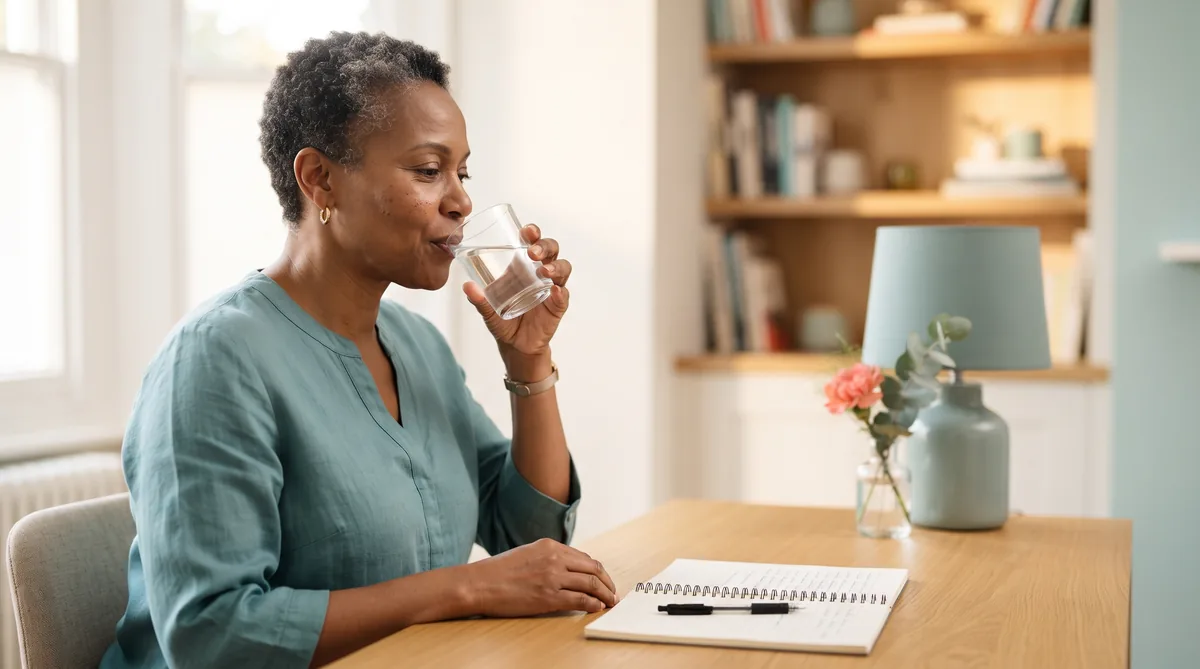
When your mouth is dry, you sip constantly. Many women with Sjögren's carry water everywhere, and the total climbs without them noticing. A bladder that is already irritable then gets a steady stream to deal with all day.
The answer is not to drink less. Dehydration concentrates urine, and concentrated urine irritates the bladder. The answer is to change how you drink:
- Sip small amounts to wet your mouth rather than drinking large glasses for comfort.
- Use mouth-moistening tools your dentist or rheumatologist recommends, such as sugar-free lozenges or saliva substitutes, so water is not your only relief.
- Front-load fluids earlier in the day and taper after dinner if you wake at night.
- Watch bladder irritants in what you sip: coffee, tea, fizzy drinks and citrus all count.
I explain how to find your own fluid target in how much water to drink with an overactive bladder, and the common irritants in foods that irritate the bladder.
Dryness Below the Waist
Sjögren's dryness does not stop at the eyes and mouth. Vaginal dryness is common in women with the disease; researchers at the University Medical Center Groningen reported that most women with primary Sjögren's experience it. After menopause, falling estrogen thins the same tissues further.
That matters for the bladder because the urethra and vagina share tissue that depends on estrogen and on protective bacteria. Thin, dry tissue can produce burning, urgency and discomfort that mimic an infection. If you are past menopause, ask about low-dose vaginal estrogen, which treats the tissue locally and has strong evidence for urinary symptoms. I go through it in menopause and bladder health.
What Actually Helps With Sjögren's and Bladder Problems
Bladder training
Gradually stretching the time between bathroom trips retrains an urgent bladder, and it has no dryness side effects at all. It is the first-line treatment for overactive bladder in the main US urology guideline. My bladder training schedule gives you a week-by-week plan.
Urge suppression and the pelvic floor
When an urge hits, stopping, standing still and doing a few quick pelvic floor squeezes can calm the bladder long enough to walk, not run, to the bathroom. A pelvic floor physical therapist can teach this properly; see what to expect from pelvic floor therapy.
A medication review across specialists
Bring a full list to one appointment: what your rheumatologist prescribes, what your urologist or gynecologist prescribes, and any over-the-counter pills. Ask specifically whether anything on it adds to dryness or to bladder urgency. My list of medications that cause bladder leaks is a useful starting point.
Ruling out infection properly
Do not assume every flare is “just Sjögren's”. Real infections still happen, and they need a urine culture. Fever, back pain, blood in the urine, or not being able to empty your bladder need prompt care.
Where Supplements Fit, Honestly
No supplement treats Sjögren's or the autoimmune side of its bladder symptoms, and I would be wary of anyone who says otherwise. Where a supplement can play a supporting role is narrower: if your workup shows repeat, culture-confirmed infections, especially after menopause, the urinary microbiome becomes part of the conversation.
That is the gap FemiCore is built for. It combines cranberry standardized to 30% proanthocyanidins with five named Lactobacillus strains, including L. crispatus, the species most linked to a protective vaginal environment. I explain the evidence and its limits in my FemiCore review and in probiotics for bladder control.
One honest caution specific to Sjögren's: if you take immunosuppressive drugs, ask your rheumatologist before starting any live probiotic. The NIH's NCCIH notes that probiotic risks are greater in people with compromised immune systems.
Editor's Recommendation: repeat UTIs after menopause
FemiCore pairs standardized cranberry with L. crispatus and four other Lactobacillus strains in one daily capsule, with a 60-day money-back guarantee. Ask your doctor first if you take immunosuppressants.
Questions to Bring to Your Next Appointment
- Could my urgency be part of Sjögren's rather than just menopause?
- Should I be checked for interstitial cystitis if my cultures keep coming back negative?
- If I need a bladder medicine, is a non-anticholinergic option like mirabegron or vibegron reasonable for me, given my blood pressure?
- Could my saliva medicine be adding to my bathroom trips?
- Would vaginal estrogen help my tissue dryness and urinary symptoms?
- Is a probiotic safe with my current immune treatment?
Key Takeaways
- Sjögren's and bladder problems are linked: 68% higher overactive bladder risk and 2.34 times the interstitial cystitis risk in a cohort of 11,526 patients.
- Women and people with severe dryness carry the most risk.
- Anticholinergic bladder drugs can worsen dryness; in a 2023 trial, 6 of 17 switched off solifenacin and none left mirabegron.
- Pilocarpine for dry mouth can increase urinary frequency (about 10% vs 4% on placebo); cevimeline did not show this.
- Sip, do not gulp: constant water for a dry mouth can feed an irritable bladder.
- Supplements do not treat Sjögren's; a microbiome formula only fits if you have repeat confirmed UTIs, and only with your doctor's OK if you take immunosuppressants.
Frequently Asked Questions
Can Sjogren's syndrome cause bladder problems?
Research links them. A 2019 nationwide study of 11,526 people with primary Sjogren's found a 68% higher risk of overactive bladder and 2.34 times the risk of interstitial cystitis, and a 2003 study found severe urinary symptoms in 61% of women with Sjogren's versus 40% of women with osteoarthritis, mainly urgency.
Why do I pee so much with Sjogren's?
Several things can add up: bladder irritability linked to the disease itself, constant sipping to relieve a dry mouth, bladder irritants in what you drink, and medicines such as pilocarpine, which caused urinary frequency in about 10% of Sjogren's patients versus 4% on placebo in its trials.
Is interstitial cystitis more common with Sjogren's?
Yes. In a 2019 Taiwanese cohort, people with primary Sjogren's had 2.34 times the risk of interstitial cystitis or bladder pain syndrome compared with matched controls. If you keep having UTI-like symptoms with negative urine cultures, ask your doctor about it.
What bladder medication is best if I have Sjogren's?
That is a decision for your doctor, but dryness is a key factor. In a 2023 randomized trial in Sjogren's patients, mirabegron and solifenacin improved bladder symptoms similarly, but 6 of 17 patients on solifenacin switched because of dry mouth or constipation and none on mirabegron did. Mirabegron can raise blood pressure, which also needs weighing.
Should I drink less water if I have Sjogren's and a weak bladder?
No. Dehydration concentrates urine, which irritates the bladder. Instead, sip small amounts to wet your mouth, use saliva substitutes or sugar-free lozenges your clinician recommends, drink more earlier in the day, and cut back on bladder irritants such as caffeine and fizzy drinks.
Can probiotics help bladder symptoms with Sjogren's?
Probiotics do not treat Sjogren's or its autoimmune bladder symptoms. They may support the urinary microbiome if you have repeat confirmed UTIs, especially after menopause. If you take immunosuppressive medication, ask your rheumatologist first, because probiotic risks are greater with a weakened immune system.
The Bottom Line
Sjögren's and bladder problems belong in the same conversation, even if your rheumatologist and your urologist rarely have it with each other. The urgency, the frequency and the “infections” that are not infections have a plausible link to the same disease that dries your eyes and mouth. The most practical move is a joined-up medication review: some bladder pills deepen dryness, and some dryness pills make you pee more. Start with bladder training and smarter sipping, rule out infection properly, and treat menopause dryness locally if it applies to you. Supplements come last and only for the right reason.
— Ellen Bennett

Ellen Bennett
Women's Health Researcher. Compiles peer-reviewed evidence on bladder, urinary, and pelvic health, naming each study and source. About the author →
Further reading: the complete guide to bladder leaks, stress vs urge incontinence and nocturia in women.
Research methodology. This guide draws on NIAMS (NIH) patient information on Sjögren's disease; a 2003 controlled study in the Journal of Rheumatology; a 2019 nationwide cohort in PLoS One; a 2024 study in BMC Urology; a 2023 randomized trial in Lower Urinary Tract Symptoms; the US prescribing information for pilocarpine and cevimeline; a University Medical Center Groningen study on vaginal dryness; and NCCIH guidance on probiotics. Study figures were checked against the original abstracts in October 2026.
Medical disclaimer. This article is for information only and is not medical advice, diagnosis, or treatment. Dietary supplements are not intended to diagnose, treat, cure, or prevent any disease. Do not stop or change prescription medication based on anything you read here. Blood in the urine, fever, pain, or being unable to empty your bladder need a doctor.
Last Reviewed: October 2026 by Ellen Bennett, Women's Health Researcher. Sources: NIAMS (NIH); Journal of Rheumatology (2003); PLoS One (2019); BMC Urology (2024); Lower Urinary Tract Symptoms (2023); Salagen and Evoxac prescribing information; NCCIH.