

Published on September 12, 2026 — by Ellen Bennett, Women’s Health Researcher
Medical & Affiliate Disclosure: This article is for educational purposes only and is not medical advice. Always talk to your doctor about urinary symptoms and about any change to arthritis treatment. Some links below are affiliate links; if you buy through them we may earn a commission at no extra cost to you. That does not change what we write.
Independent women’s health research · Written and fact-checked by Ellen Bennett, Women’s Health Researcher · Last verified: September 2026
Most articles about bladder leaks assume the problem is your bladder. For a large group of women over 50, it is not. The bladder holds fine. The signal arrives on time. What fails is the twenty seconds between standing up and sitting down: the stiff knee that will not take weight straight away, the hip that needs a moment, the fingers that cannot manage a waistband fast enough.
That is a different problem with a different name and a different set of solutions, and almost nobody writes about it for the woman living it. If you have arthritis and you are leaking, this article is about why those two things travel together, what the population data actually shows, and what changes the outcome when the issue is the journey rather than the bladder.
Quick Answer: Arthritis and bladder leaks are linked, and the largest US dataset confirms it. A cross-sectional study of 24,528 adults using NHANES data from 2011 to 2023 found arthritis associated with 31% higher odds of stress incontinence, 44% higher odds of urge incontinence, and 49% higher odds of mixed incontinence. Part of that is mechanical: reduced mobility means you reach the toilet too late, which is called functional incontinence. The encouraging part is that it appears to work in reverse too. In a study of patients having hip replacement for osteoarthritis, 43% had urinary incontinence symptoms beforehand and 64% of them showed improvement three months after surgery.
Functional Incontinence: The Type Nobody Names
The definition that changes the conversation: functional incontinence is leaking that happens because something outside the urinary system prevents you from getting to the toilet and undressed in time. The bladder and pelvic floor may be working normally. The barrier is mobility, dexterity, pain, or the layout of your home.
This matters because the standard advice for bladder leaks assumes a bladder problem. You get told to do Kegels, cut caffeine, and train your bladder to hold longer. All good advice, and all beside the point if your actual bottleneck is that it takes you fifty seconds to cross the hallway and eight more to manage a button.
Women in this situation often conclude they are failing at the exercises. They are not. They are doing the right exercises for the wrong problem. Naming it correctly is the first useful step, because it redirects effort to where it will actually pay.
Worth saying clearly: functional incontinence frequently coexists with the other types rather than replacing them. Many women over 50 have some genuine urgency and a mobility barrier, and each one makes the other more costly. If you are not sure which is which, our guide to stress vs urge incontinence covers the two bladder-side types, and this article covers the third factor that sits on top of them. For the other types of leaks and how they differ, see my complete guide to bladder leaks.
What the Data Actually Shows
The link between arthritis and incontinence has been described for decades as a “neglected disability,” but the strongest recent evidence comes from a large national dataset.
A cross-sectional study published in PMC pooled five consecutive cycles of the National Health and Nutrition Examination Survey covering 2011 to 2023, analyzing 24,528 adults aged 20 and over. Among them, 27.0% reported arthritis. After adjusting for other factors, the association held across every subtype.
| Incontinence type | Increased odds with arthritis | Odds ratio (95% CI) |
|---|---|---|
| Stress incontinence | 31% higher | 1.31 (1.16 to 1.47) |
| Urge incontinence | 44% higher | 1.44 (1.30 to 1.60) |
| Mixed incontinence | 49% higher | 1.49 (1.31 to 1.70) |
Two honest notes about reading this. First, it is a cross-sectional study, which means it shows association, not proof that arthritis causes incontinence. Second, the association was strongest for mixed incontinence, which fits the picture of several mechanisms stacking rather than one clean cause.
And here is the finding that deserves more attention than it gets, because it runs the other way. Research tracking urinary incontinence after total hip replacement for osteoarthritis, summarized in a 2026 analysis in PMC, describes an earlier prospective study in which 43% of patients reported incontinence symptoms before surgery and 64% of those showed improvement by three months afterward. The same analysis found that improvement was rapid within the first three months and then plateaued.
Be careful how you read that, because it is improvement rather than cure, and the proposed mechanism is not only about walking speed. Researchers have suggested a relationship between hip joint function and pelvic floor function, possibly involving the obturator internus muscle, which sits in the pelvis and works alongside the pelvic floor. So restoring hip mechanics may help continence through more than one route. What it does support is the general principle: in this group, treating mobility is part of treating the bladder.
Why These Two Arrive Together in Your Fifties
There is a reason this combination catches so many women off guard at roughly the same point in life, and it is not coincidence. Two separate clocks happen to strike at once.
The first is joint change. Osteoarthritis becomes far more common with age and is more common in women than men, with the rise steepening around and after the menopausal transition. The second is the hormonal shift itself. Falling estrogen thins the tissue of the urethra and bladder base, which lowers your margin for error before any mobility issue is added on top. Our guide to menopause and bladder health covers that second clock in full.
So a woman at 55 can be dealing with a bladder that is already less forgiving and a journey to the bathroom that has gotten slower, at the same time. Neither alone might have caused a problem. Together they produce leaking, and because each is usually treated by a different specialist, nobody puts the two halves side by side. That is the specific gap this article exists to close. If your pain is widespread rather than in one or two joints, read how fibromyalgia changes bladder signals, because that is a different mechanism.
The Four Mechanisms, and Which One Is Yours
Arthritis affects continence through more than one route, and they call for different fixes. Most women recognize themselves in one or two of these. Winter makes the journey harder still, with layers, zips and gloves, which I cover in cold-weather bladder leaks.
- Lower-body mobility. Arthritic knees and hips slow the walk to the bathroom and, critically, slow the transition from sitting to standing. The urge arrives with the same warning it always did, but the journey now takes longer than the warning lasts.
- Hand and wrist dexterity. This one is badly under-discussed. Stiff, painful fingers turn buttons, zips, tights, and shapewear into a genuine obstacle at exactly the wrong moment. Women describe reaching the toilet in time and still leaking while fighting a waistband.
- Reduced activity over time. Pain discourages movement, and a more sedentary pattern is associated with weaker pelvic floor support and with constipation, which itself worsens bladder symptoms. Our guide to constipation and bladder leaks explains that connection, because a loaded bowel presses directly on the bladder.
- Inflammatory and medication effects. Beyond mechanics, arthritis itself is associated with overactive bladder symptoms: a separate analysis of NHANES data in Scientific Reports examined that link directly. Some medications used for pain and inflammation also carry their own urinary effects. Our list of medications that cause bladder leaks covers the common culprits worth reviewing with your pharmacist.
What Actually Helps When the Problem Is the Journey
Reframe the goal: if the bottleneck is the journey, then buying time and shortening the journey beat almost everything else. These interventions are unglamorous, cheap, and they work on the actual constraint.
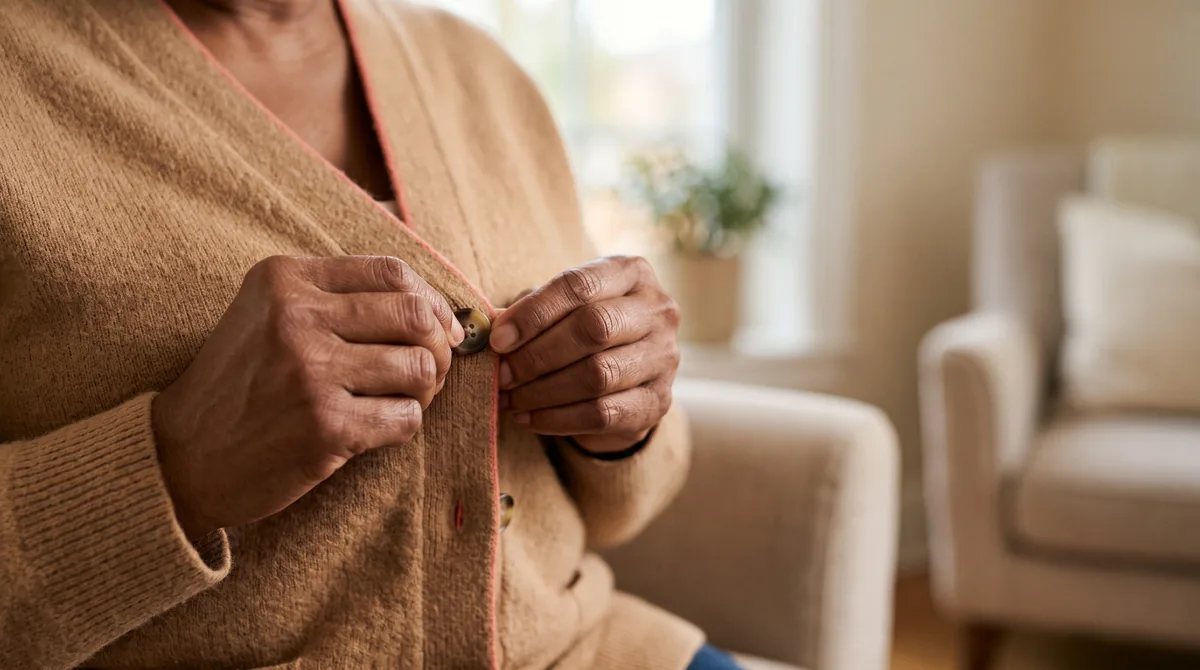
Attack the clothing barrier first. This is the fastest win available to most women and it costs almost nothing. Elastic waistbands instead of buttons and zips. Skip shapewear and tights on days you are stiff. A practical trick recommended by arthritis organizations is looping an elastic band through a buttonhole and around the button, so the waistband opens without fine finger work. Adaptive dressing aids and long-handled grabbers exist for exactly this and are worth having.
Shorten the route. Look honestly at the path from where you sit most to where the toilet is. Clear it. Remove the rug you step around. Consider a rail beside the toilet and, if you use a chair that is hard to rise from, a firmer or higher seat that shortens the stand-up. Night lighting matters more than people think, because a hesitant walk in the dark is a slower walk.
Buy time with bladder training. If you can extend the gap between the first urge and the moment it becomes unmanageable, you effectively lengthen the runway. That is genuinely useful when your walking speed is fixed. Our bladder training schedule sets out how to build that gradually.

Do the pelvic floor work anyway, adapted to your joints. Pelvic floor muscle training has strong trial evidence for stress and mixed incontinence, and it does not require you to be mobile. It can be done seated. If you have tried and it did not help, it is worth reading why Kegels are not working, because technique errors are common and over-tightening can make urgency worse. A pelvic floor physiotherapist can adapt a program around arthritic joints, and our guide to what to expect from pelvic floor therapy explains how a first appointment works.
Take the mobility question seriously with your doctor. Given the joint replacement finding, mobility treatment is bladder treatment for this group. Pain control, physical therapy, walking aids, and where appropriate surgical options all belong in the same conversation as your continence. Raise them together rather than in separate appointments, because the connection is the point.
Editor’s Recommendation
For the urgency or repeat-infection side of the picture, FemiCore pairs standardized cranberry with five named Lactobacillus strains in one daily capsule, with a 60-day money-back guarantee.
Where a daily formula fits: if your leaking is functional, the mobility fixes above are the answer. Many women with arthritis also have an urgency or repeat-infection component, though, and that is the part a urinary-microbiome formula like FemiCore is built to support. Our ranking of bladder control supplements compares the options. Fix the journey and support the bladder side together. If you also have low bone density, some exercise advice changes, and I cover bone-safe bladder work for osteoporosis separately.
When to Raise It With Your Doctor
- New or worsening leaking that arrived alongside a flare or a change in your mobility
- Any new incontinence after starting a new medication, which is worth a pharmacist review
- Pain, fever, burning, or blood in your urine, which needs prompt care and is not a mobility issue
- Leaking that is limiting what you do, which is reason enough on its own and does not need to be severe to be worth treating
- Difficulty emptying your bladder fully, or a weak stream, which needs assessment
One thing worth naming: this is among the most under-reported problems in women’s health, partly because it gets filed under “getting older” by both patients and clinicians. It is not an inevitable part of aging, and the older framing of incontinence in arthritis as a neglected disability exists precisely because it goes unmentioned. Bring it up. The National Institute on Aging has a plain-language overview that can help start the conversation.
Key Takeaways
- The link is real and measured. NHANES data on 24,528 adults found arthritis associated with 31% higher odds of stress, 44% urge, and 49% mixed incontinence.
- Functional incontinence is a distinct type. The bladder works; the journey fails. Standard bladder advice misses it entirely.
- Mobility is bladder treatment here. After hip replacement for osteoarthritis, 43% of patients had incontinence beforehand and 64% of those improved within three months.
- Hands matter as much as knees. Buttons and tights are a real barrier at the worst possible moment, and elastic waistbands are a genuine intervention.
- Bladder training buys runway when walking speed is fixed, and pelvic floor work can be done seated.
- No supplement fixes a mobility barrier. Fix the journey first, and treat the bladder side only if you also have that component.
Frequently Asked Questions
Can arthritis cause bladder leaks?
It is strongly associated with them. A cross-sectional study of 24,528 US adults using NHANES data from 2011 to 2023 found arthritis linked to 31% higher odds of stress incontinence, 44% higher odds of urge incontinence, and 49% higher odds of mixed incontinence. The main mechanisms are reduced mobility delaying the trip to the toilet, hand stiffness slowing undressing, reduced activity over time, and the effects of inflammation and some medications.
What is functional incontinence?
Functional incontinence is leaking caused by something outside the urinary system that stops you reaching the toilet and undressing in time. The bladder and pelvic floor may be working normally. The barrier is mobility, dexterity, pain, or the layout of your home. It commonly coexists with stress or urge incontinence rather than replacing them.
Will joint replacement help my bladder leaks?
It may improve them. In research on total hip replacement for osteoarthritis, 43% of patients reported incontinence symptoms before surgery and 64% of those showed improvement by three months, with the gain arriving quickly and then plateauing. Note that this is improvement rather than cure, and it is not guaranteed. Whether surgery is right for you is a decision for you and your orthopedic team, but it is worth telling them that continence is part of what you hope to improve.
Do Kegels help if my problem is getting to the bathroom in time?
They help with the bladder-side component, and most women with arthritis have some of that too, so they are still worth doing. They will not solve a mobility barrier on their own. The highest-value changes for a purely functional problem are shortening the route, clearing obstacles, and switching to clothing you can manage quickly.
Which type of incontinence is most common with rheumatoid arthritis?
Urge symptoms are commonly reported with inflammatory arthritis, and a separate analysis of NHANES data in Scientific Reports examined the association between arthritis and overactive bladder directly. In the larger NHANES incontinence analysis, the strongest association was for mixed incontinence, which suggests several mechanisms stacking rather than one clean cause. It is worth reviewing your medications with a pharmacist as part of working out your own picture.
The Bottom Line
If you have arthritis and you are leaking, the most useful question is not “what is wrong with my bladder.” It is “where exactly do I lose the race.” For a lot of women the answer is the eight seconds at a waistband, or the fifteen it takes to rise from a low chair, and those are fixable in ways that cost almost nothing. Fix the journey, buy yourself runway with bladder training, keep doing the pelvic floor work seated, and take the mobility conversation to your doctor as a continence conversation. This is not something to file under getting older and quietly work around.
— Ellen Bennett

Ellen Bennett
Women’s Health Researcher. Compiles peer-reviewed evidence on bladder, urinary, and pelvic health, naming each study and source. About the author →
Research methodology. This article is a desk review of published research on arthritis and urinary incontinence, including a pooled analysis of five NHANES cycles covering 2011 to 2023, alongside practical guidance from arthritis and continence organizations. Every study named is linked and was opened and checked on the verification date below. The NHANES analysis is cross-sectional, which shows association rather than proof of cause, and that limitation is stated in the text.
Medical disclaimer. This article is for information only and is not medical advice, diagnosis, or treatment. Do not change arthritis medication or treatment based on anything you read here. Dietary supplements are not intended to diagnose, treat, cure, or prevent any disease and do not address a mobility barrier. Pain, fever, burning, or visible blood in your urine needs prompt medical care.
Last Reviewed: September 2026 — Last Updated: September 2026 — by Ellen Bennett, Women’s Health Researcher. Sources: PMC, Association between arthritis and urinary incontinence in US adults, NHANES 2011 to 2023; PMC, Trajectory of urinary incontinence symptoms following total hip arthroplasty for hip osteoarthritis; National Institute on Aging; NIH/NIDDK; Urology Care Foundation; Mayo Clinic.